Who decided what handles should look like?

Joined
Oct 31, 2004
Messages
1,442
I want to start out by saying that, dispite how they may sound, all of my questions here are a result of genuine curiosity. Some of this may sound rhetorical and insulting but I assure you it's not how I mean it.
Anyway, as the title says, who decided what a knife handle should look like? I mean the classic handle shape as seen here on the swamp rat knifeworks "camp tramp" (http://www.swamprat.com/images/trampsm.jpg):
trampsm.jpg

For the past couple of months I've been thinking about this handle shape. I'm not going to guess what percentage of handles I see are some iteration of this but it's way up there. Whos hand is shaped like that? Mine certainly isn't and of the dozens of handles like that I have held, none of them are remotely comfortable. I've done some experiments lately with clay to figure out what the internal shape of a close fist is and the basic shape is almost exactly the reverse of that classic shape - that is, the curved part faces the palm and the flat part faces the fingers. When I turn one of those classic handles around in my hand it fits much better. So what gives? I know I'm not the only one who's thought about it but I keep seeing handles like this. What is going on that I don't know about? One thing I will say to its credit is that handles like that have very elegant lines. They do look good and they look traditional. But that just gets me hung up on why they ever got to be traditional.
Please help me, I'm confused.

- Chris
 
Chris,

I'm no help either and wonder the same thing.

I used to think I wanted a handle that fit a closed 'fist'. Then I discovered that that's one of the rarest grips in knife use!?

Look at how you hold a steak knife. The butt is in the pit of the palm and the index finger is across the top.

While skinning, your thumb and index finger are on the sides and opposite each other. Try it. Look at how the handle would have to be bent almost 90 degrees to the side to fill a closed hand.

Now given all the ways we use/grip knives ... maybe a round stick is the answer!

I hope you get lots of input on this......

Steve
 
Well....Chris, your idea of classic and mine might differ a smidge.

I guess to answer your question as best as I can (Hopefully others will have better answers)

The first decision maker was materials. These needed to be available, reasonably weatherproof, strong and easily worked with the tools at hand. This was often horn, antler or bone.

Wood was next on the list and easier to shape so in comes factor number 2. That is ergonomics. What fits the hand and allows the best grip for the type of knife.

Enter factor number 3. Tools. The shape was/is determined a lot by the tools used to shape it. In recent times you see your version of the Classic shape. It is easily made using modern belt grinders.

Probably last and maybe more important (although it shouldn't be) is ...style or fashion. This determined the handle material as well as the shape. I've seen some stunning shapes that no one could hang on to .
 
Steve,
Just knowing that someone else is wondering takes a load off. I've heard that the classic handle was designed to fit a closed fist, too, but the thing that bugs me is that it doesn't fit a closed fist. Or any other kind of fist. It does allow for a lot of versitile grips, but none of them are comfortable. There are lots of other handle shapes I've seen on other knives and made myself that are much more comfortable in the same number of grips.
Go figure.

- Chris
 
We've all thought that Chris and just like you, I've tried the clay trick. The simple truth is that there is no such thing as the perfect grip. For large knives, a pinkie hook helps with swinging but would just get in the way on a skinner. On a carving a flat sided football shape works well but would shift all around on a camp knife.
I have found a few grips I like. The first is a simple, round butt, slab sided grip. The second is close to what you show as the Classic. Neither is perfect and that's where practice with one particular knife comes in.

Many years ago, I worked summers as a carpenter's helper. We did many things with a razor knife. I couldn't believe the old carpenter could cut the way he did but within weeks, I could hold trim between the blade and my thumb and slice it as neatly as could be asked for.
 
Chris,

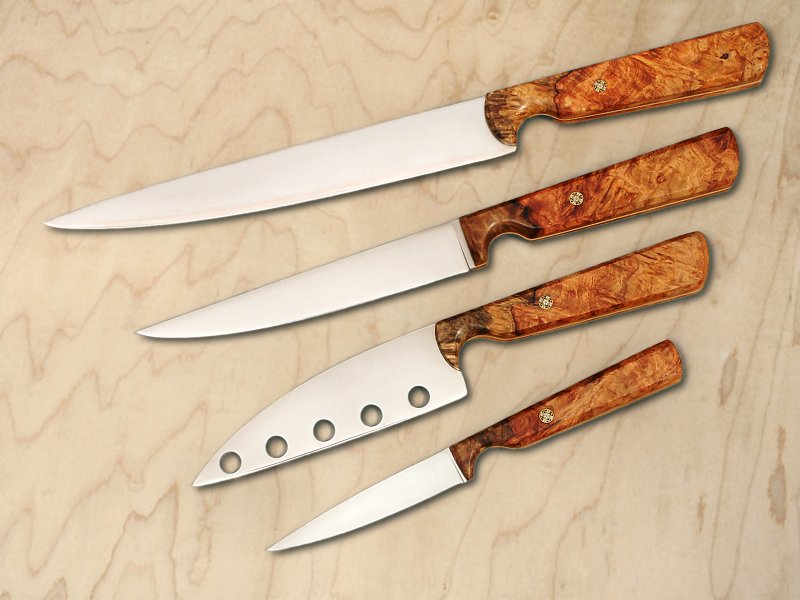
Here's a set of kitchen knives I did. Grant you the handles do NOT look usable/comfortable. Oddly enough they are very versatile and comfortable (so the owners tells me).

sando-set.jpg


It's not shaped like a hand at all and the edges are more beveled than round.

However, the bevel gives a secure feeling and a sense of up/down VS. a round handle. The finger groove for the index finger rarely sees an index finger. It ends up being more of a grip point, or used by the middle finger.

This wasn't a plan. It was just something that turned out to work, but doesn't look like it should.

Steve
 
Chris, you need to get your hand on an Ed Fowler "Pronhorn" it will change the way you look at every other knife.
 
This is a good thing to bring up. I've wondered what would be the best handle design. I agree with Don, I don't think there is. The nice thing about the human hand is it can adopt to gripping all different shapes. Some comfortable and some not. I've used a box cutter for 28 years and have become quite fast cutting the tops off of cases at work. It sounds simple to cut a box top off, but you'd be suprised at the amount of people who can't do it :eek: The angle and pressure in which you cut enables from not cutting the product inside the case, such as boxed items like cereal. My point is a box cutter is a very simple design that is basically straight. It will be interesting to hear more input.
Scott
 
A lot of it for me is aesthetics. As somebody said, the human hand can wrap itself around a whole lot of shapes. I try and draw something that I really like the look of, then cut it out and see what it feels like. The handle usually ends up somewhere in between. I do tend to like a "belly" of some sort on the bottom of the handle. If you hold out your hand, thumb up, and just let it go limp, the inside of your fingers tend to curve a bit. That may be why that "traditional" handle you described has a belly.
Having said that, I also like to keep the function of the knife in mind. For an all purpose blade (mostly what I make). I try and keep the handle more simply shaped so that it is more eaisly gripped from different angles. One of my favorite handles was slabs with 1/4" bevels all around the edges. Like someone said earlier, it gives a sense of up and down and those little angles an flats make for a pretty secure grip.
These are just some thoughts of mine. I really like this thread as I get to hear others thoughts about why they make handles the way they do. Keep sharing! :p
Ed
 
Great thread Hesparus, and excellent feedback. Knifemakers have probably given this topic more thought in the last 30 years than in all of human history before that, because we have the tools to make a handle any shape we want - not limited by the shape of the original material.

"Old" knives, i.e. flint blades hafted in bone or wood are hard to come by in their original handles, but the oldest one we have, Otzi's flint knife, has a basically round straight handle. That's a good shape for almost any work.

Like Don said, swinging a knife lends a handle with a curl at the butt, while stabbing recommends some kind of stop at the front of the handle. These are rather specialized uses! ;) So your average utility knife may not have them.

I've been playing with the idea of a fairly straight handle, thin at the ricasso with a palm swell in its thickness and a flair in thickness toward the butt, obviously influenced by Bob Loveless. This handle allows many secure grips. I don't quite have it down yet, but getting there.

One lucky day I did get to handle one of Ed Fowler's knives, and it fit my hand like an extension of my own anatomy. It was a eureka! moment, to be sure.

In the end, I believe it comes down to one thing: the handle should allow the knife to be held safely for all its intended uses.
 
That may be a good selling point. Our handles are carved to perfection using the Magic Rasp of Life. They are guaranteed to fit your hand for 500 years or they will be repaired free..... By Dan Gray ! :D
Darn........sorry Kit. Old habits are hard to break! :footinmou
 
Something else I've found interesting about handles. I never really had the opportunity to experiment with handle shapes until of course, I started making knives. When I bought a knife I had to except whatever handle shape came with it. Some were good and some were ok. I've found for myself that a fatter handle was easier to use then a slimmer one. A good example was with the two Busse blanks I purchased from Justin Gingrich. One I finished with 3/8" thick micarta and the other I did with 1/4" thick micarta. When I had them out in the woods chopping with them, the 3/8" scales were more comfortable when the blade would impact the wood I didn't feel the shock as bad. The 1/4" scales would turn in my hand and I felt more vibration making it uncomfortable. The same with a hunting knife. The fatter the scales the more easily I was able to manuever the knife in the hand. This is what fits me and may not be suitable for someone else.
Scott
 
Sando (Steve),

I really like the handles on those kitchen knives and the blades...superb. Slightly OT, but can you post another explanatio on them...why the holes on the one blade (it is very pretty). I do like the handle shape myself and tend to like more "square" feeling handles in my kitchen knives. gives me a sense of leverage and control...
 
Using something like playdough, if you get a big wad of it and squeeze it in your hand to conform to the shape of your hand and then use that as a mold. Has anyone done that? I could see someone doing that in a line of production knives, for a "custom" fit. Maybe in a cost effective rubber/ respirine handle material, or something similar. It might be considered unattractive to some who are used to the standard shapes, but I think it makes sense.

I also agree with what Phil said... Among knife makers I don't know any who makes a knife as comfortable to the shape of the hand as a Pronghorn. When my father in law held one for the first time his comment was "... Wow, that fits like a glove!"
David
 
The pics don't show it, but the handles on those kitchen blades taper from the butt to the 'bolster'. That's another handle shape issue that I think is necessary for most applications.

I'm really thinking about what Scott said about thickness. I tend to use 1/4 material for slabs. Now I have to rethink that!

Steve

PS Tarl, The blade holes were there because I don't know how to do scallops. The idea is to reduce suction and make cutting sticky things (like cheese) easier. I told the customer if he didn't like I'd replace it. He liked it just fine.
 
I have never held a "Pronghorn" but I have seen pictures of them in Knife Talk and wondered how they feel in your hand. I must confess I never thought they looked very comfortable but I couldn't immagine that a guy like Ed Fowler wouldn't consiter something like that. Glad to hear they're nice.
Steve - actually, I think those handles look very comfortable (and the knives are absolutely gorgeous, by the way).
David - there is a product marketed to gun owners that does just that. I think you mix it up like epoxy, then wrap it around your gun handle and squeeze it. I've actually done something like that, but with the knife handle, instead of play dough. I squeezed it and ground some off wherever it pinched (relatively successful, but hard to repeat especially for a customer). I thought about forming a mold with what they call "booger wax" and then casting it in metal but I didn't know how to attach it to the knife afterwards (and I hate casting with the fury of a thousand suns). Furthermore, it has been mentioned at least a couple of times that, unlike guns, knives are held in many different ways and the more specific a handle is to one particular grip the less useful it is for other grips. Having said that, I often make knives for people like martial artists who only want one way to hold it and I take measurements of their hands so I can fit them as perfectly as I can. They can typically be used in at least two different grips so they're not totally useless for anything except fighting - which is a good thing because, as we all know, fighting knives never get used for fighting.

- Chris
 
I make knives for dozens of different uses and the handle designs vary widely based on how that knife will be used and more importantly how long it will be used in that manner.

The how long bit is very important when you begin to play with modelling clay, squeezing it tightly to see what comes out. If you had to squeeze that tightly for any length of time your hand would cramp up and work would become impossible. Long use knives therefor have a compromise handle design to assure a good grip without having to use a lot of pressure. In this situation a larger handle design is usually indicated, try closing your hand with nothing in it until the thumb and forefinger meet and the rest of the fingers line up with the first finger. Turn the hand over and observe the line traced by the bases of the four fingers... it is not straight, it curves slightly outward in the middle, like the curve of the handle in question. The design would be better if the top of the handle were arched a little to match the palm arch that you get when you close the hand as indicated.

Another job requirement will change the handle design again however. Consider a job such as cutting paper matting for mounting pictures in a frame, here the accuracy requires the index finger to rest on the top of the blade. A stick handle of appropriate diameter would probably be better in this requirement. A broader blade requiring more pressure like a leather skiving knife requires a more substantial handle. Same blade style but different job, chopping in lard to make pastry, but the handle is going the wrong direction.

I think you get the idea, nothing is totally right or wrong but it must be appropriate to the job.
 
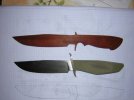
This is the handle style I mentioned earlier. I changed it after reading this thread last night. I was going with the wooden model, but got to thinking about how awkward that would be in say a reverse grip. I may be changing the gaurd to just be on the bottom to allow for thumb or forefinger to press on top of the blade. Will probably put some filemakrs up there for traction.
Thanks to all in this thread. You helped me break through a mental roadblock on this project.
Ed
 

Attachments

  • DSCN1298.JPG
    DSCN1298.JPG
    31.4 KB · Views: 55
Back
Top