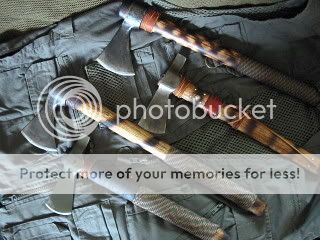
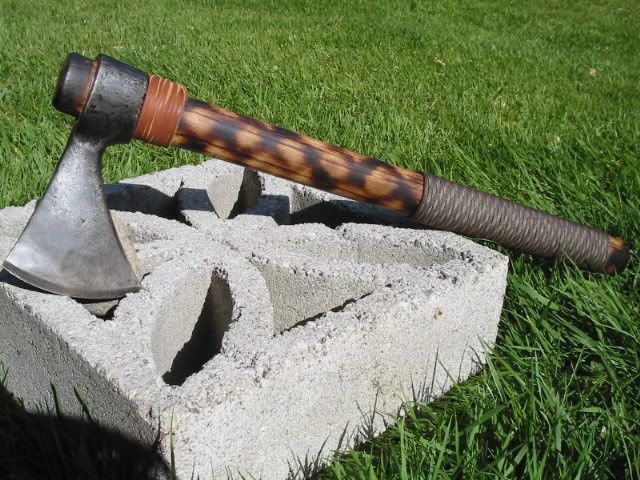
I'll just copy a post I put int he "bushcraft hawk" thread:
The bit of the Trail Hawk can be a big plus depending on what you want it to do (there's a reason I mentioned it first).
You DO NOT want a Trail Hawk if:
1.) You want the hawk to replace a knife. If you want to choke up under the head and use it to skin game, slice things, etc, it can be done, but is not easy with such a narrow edge.
2.) If you want an axe with an oval haft. What I mean is, if you want to split large rounds of wood, this isn't your huckleberry. It can be done (it's one of the first things I tried when I got my Vechawks -- based on the Trail Hawk head), but it takes a different technique than just slamming the head into the middle of a round of wood.
However, if you want a light tool and are willing to use a hawk like a hawk instead of an axe, or replacement knife, then it has several advantages:
1.) It's lighter. Less metal = less weight.
2.) You can chop just as efficiently on larger pieces, but you go about it differently. OK, with an axe/hatchet, you're used to fairly wide chunks of wood coming out with each strike. With the Trail Hawk, the hawk bites deep because of the narrow edge. First swing, the head goes in -- on softwood, I have little problem burying it to the front of the eye, on hardwoods, about 2" deep), the first strike will stick. Pull the hawk out, and strike on a narrow angle just behind the first. When you pull the hawk out, a narrow, long wedge of wood comes with it. Repeat as necessary. That's why Vec says hawks "peck" at wood.
3.) If you stick to the methods of the original hawk users, it's efficient. People didn't use hawks to build log cabins. They used full sized axes and buck saws. The general rule of thumb for hawks was to stick to wood the diameter of your wrist or smaller. Depending on the size of your wrist, the Trail Hawk will take that in 2-3 strikes.
4.) Seeing the narrow edge on the hawk, you understand why it's most often paired with a long knife, or machete. A very small knife, back in the day called a patch knife, is also often carried.
But, as always, it comes back to what work you want it to do, and how you are willing to do it.