why a continuous curve?

Joined
Oct 31, 2004
Messages
1,442
I've seen this come up a few times — Habilis Bushtools makes a big deal over how their knives have a continuous curve to the edge, and I just saw a video of Mors Kochanski in which he mentioned it as an important component of a bushcraft knife. Why is it important?
Thanks,
Chris
 
It allows for a rocking motion over the entire length of the edge against a flat surface, which is a technique that can come in handy. It's not drastically important though. I actually prefer having about an inch or so at the base of the blade be straight for making precise cuts, as well as cutting cordage.
 
I've always had better luck creating more curly feather sticks when I used the belly of the blade as opposed to the straight portion of a blade. They tend to slice a little better.
 
This is because less surface area is making contact with the wood at the start of the cut. :)
 
I've always found that a continuous curve really helps with slicing performance.
 
I don't think that a continuous curve in a knife blade is important for what I do. In fact I can't see why it is of critical importance to anyone, but my experience isn't that broad. I guess some folks would be upset if their ulu had a straight edge.

I'm a hunter and I like a bit of a curve under the point of my knife, but I don't need more than that. Like was suggested earlier, a straight blade is better for cutting rope. I've found rope particularly difficult to cut, especially the dense, tightly twisted film ropes. If the blade is has a convex curve along the cutting edge, there can be a tendency for the rope to slide away from the cutting pressure. I'd feel the pressure if I had to cut a decent rope to save a life and all I had was one of those short, thick, fat neck knives with a very curved blade.

When I was spending a lot of my spare time trapping brushtailed possums, one knife that I particularly liked using had hardly any curve on the blade. I guess the tip developed a tiny radius over time, but it wasn't that pronounced. I found this knife to be particularly good for the opening cuts when I was skinning the animals. The knife I'm talking about is the cheap folder on the extreme right of the picture below:

P1010852.jpg


Wharncliffe and seax blades have very little or no curve. And over the years people seem to have been happy to use knives of that design.

When I'm filleting a fish, I guess a fairly long portion of the straight edge of my blade is being used. And this is also the case when I'm slicing steak. But when I think about skinning, jointing and boning with a knife I reckon that often it is only a small portion of the tip of the blade that is doing most of the work.

When I have a relatively straight knife in my hand, I sort of know instinctively where it is in relation to what I'm doing. I guess I could adapt to a curved blade, but it doesn't seem to be such a logical shape to me.

So, in conclusion after all that analysis and ranting..... nah, I don't think you need a knife with a continuously curved blade for general hunting and bushcraft use.

 
I don't think that a continuous curve in a knife blade is important for what I do. In fact I can't see why it is of critical importance to anyone, but my experience isn't that broad. I guess some folks would be upset if their ulu had a straight edge.

I'm a hunter and I like a bit of a curve under the point of my knife, but I don't need more than that. Like was suggested earlier, a straight blade is better for cutting rope. I've found rope particularly difficult to cut, especially the dense, tightly twisted film ropes. If the blade is has a convex curve along the cutting edge, there can be a tendency for the rope to slide away from the cutting pressure. I'd feel the pressure if I had to cut a decent rope to save a life and all I had was one of those short, thick, fat neck knives with a very curved blade.

When I was spending a lot of my spare time trapping brushtailed possums, one knife that I particularly liked using had hardly any curve on the blade. I guess the tip developed a tiny radius over time, but it wasn't that pronounced. I found this knife to be particularly good for the opening cuts when I was skinning the animals. The knife I'm talking about is the cheap folder on the extreme right of the picture below:

P1010852.jpg


Wharncliffe and seax blades have very little or no curve. And over the years people seem to have been happy to use knives of that design.

When I'm filleting a fish, I guess a fairly long portion of the straight edge of my blade is being used. And this is also the case when I'm slicing steak. But when I think about skinning, jointing and boning with a knife I reckon that often it is only a small portion of the tip of the blade that is doing most of the work.

When I have a relatively straight knife in my hand, I sort of know instinctively where it is in relation to what I'm doing. I guess I could adapt to a curved blade, but it doesn't seem to be such a logical shape to me.

So, in conclusion after all that analysis and ranting..... nah, I don't think you need a knife with a continuously curved blade for general hunting and bushcraft use.

I don't think that a continuous curve is necessary, but having the base of the blade straight and a good gradual curve to the point gives you a nice precision/resistant material-cutting region, a moderate belly for getting into concavities or making rolling/sweeping cuts, and a fine point.

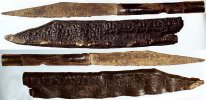
For the record, historical saexes typically had a fair amount of curvature to the edge, contrary to the straight-edged variety we most commonly see presented in so-called saexes today.

post-99-1190298091.jpg
 
I am growing in my respect for your knowledge of knives and knife theory 42B. Thanks for the pictures of those artifacts.

When I read 'curve' in the initial post, I immediately pictured the old-style skinning knives with a huge curve in them. And this is not what the original post is all about of course.

Nevertheless, I'm still happy with a straight edge with a moderate curve upwards at the pointy end. But one essential thing, in my opinion, that a general purpose knife needs is a fairly sharp point. Blade sharp and angle sharp.

Back to curves. I believe that where strong forces act through anything, it is best to have curved or gradual changes of direction in the structure of whatever is carrying the load. In practical terms this might mean that your axe handle will last longer if there is a gradual taper in thickness from the head to the rest of the handle rather than an abrupt shoulder. A bridge designer is unlikely to have an abrupt change along the length of a supporting beam. If a car axle has a sudden step-down in diameter, chances are that is where it will break. I think that this is also one factor behind the phenomenon of knots weakening a rope.

So if one of the justifications for saying that a continuous curve is best on an edge is to make the blade less likely to break, I guess it is correct in theory if one is considering cutting (not sideways) forces being applied to the blade. But if the blade is so brittle that the curvature of the edge is important, then the knife is one that I'd avoid.

To me the one place where a sudden change of direction/dimension is to be considered, is where the tang/handle meets the blade. This is where some knives break. A sudden change of dimension is particularly hazardous especially if the steel is hard in the area and the area has sharp internal corners and rough cutting marks.

I do realize that the continuous curve idea is probably intended to relate more to cutting performance, but I cant help thinking about the strength factor.
 
I think your point about structural effects of curvature is actually relevant if we throw batoning into the picture. It'll help slightly in mitigating shock via stress points. Easy to confuse continuous curvature with strong curvature, though, so no foul there. ;):thumbup: And thanks for the kind words. I just try to absorb whatever I can. I'm full of all sorts of useless trivia. :D
 
You're right about the batoning, particularly if the blows are not applied directly above where the knife is contacting whatever is being split. (Assuming the action is taking place vertically).
 
Back
Top