Why a ricasso?

Joined
Feb 17, 2006
Messages
64
OK, another real basic question. Why a ricasso? One book I read said that a ricasaso is the area of greatest potential weakness of the blade. Another suggested that it was a blade lengthener without much practical utility. It seems to me that a ricasso, at least on a kitchen knife, can create a concave blade after much sharpening.

I've made only 10 knives (starting off crappy but getting better), none with a ricasso, and so far no problems. I'd appreciate your thoughts, especially if I am in for some long term surprises. What say ye??

Rookie 7 aka Phil Millam
 
OK, another real basic question. Why a ricasso? One book I read said that a ricasaso is the area of greatest potential weakness of the blade.

Not sure why that would be?

Most of the time the ricasso is a bit thicker than the normal cutting areas.

However in a sub-tang knife I could see that the part of the tang just behind the ricasso might be a point of weakness...
 
The ricasso is the transition between the blade edge and the tang. In most forged blades this is the strongest area of the blade. If it is a dropped edge blade ,like a big bowie, then the ricasso is "weaker" than the blade at its thickest,but still quite strong. The main reason is to allow a transition of the differential temper from the softer tang to the harder edge. Take a sword as the maximum length example of a blade. The tang must be soft enough to withstand enormous stress.The tang is also much narrower than the blade. The blade has to be hard and springy,which requires an entirely different temper than the tang. If it were not for the ricasso (sometimes four inches long) to make a transition ,one of two things would happen.1) The blade would bend just in front of the guard,or 2) the blade would break right at the guard.Both of these situations occur on cheap ,poorly made swords.The ricasso provides a thick,mid temper area.The reason the ABS tests blades by bending them is to prove that the bladesmith can control the hardness in these areas.The other reason for a ricasso is to provide a seat for the guard with enough surface to make the guard strong.The ricasso is traditionally rectangular in cross section,which is much easier than a triangle to fit a guard onto. Anyone who has fitted a katana (which has no ricasso) knows the difficulty of getting a tight fit on the tsuba at the machi.
Stacy
 
Well put Stacy. It is also convenient to do so for full tang blades, where tang perimiter is visible.

rlinger
 
As rlinger pointed out, on a full tang blade the ricasso provides a transition from the triangular blade cross section to the rectangular tang cross section.
Stacy
 
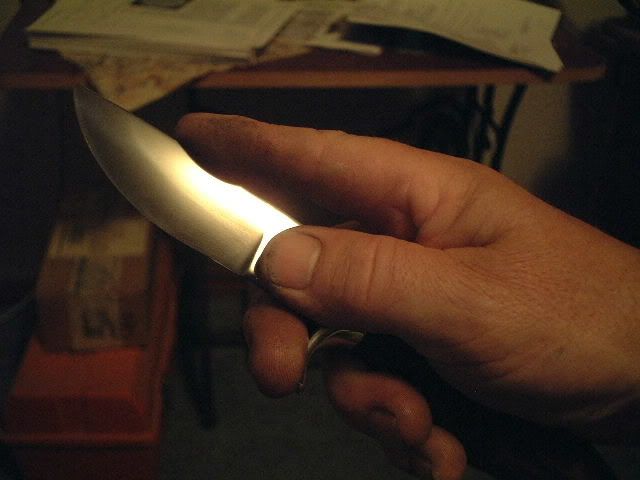
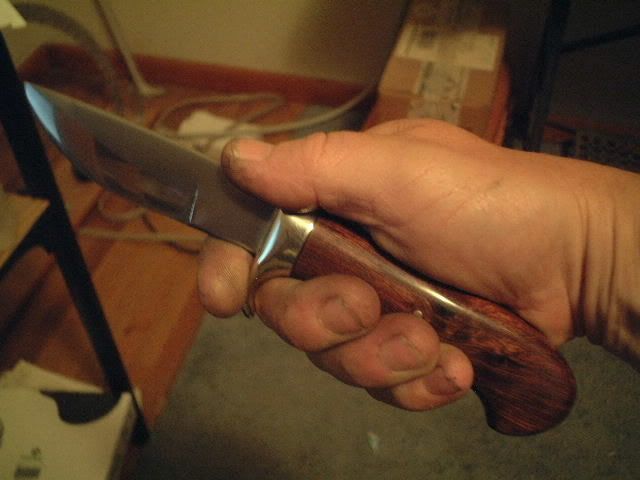
I disagree with it NOT having "practical utility"!
user.jpg

user2.jpg
 
kbaknife, you beat me to it. the ricasso also ofers another control surface when using the blade. on a rapier, i finger is usually wrapped around the ricasso (and guard) for better point control. in a smaller knife this can also be done for finer carving or whittling where more control is needed.
 
OK Here is my 2 cents worth on this.....

Having a dropped edge on a knife will give ease of sharpening over the full length of the edge (no bumping the plunge lines)along with a wider blade so more sharpenings before wearing out the blade....You can get a wider blade from a narrower bar of steel when forging....You get a finger groove to choke up on a blade...You can make a regular sized handle flow with a wider blade....You get a flat tang for ease of guard fit up....

Without a dropped edge you get a blade with what seems like more steel in front of the guard (but both styles starting with the same width steel will have the same thickness and size of riccasso)...Both styles have thicker tangs than knives with edges all the way to the guard....This style is harder to forge properly,but not impossiable....

The only down fall of the dropped edge over the straight riccasso to me is if you are penetrating something,the dropped edge can hang when extracting the blade and the straight riccasso wont.

On a properly differentially heat treated blade this area shouldnt be a strength factor as the blade should flex the entire length of the blade and any cracking or breaking will happen in the center of the blade at the main point of the arc or at the edge of the vise you have the blade clamped in...

Look back in history you see both styles produced and used well....To me a argument of which is better is almost as varied as the argument of forged over stock removal....A knife is a knife and if it cuts and does it's intended job a riccasso or no riccasso shouldnt be a issue...Just make what you think is the best knife in your opinion and then be prepared to defend why when asked:D ....Me personally,I like both styles so I make them along with ones that sharpen all the way to the guard.....Remember there are no rules set in stone as to what a knife looks like or how it should perform (other than it must cut) And untill there is a set rule in stone I will make what I like or my customer likes,If this rule ever happens we will all make the same exact knife and most of us will just quit as that would not be any fun....

So Just have fun and go make a knife you like:D :) :D

Bruce
 
thanks to all who replied. I learned a lot about ricassos, and will try a knife with one soon. you guys are the best!
 
I understood that because the ricasso is thicker than the cutting part that is where a well made sheath 'grips' and makes sure the blade stays put.
 
Back
Top