
why clay?

Fred.Rowe

Knifemaker / Craftsman / Service Provider
Joined
May 2, 2004
Messages
6,848
I enjoy heat treating steel. The whole process of; heating the metal, watching the colors change as the steel changes temperature, the quench, the hole thing. I started out using a torch, edge quenching. Then I read about heating the hole blade, quenching that, and then using my torch on the spine.
Then about two years into this, knife making thing, I tried, CLAY. Now there is a ton of "mystic" in the knife world, but when it comes to clay, it has more than it's share. I used my usual scientific approach, I purchased 100 lb bag and started using it.
So now, four years later, I have a process that I use that gives me the results I am looking for; hard edge, tough-ductile spine, controlled temper line.
I can control the rate, at which, different areas, of the blade cool, after quench. A friend came by the shop and watched me harden a blade. When I was done , he asked; why did I heat the spine of the blade first? I answered;" you want the spine to be at non magnetic, so when you quench the blade, the spine will not harden because of the clay, but it will result in
a spine that is very tough and yet ductile"
Do you think my reasoning is sound? Give me your approach to clay. Fred
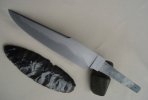
 

Attachments

  • bladepost66.jpg
    bladepost66.jpg
    33.6 KB · Views: 106
Well,that is partly right.I assume you must be using a torch to HT.The main reason for heating the spine is to avoid over-heating the edge,The heat will flow from thick to thin better that the other way around.In a clay coated blade this is even more important,since there is an insulating material over the spine.The edge could be severely damaged by overheating before the spine ever got to critical.You are correct in the fact that the cooling at quench occurs faster in the non-clayed surfaces,and thus results in the different structures being formed (austentite,troosite,bainite,pearlite,martensite), depending on the rate of cooling at that spot.The entire blade should be at critical temp (non-magnetic)before quenching a clay coated blade.When using an oven to HT this is not a problem.When using a torch or a forge,the blade has to be brought up to critical slowly,and soaked long enough to assure even solution of carbides.If heated too fast the edge will almost surely over-heat.
Stacy
 
Hi Stacy,

I use the long "side door" of a whisper low boy to supply the heat. I prop the side door open, with an 18" piece of cast refractory cement, its about 8" high. This forms an even heat tunnel. I set a fire brick up forward, were the tip will be. A place on the hot side of the tunnel to proctect the tip. I have hardened upwards of 300 blades with this set up and find it works well for me.
The reason for posting this thread was, mostly, to see, if a majority of people, who use clay, heat the spine of the blade, to critical temp. There was an artical in the last Blade that stated the Japanese heated the edge in a hot fire and used the clay to "protect" the spine from the heat, never intending to get the spine to the non mag. temp. Surely the Japanese learned , in a thousand years, to get the most out of there steel. To me that means getting the spine to n.m. where you get the most out of clays insulating effects. I was puzzled by the statment. I have learned not to assume anything. So I thought I would ask.
I got a digital controller this week. I am building another gas forge to do my heat treating in. Got it off of Don Foggs site.
How do you supply your heat. If you use an oven , how does this affect your clay hardning? if at all. Thanks for your input, Fred :cool:
 
Larger blades are in a Whisper Lowboy that has been preheated to a good even heat.Shorter blades are in an electric oven. I place the blades edge down in a blade rack.I am in the process of building a larger temp controlled gas forge,too.Four burner,24" chamber.Dave Catoe has a vertical electric HT oven that is 36".We do the swords there.
I have read about the Japanese only concerning themselves with the edge.In the style they do ,that is all that matters.In a charcoal trench forge there is not much control of the heating,and when the edge is at critical it is time to quench.
 
Stacy,

That makes sence, about the japanese sword makers. If you can think in 13th century mind set; there thoughts were about cutting not flexability. especialy when it came to swords for the 'troops". Expendable, I would imagine.
The new h.t. forge I am building will be 24" long with three forced air burners.
I'm putting the cut fire brick, to hold the blades, along the forge bottom. A more even heat I would think than laying them flat.
I hope your new forge works out for you and that the new year treats you rite. :thumbup: Fred
 
Fred,You are quite correct in that the ancient blades were about cutting and durability.Modern folk lore has added mystic proprieties to them.Ancient blades were often so soft (except the edge) that they readily bent in battle.They were just straightened out and on with the battle.A broken blade was useless,a bent blade still worked.Many san-mai blades were mild steel with only a edge bit (the ha) forged in.
 
SO, would that make a double edged Japanese sword a "ha ha"?

Sorry, couldn't resist!:o
 
Back
Top