
Why do many knives have this feature, and what's it for? (Pics)

Joined
Feb 27, 2010
Messages
622
I've searched and thought for a long time but finially give in and will ask.

What's this little curved cut out area for? Why is it there and why is it curved?
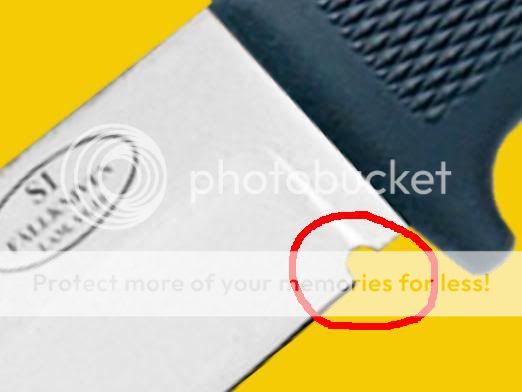
Fallkniven_s1_.jpg


Many of my knives are just straight/flat in that area, I assume for strength, but a good many of my knives have the same cut out as above.

I know the ESEE HEST has a deep notch there that is used to break wire (somehow?), but surely that's not what it's normally for?

Personally I would prefer the cutting edge to continue right up to the handle/bolster so I can slide the knive right up to the hilt and keep on slicing if needed. Thats mainly true with cardboard and such.

Thoughts?
 
That's a sharpening choil. The area is cut out so you can sharpen the whole edge. It's curved so it doesn't weaken the blade.
 
That's a sharpening choil. The area is cut out so you can sharpen the whole edge. It's curved so it doesn't weaken the blade.

Yup...as opposed to a V-notch that would focus a stress riser in the crook of the V.

Some people do not like this feature because whatever you are cutting can slip up the blade and into the choil and bring your cut to a halt.
 
Ah yes well, that makes sense now that I think about it :p

I guess, what would the alternative be? Many knives have the edge of the blade extend down past that area like my NL1:

Fallkniven%20NL1.jpg


That allows sharpening the whole edge too.

What's that area actualy called by the way? Is an area of unsharpened metal between the edge and the handle or gaurd called a choil?

Makes sense having any cut out rounded so there is no stress point.

Some people do not like this feature because whatever you are cutting can slip up the blade and into the choil and bring your cut to a halt.

That's exactly what I was thinking, very few knives have edge all the way to the handle. If I'm lazy the blade can slip up to the cut out. Should just pay more attention to knife control.

Thanks for the replies.
 
The unsharpened part that is the full thickness of the blade between the blade bevel and the handle is called the ricasso.
 
The unsharpened part that is the full thickness of the blade between the blade bevel and the handle is called the ricasso.

Thanks. Why do many knives have that there instead of continuing the blade edges up to the handle?

I sharpen with stones, sandpaper or edge-pro and can't see a problem sharpening right to the edge. A pull through though, I guess wouldn't get cose enough to the edge.
 
I don't know exactly why it is used but you do see it on a lot of stick tang knives. I would think on these knives having a full thickness piece of metal that attaches to the 'stick' could really increase the strength of the overall knife.
 
this is mostly used for ease of maintenance. without this whatever you use to sharpen you'll end up with a slight recurve with time. this cutout allows to keep the edge straigt until you reach the top of the choil.

the lack of this is my main complaint with spyderco.
 
That is a great featurel. I hate it when my stones rake over the tang stamp when I slip on a sharpening stroke. It is like fingernails on a chalk board. Viva la choil!
 
That's exactly what I was thinking, very few knives have edge all the way to the handle. If I'm lazy the blade can slip up to the cut out. Should just pay more attention to knife control.


Just a quick example-when I worked on a oil rig, sometimes you'd have to mix chemicals into the drilling fluid. Those chemicals usually come in 50 or 100 lb. bags which often have to be hand carried to the mixing spot. Occasionally, you'll be mixing a lot (multiple pallets) in a very big hurry. It can literally be a life or death situation, and 'paying more attention to knife control' really needs to not be an issue:eek: I'm not saying that little notch is going to cause the rig to burn down, but there are times when that constant 'catch' of that sharpening notch will pretty dang irritating, especially at the end of your 14th day straight of 12 or 16 hour days:p Sacks, cardboard, rope, etc, that little notch can be an awful pain sometimes!
 
I love them, personally. It makes it much easier to sharpen the knife using benchstones without having to worry about a) leaving portions of the blade unsharpened, and (most importantly) b) messing up your benchstones.

I've found that, when sharpening a knife that doesn't use a sharpening choil on japanese waterstones, the portion of the tang(?) that meets the edge (like on the endura below) will rub against the corner of the benchstone, rounding or chipping the stone. This happened to me whenever I tried sharpening my Leek or Tenacious on benchstones - it came down to a choice between getting the whole edge sharp or keeping my benchstones intact.

sp10pgre.jpg


For guys who use other sharpening methods or aren't too picky about getting 100% of their edge sharp, it's probably not a desirable feature.
 
If you don't have the choil, the edge is lifted off the stone when you sharpen and can prevent the last 1-2 inches from being sharpened. this happenes on a lot of my Seki Spydercos because they ten to have a a very slight recurve near the ricasso which prevents the stone from contacting the edge without a small choil there..

After a few sharpenings, my ceramic stones tend to square that area on Spydercos and all is well. On the other end, Benchmade always sharpens their edge all the way off the blade in one way or another, usually with a omewhat unique drop-off not normally seen in folders.
 
I've found that, when sharpening a knife that doesn't use a sharpening choil on japanese waterstones, the portion of the tang(?) that meets the edge (like on the endura below) will rub against the corner of the benchstone, rounding or chipping the stone. This happened to me whenever I tried sharpening my Leek or Tenacious on benchstones - it came down to a choice between getting the whole edge sharp or keeping my benchstones intact.

sp10pgre.jpg

Yep... Takes the diamonds off of the corners of diamond stones, too.

If you don't have the choil, the edge is lifted off the stone when you sharpen and can prevent the last 1-2 inches from being sharpened. this happenes on a lot of my Seki Spydercos because they ten to have a a very slight recurve near the ricasso which prevents the stone from contacting the edge without a small choil there..

It's not just the recurve. It's the concavity. Because that part right at the ricasso is thicker, it raises an angle when you think you're holding the blade flat. So there ends up being a point of contact right there at the ricasso and another one somewhere down the edge, and there is the section between which ends up not getting sharpened as well. Admittedly, Spyderco Sekis are the worst at this.
 
Thanks. Why do many knives have that there instead of continuing the blade edges up to the handle?

I sharpen with stones, sandpaper or edge-pro and can't see a problem sharpening right to the edge. A pull through though, I guess wouldn't get cose enough to the edge.

That style of blade (like on your fallkniven tor) is a very common blade shape for traditional styled fixed blades. The cutout has 2 practical advantages: First it serves not only as a sharpening choil, which makes it so that you can easily sharpen the whole blade, but also as a finger choil. When you want to choke up on the blade for very fine detailed cutting you put your index finger in that cutout and it will help a lot. It also gives leverage for downward cuts. The second and most important advantage of the cutout is that it alows the blade to be the full thickness of the steel stock when forging the blade. This allows it to be the maximum thickness for maximum strength. However this advantage does not cohere with lower quality knives or stock removal/laser cut blades only forged. It has also become sort of a "cool factor" also. It just makes the blade look more traditional so some manufactures put it there for looks. If you have additional questions google Randall made knives, they explain it better than I can.
 
Yup...as opposed to a V-notch that would focus a stress riser in the crook of the V.

Some people do not like this feature because whatever you are cutting can slip up the blade and into the choil and bring your cut to a halt.

I posted a thread on this some time ago. I hate that little cutout for exactly this reason. It seems it's always catching on stuff. The mini Griptilian is a terrible offender.

A lot of traditional knives don't have this. Opinels don't. Another reason to carry these older designs.
 
Back
Top