Why I like an Axis lock for hiking and camping....

Joined
Dec 10, 2006
Messages
5,978
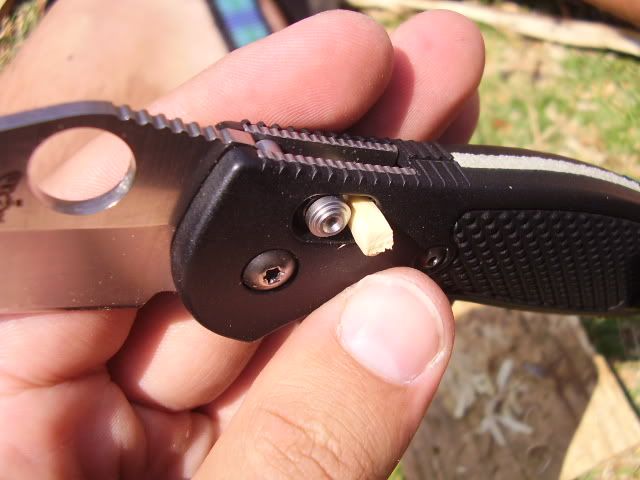
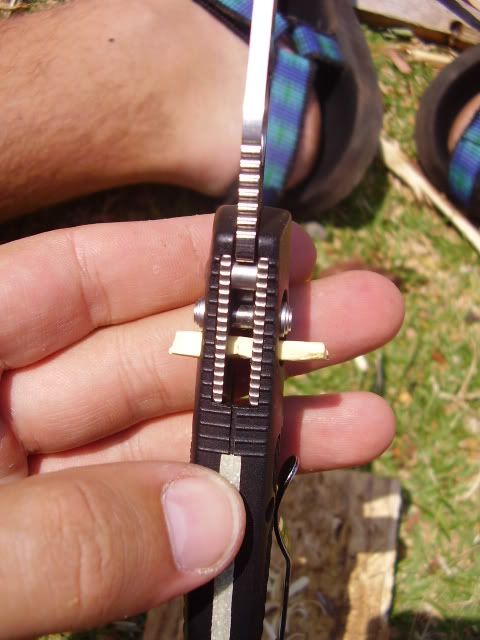
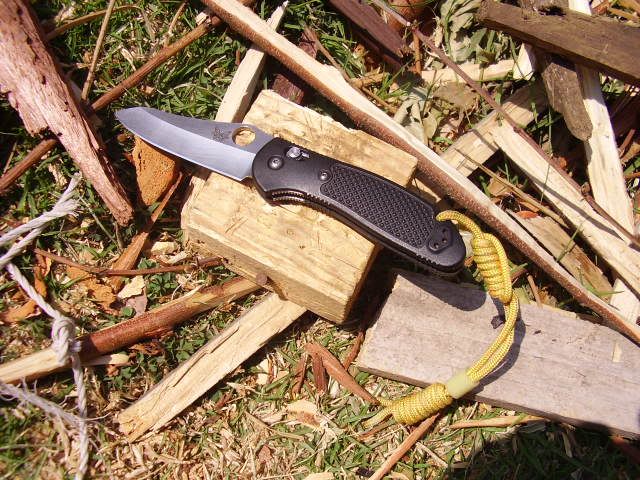
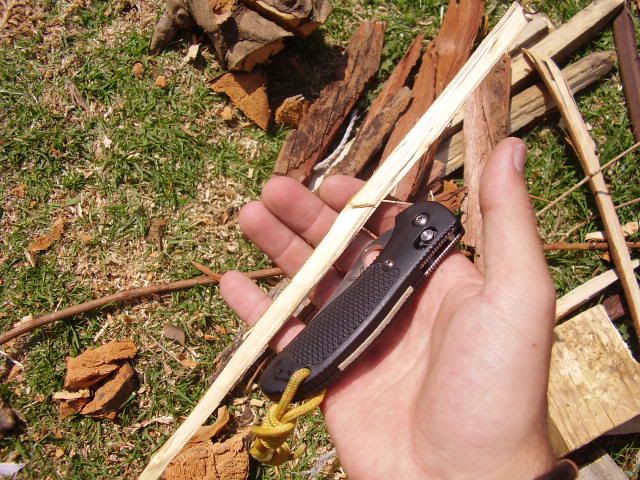
I like the convenience a folder provides when hiking and camping combined with a good fixed blade or axe. There are many great folders out there from a good old slipjoint to a custom reaching $1000+. All good and have their place IMO for us knife addicts. There is one reason I like the Axis lock specifically as a back up knife when hunting, camping etc.

If the omega springs would go, the lock is not rendered useless unlike many others locks that if their spring would break, come loose or what have you. Here is what I mean:
P9040016.jpg

P9040018.jpg

P9040019.jpg

P9040020.jpg


[youtube]JkVtxEQ215k[/youtube]
 
Ya, but that won't work with my favorite axis lock knife, the benchmade ares. On all flavors of the ares knife the axis lock locks up to where there is no space to put anything behind the knife like you did in the video, the rest of my bechmades you can, but for some reason not the ares. Still keeping the ares as it is my favorite design, but I am getting rid of the rest of my benchmades (Except the 710M2) to get a sebbie just to see what the hell I am missing.
 
Maybe it´s an option to put a stick behind a broken axis lock. But that is not enough for me to take an axis over any other kind of lock.

Breaking omega springs are fairly rare. SO i look for how the knife will work in every day conditions.

Will the lock work, even full with sand or dust or mud or blood?

Will the lock get damaged by rust due to the sand, dust or mud and blood?

That is, what will happen sooner than a breaking omega spring. IMO.

Any experiences?

(Yes, i know the videos about the Griptilian in the mud, water and sand, with the dog)
 
I go for liner locks myself. Although usually not a fan, the very simple construction and relatively strong locking leaf are why I like it for outdoor work.
 
huh that is nice for emergencies, thanks for the pictures.

I have noticed that I simply prefer to take a small fixed blade (plastic mora) and hatchet and leave a folder purely for backup/fun. If a folder breaks, you can blame it on bad construction or inherent weaknesses of a folding knife. If a fixed blade breaks, you did something stupid. :p
 
Maybe it´s an option to put a stick behind a broken axis lock. But that is not enough for me to take an axis over any other kind of lock.

Breaking omega springs are fairly rare. SO i look for how the knife will work in every day conditions.

Will the lock work, even full with sand or dust or mud or blood?

Will the lock get damaged by rust due to the sand, dust or mud and blood?

That is, what will happen sooner than a breaking omega spring. IMO.

Any experiences?

(Yes, i know the videos about the Griptilian in the mud, water and sand, with the dog)

With sand and blood yes including car cv joint oil (I dont really play in the mud any more, but I have a lot of pictures of the knives in use). In the Axis lock, liner lock on my Burger EXK as well as the framelock of Chris Reeve. All have functioned in my EDC rotation as well as hunting, swimming and work on the farm.

I dont want this thread to go into a direction of what lock is better then this or that. This is just an informative post on something I realised while playing around and relaxing with my knives.
 
There is one reason I like the Axis lock specifically as a back up knife when hunting, camping etc.

If the omega springs would go, the lock is not rendered useless unlike many others locks that if their spring would break, come loose or what have you.

But...there are no delicate spring to break in other locks.
 
I love my Axis lock knives, but I wouldn't count on their reliability in the bush.

You can clean out a frame lock with your shirt tail or a bunch of straw.
 
I agree. When I go into the woods I carry my super light Buck Mayo TNT as back up to what ever fixed blade I have that day. I like the axis lock just fine, but I wouldn't trust it in the woods as my only cutting device. Actually, about the only folder I would totally rely on in the woods is a tank built frame lock like a sebbie or sng or a Buck 110, preferring the buck over anything else.
 
I would be skeptical about the axis lock's reliability in a hiking or camping knife. My Presidio's axis lock tended to get all gummed up from mere pocket lint after carrying it for a couple weeks - I'd hate to see what dirt, sand, or guts would do to it.
 
If the omega springs would go, the lock is not rendered useless unlike many others locks that if their spring would break, come loose or what have you.

The problem with that logic is many locks don't have a spring at all, so they can't have an issue with a spring breaking. It seems the fact that a spring can break is a reason not to carry it hiking or camping, as opposed to the given argument that one should use an Axis lock because there is a temporary solution to the problem should it occur.

I don't argue that one should never carry an Axis lock when camping or hiking but rather the logic given here for why one should carry one is flawed.
 
The problem with that logic is many locks don't have a spring at all, so they can't have an issue with a spring breaking. It seems the fact that a spring can break is a reason not to carry it hiking or camping, as opposed to the given argument that one should use an Axis lock because there is a temporary solution to the problem should it occur.

I don't argue that one should never carry an Axis lock when camping or hiking but rather the logic given here for why one should carry one is flawed.

What other locks don't have springs?
 
The problem with that logic is many locks don't have a spring at all, so they can't have an issue with a spring breaking. It seems the fact that a spring can break is a reason not to carry it hiking or camping, as opposed to the given argument that one should use an Axis lock because there is a temporary solution to the problem should it occur.

I don't argue that one should never carry an Axis lock when camping or hiking but rather the logic given here for why one should carry one is flawed.

Going to have to refute your logic here. A framelock is a spring: a leaf spring. So is a linerlock. A backlock/midlock is given it's force by a leaf spring. The Axis-lock has two Omega springs, which double its redundancy: a redundancy I can attest to as I have had two broken Axis-locks that still locked up with zero bladeplay. If I continue from this line of reasoning, the Axis-lock is perhaps the most desirable because of this double redundancy: if one spring breaks, the other can continue to operate. Or, as the OP has shown, you can simply wedge something behind the Axis bar.

Can you do this with any of the other lock styles?

Look up something called a "fatigue limit". Every spring has one.
 
You have to look at a few factors and weigh them to choose a lock (or a fixed blade) and they have been mentioned. How much shock and static load will the lock handle. How well does the lock operate in environments with contaminants. How easy is it to operate under given conditions. How easy is it to clear the lock if contaminated. Is it possible to repair the lock if it fails.
 
Yeah, I've heard this before and I think it holds some credence but practically speaking it's not relevant, IMO. If you are carrying a good quality fixed blade and a good quality folder. What are the odds that both fail? Better chance you'd be struck by lightning :p.
 
Going to have to refute your logic here. A framelock is a spring: a leaf spring. So is a linerlock. A backlock/midlock is given it's force by a leaf spring. The Axis-lock has two Omega springs, which double its redundancy: a redundancy I can attest to as I have had two broken Axis-locks that still locked up with zero bladeplay. If I continue from this line of reasoning, the Axis-lock is perhaps the most desirable because of this double redundancy: if one spring breaks, the other can continue to operate. Or, as the OP has shown, you can simply wedge something behind the Axis bar.

Can you do this with any of the other lock styles?

Look up something called a "fatigue limit". Every spring has one.

An omega spring is a thin piece of coiled wire while a framelock/linerlock spring is an entire slab of steel or titanium. Cant really compare the two when it comes to strength. Granted there's a cutout in that slab but that is still much stronger than an omega spring. Even lockbacks use a thicker and stronger type of spring. Theres no doubt in my mind the Axis lock is an overall strong and reliable lock but its one drawback is the more complex lock mechanism compared to something very simplistic and easy to maintain like the framelock.
 
Going to have to refute your logic here. A framelock is a spring: a leaf spring. So is a linerlock. A backlock/midlock is given it's force by a leaf spring. The Axis-lock has two Omega springs, which double its redundancy: a redundancy I can attest to as I have had two broken Axis-locks that still locked up with zero bladeplay. If I continue from this line of reasoning, the Axis-lock is perhaps the most desirable because of this double redundancy: if one spring breaks, the other can continue to operate. Or, as the OP has shown, you can simply wedge something behind the Axis bar.

Can you do this with any of the other lock styles?

Look up something called a "fatigue limit". Every spring has one.

That's true they're all springs, but I think the fault is in my wording, not my logic. The set of actions that will cause an Omega spring to fail is not the set class of actions that will cause a backlock, midlock, liner lock, frame lock, etc., to fail (as kawr said before me).

Rewording my argument, the set of actions that will cause an Omega spring to fail is not the set of actions that will cause other locks to fail, so the fact that one may fix an Omega spring's failure in the field is not a reason to carry it over another type of lock, as knives with other types of locks will not fail due to the same set of actions that cause an Omega spring to fail.
 
every lock has a set of actions that will make it fail. It is matching those to your use, and then making sure you have a well executed example.
 
hardheart has a very good point with that last post. Right lock for the right application.

I don't own an axis lock knife anymore, I spend at least 4 hours a day five days a week on the river, knives get wet, and while my tasman salt is the only one that gets use while on-water my edc does get wet if my pocket does. I have had three axis lock springs rust and fail. IMO the thinness of the wire they use for the locks is just not meaty enough (2 knives by the way, a mini grip and a 940) The grip I decided way mostly my fault because it was stored in a wet pfd for a month, but in hindsight my buck 110 has sat in the same jacket for two months and functions fine, despite being ugly now.

You are right in that that is a great thing about the axis lock, being able to get it locked with a wedge, but with anylock with a stop pin you can use it fine as a friction folder with some dirt applied to the pivot. For my needs that works fine.

Good idea, and topic though! :)
 
Going to have to refute your logic here. A framelock is a spring: a leaf spring. So is a linerlock. A backlock/midlock is given it's force by a leaf spring. The Axis-lock has two Omega springs, which double its redundancy: a redundancy I can attest to as I have had two broken Axis-locks that still locked up with zero bladeplay. If I continue from this line of reasoning, the Axis-lock is perhaps the most desirable because of this double redundancy: if one spring breaks, the other can continue to operate. Or, as the OP has shown, you can simply wedge something behind the Axis bar.

Can you do this with any of the other lock styles?

Look up something called a "fatigue limit". Every spring has one.

Sorry, but I've never, ever heard of a liner lock or a back lock failing due to spring failure. I have, however, heard of many counts of the Axis Lock failing due to those flimsy Omega springs.

Redundancy helps protect a system from failing, but only if the individual machines are very reliable in the first place. That doesn't mean that the Axis system is crap; it just means that it has a greater failure rate compared to other locks.
 
Back
Top