
-
The BladeForums.com 2024 Traditional Knife is available! Price is $250 ea (shipped within CONUS).
Order here: https://www.bladeforums.com/help/2024-traditional/
You are using an out of date browser. It may not display this or other websites correctly.
You should upgrade or use an alternative browser.
You should upgrade or use an alternative browser.
Wire Inlay Tools?
- Thread starter bobbywett
- Start date


Stacy E. Apelt - Bladesmith
ilmarinen - MODERATOR
Moderator
Knifemaker / Craftsman / Service Provider
- Joined
- Aug 20, 2004
- Messages
- 38,235
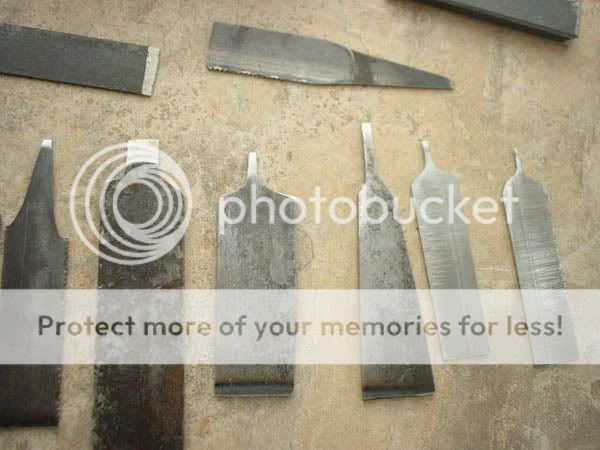
The tools are tiny chisel/knife blade tools ( they look like mini chip carving tools) with a "tip" about 2-3mm wide and a length of about 3mm. You make them from old hacksaw blades.Joe Keesler sells a kit with tools,wire,and instructions.The tools are pushed into the wood to separate the grain and make a slit that the wire (actually a flat ribbon ) is tapped into. IIRC,Bill Moran covered making the tools and doing the inlay in his "Handles" video pretty well.
Stacy
Stacy
Stacy E. Apelt - Bladesmith
ilmarinen - MODERATOR
Moderator
Knifemaker / Craftsman / Service Provider
- Joined
- Aug 20, 2004
- Messages
- 38,235
Joe Kesler - 1-270-753-7919
- Joined
- Jan 10, 2006
- Messages
- 43
I've tried inlaying wire with limited success, emphasis on the limited. I used 24 gauge deadsoft square wire. The wire keeps rolling over and then it looks like two different thickness of wire because of a bigger cross section when its twisted to the side. I was just wondering what gauge of wire you use and if maybe round wire would work better?
MSCantrell
Knifemaker / Craftsman / Service Provider
- Joined
- Mar 12, 2005
- Messages
- 1,213
Man, a picture really is worth a thousand words, isnt it? Thanks, Shakudo!
Stacy E. Apelt - Bladesmith
ilmarinen - MODERATOR
Moderator
Knifemaker / Craftsman / Service Provider
- Joined
- Aug 20, 2004
- Messages
- 38,235
Just remember, the term "wire" is different to jewelers and gunsmiths than electricians. The "wire" you want is thin,flat, ribbon - not round. Sometimes referred to as flat strip, roll stock, or bezel wire. 24 gauge by 2mm is a good size. You want it half-hard ,too. If it is dead soft it will roll over and smush around (technical term).
In copper, you might have to make it a little more than half-hard , to avoid problems.
One day ,I'm going to lay out a real fancy pattern (maybe Bill Moran's face?)and send it to my friend with the laser engraver. He should be able to cut a two millimeter deep line that is only 10 thousandths wide. Then all I'll have to do is get the wire in neatly (which can be tricky on a complicated figure).
Stacy
In copper, you might have to make it a little more than half-hard , to avoid problems.
One day ,I'm going to lay out a real fancy pattern (maybe Bill Moran's face?)and send it to my friend with the laser engraver. He should be able to cut a two millimeter deep line that is only 10 thousandths wide. Then all I'll have to do is get the wire in neatly (which can be tricky on a complicated figure).
Stacy
I've tried inlaying wire with limited success, emphasis on the limited. I used 24 gauge deadsoft square wire. The wire keeps rolling over and then it looks like two different thickness of wire because of a bigger cross section when its twisted to the side. I was just wondering what gauge of wire you use and if maybe round wire would work better?
try work hardening the ribbon by running it back and forth across a curved surface like an anvil horn. It wants to be a bit harder than dead soft or it will roll over like you found out.

