Wood Chisel Design

Joined
Jan 26, 2015
Messages
444
Does anyone know of a book about designing wood chisels?

I can find all kinds of books about sharpening them, but I haven't found one about designing them.

Thanks!
 
Not aware of any books on designing them, but you can "reverse engineer" most designs by thinking about the range of tasks the given chisel is intended for and the prioritized balance of features that provide benefits within those tasks, same as with any tool, really.
 
I haven't run into a book that specifically addresses this topic, but the information is around. Woodworking books have sections on tools, and chisels are often prominently displayed and discussed. In this case, the older the book the better, since modern books basically say, "go to the hardware store and get X tool." I found a book in my local library that dated from the 50s and was about woodworking and blacksmithing, and it had a bit to say about what you are looking for. It has since disappeared, and I wish I could remember the title. Check the (usually small) woodworking/blacksmithing section in your local library, and you might get lucky.
 
Shucks , that’s an easy one . Here is a great book full of detail by a brilliant man !
Love this book. A lot of this applies to western chisels as well.

Here is a REAL chisel. Blue paper steel, ebony wood handle, hand forged in a one man shop in Japan. Oh yah baby.

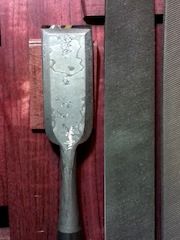

Also investigate individual magazines by Fine Wood Working magazine. “FWW”. Old back issues are available on Amazon. The full index to all the issues over the years is available on line. The author above, Toshio Odate, wrote many of those. Other craftsmen to look for are : Phil Lowe (he does restoration work on multi million dollar pieces for the Smithsonian as well as private collectors) and Eugene Landon and Ian Kirby and Frank Klausz. They may not write just about chisels but they are using them at the very highest level of craftsmanship and demonstrate subtle differences and applications in their articles.

One other book / author that is pretty interesting (may want to check out from the library) Making Classic Chairs a Craftsman’s Chippendale Reference by Ron Clarkson. This the pinnacle of chairs and chair making it just does not get any better than this. Some fairly specialized chisels in there.

We are talking this level of work for these guys; see photo bellow. This is Harold Ionson's work. He didn’t write books or articles but was interviewed for an article.


Here’s Toshio doing a little hand sawing. Yah . . . try that some time ! That board was about 3/4 inch thick before he started, maybe thinner, and the two halves are the same and even thickness requiring only some hand planing to smooth them. That saw he is using is hand made (forged and hand ground and straightened) and worth over a thousand dollars. Think Giant Razor Blade With BIG Teeth. He has walls covered with them . . . brought over from Japan soon after world war II. He is a Professor at Pratt for his day job.



Here are some little tiny chisels I custom ground for paring and fitting very small dove tails like in this drawer.
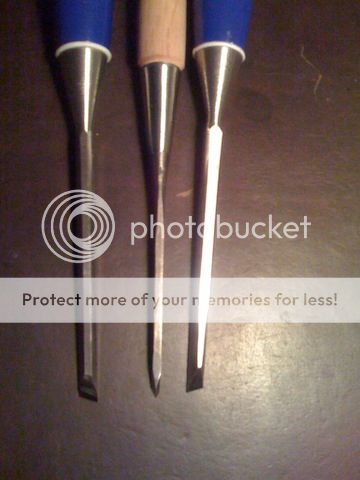



Sorry . . . I get very, very into this stuff ! ! !

 
Just a little more. This is a joinery sample I like to show to people. Picture it as the corner of a drawer or two cabinet sides.

It is called “Full Blind Dovetail Joint” When it is put together all the joinery disappears and it looks like a simple miter sawed joint. Inside though it is super strong and designed to last hundreds of years. The glue tends to breakdown over time but if this joint fits right and is used right it can basically still be quite strong and useful with little or no glue. It can be pined to lock it from coming apart.

Just requires a fine saw, some precision layout tools and the paring chisels shown and a dovetail chisel. NO POWER TOOLS AT ALL.

For perspective these pieces are about five inches long and about a quarter inch thick (6mm) but this style joint was often used in massive nine foot tall furniture (ceilings were higher back in the day).


Check out Lee Valley Tools. They have a wide variety of specialty chisels and information on their use.
 
Does anyone know of a book about designing wood chisels?

I can find all kinds of books about sharpening them, but I haven't found one about designing them.

Thanks!

And just out of curiosity, this has to do with knives how exactly? Chisel ground knives or something? o_O Maybe I missed something...wouldn't be the first time!
 
Actually, I'm not looking for information on the care of or use of chisels, I'm interested in design information-- details about the details of chisel design. Why chisels are built the way they are.
 
Actually, I'm not looking for information on the care of or use of chisels, I'm interested in design information-- details about the details of chisel design. Why chisels are built the way they are.

I would think that knowing about how and why they are used would lead you down the path of why they are designed the way they are. Form follows function.
 
Nope. Not all chefs can design kitchen knives and not all knife designers can cook.

Correct. Yet a chef worth his salt will know that the thick and heavy blade of his butchers knife is what makes it useful to bust through bone and that the thinner blade of his paring knife is what makes it excel at specific tasks.

All I'm saying is don't outright dismiss the suggestions given as they can lead you down a path of self attained knowledge.
 
I see.

I've read any amount of contradictory claims, stories and "information", and I was hoping for an authoritative source for design parameters and considerations.

It's starting to sound to me like no one has such a resource.
 
I would think that knowing about how and why they are used would lead you down the path of why they are designed the way they are. Form follows function.

This is exactly right. There are chisels for chopping mortises. There are chisels for paring with great control and precision. There are chisels for multipurpose woodworking/fitting/ shaping. Then there are dovetail chisels, boatbuilding slicks, others unmentioned, all with hugely different purposes.

Zero in on your parameters and it will be a bit easier to provide some direction. The resources exist, at the least, there is info on why a specific chisel form has evolved but which form is the question.

Ray
 
There are also at least five different generations of mortise chisels, depending on country, method, time and, to a certain extent, industrialization. That's just one example (the first you happened to mention) to answer one word in your screed. (Mortise chisels are actually one of the easiest to define, research and document, but the example serves the purpose.)

If you don't have an answer, that's fine, but my question is already sufficiently defined. If you only have an answer for any one of the things you mentioned, I'd appreciate it. Somehow, I doubt you do.

The more research I do on this topic, the less likely any reasonable source appears. It's beginning to sound like people repeating what they were taught by their father, and if their father's father was wrong, then so are they.

I've run into an enormous amount of legend and myth, but no source with any authority.
 
My screed? Not even worth more time on this thread - yeah - too many generations, countries, cultural preferences and levels of industrialization for me to bother sorting through for your benefit. Pound on some steel and put an edge on it 'till you like it.

Cheers, Ray
 
Thanks for your help.

My doubts notwithstanding, if anyone else has a resource on chisel design, I'd like to read it.
 
I see.

I've read any amount of contradictory claims, stories and "information", and I was hoping for an authoritative source for design parameters and considerations.

It's starting to sound to me like no one has such a resource.

The Toshio Odate book is just such a source. Have you looked at it ? Have you read it ?

PS: perhaps you missed the link. See the first line of my first post. Click on the words "a great book". Read all of the book and take your time and absorb what he has to say. It is worth the extra time.
 
Last edited:
Take a look also at "The Complete Guide to Sharpening" by Leonard Lee (Founder of Lee Valley Tools BTW). He has some suggestions for sharpening carving tools that I've not seen in print elsewhere. But it may not be more helpful than Odate on chisels. Once you get beyond the tradesman's "butt chisel", chisel design is inevitably tied closely to the intended task. What's the bevel angle? For use in hard or soft wood? Paring or mortising? Push or strike a chisel, it's a column, pry with it, it's a beam. If the forces involved and the steel are known, the rest is engineering and that will tell you how thick a chisel must be for a given width, or how large the shank must be for a given length. But I've seen enough bent chisels to know that carpenters don't always respect the limitations of the particular tool. There might be someone's Master's thesis out there about optimal chisel design, but I suspect history will be just as effective a teacher. Chisels, like knives, are ancient tools and certain task specific forms survive for a reason.
 
Wowbagger, you're right, I missed it. Now I've ordered it.

I take it from your posts that you're an enthusiastic woodworker, and you appear to have a preference for Japanese methods. Would you say that is accurate? :)

P.S. It's interesting that documentation on Japanese hand tools is easy to find, American hand tools is harder, and information about European hand tools is virtually non-existent.

It's been said that Americans will talk all day about methods, but resent any attempt to find out about the money, while Europeans will discuss the money all day but won't say a word about methods.
 
Back
Top