Wood Irritant Warning

Joined
Jan 1, 2018
Messages
861
Last week my wife any I went on a cruise. The week before I noticed that I was getting itchy. Then during the cruise I broke out in a very itchy rash all over my torso. Its been 2.5 weeks now and my whole torso is covered in an itchy rash that is starting to work its way up my neck and down past my knees. No pain but just imagine trying to sleep with 100,000 black fly bites. My entire body is red. It really makes sleeping difficult.

I went to the doctor yesterday who said it was likely an allergic reaction. We haven't change any soaps or detergents and we don't have any bugs up here this time of year so I was at loss. Then my wife mentioned about a cleaver I made her the weekend before we left. The handle was made from Yellow Box Burl and African Blackwood. I have a bad habit of grinding without a mask.

I don't know for sure but it's very possible that the blackwood has caused this reaction as it is a known irritant.

Everyone knows to grind with a mask but I just wanted to throw this warning out there. Hopefully it'll be gone soon. Needless to say, I'll be more diligent about PPE moving forward.
 
Last edited:
A few years ago I cut up a lot of cocobolo. My bandsaw had a vacuum so I didn't wear a respirator. I had a nosebleed for two or three days. I sure learned my lesson.
 
A few years ago I cut up a lot of cocobolo. My bandsaw had a vacuum so I didn't wear a respirator. I had a nosebleed for two or three days. I sure learned my lesson.

Yeah cocobolo is one that A LOT of people are allergic too. My wife one of them. David Lisch too, i took a class of his years ago, and was going to use some cocobolo for the handle and the look on his eyes when i mentioned it! lol
 
Blackwood is very toxic
I got the same all over my hands and face from it on my first knife
It's well known for it
 
Cocobolo & I believe? Blackwood are in the rosewood family. One way or another, you have sensitized to the Blackwood! Read up on it! I didn’t stop when I was having some reactions to Cocobolo and then one day in the shop I had a case of shock where my chest tighten up & I thought I was having heart trouble. Don’t use that wood or any related to it cause next time the reaction will be worse! I had to pay a couple of guys to vacuum out my shop & everything in it cause I’d been using the Coco for months & was afraid to go back in until t was cleaned! Be careful . You don’t want to end up in the hospital ....
 
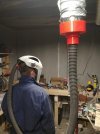
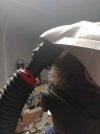
Guys were a proper respirator at least... Get a PAPR and live a happy life without any problem, your health does not have a price. If you can smell it, fit is not good. If price is a struggle, I have a friend who is a physic engineer. He made me very useful parts adapters that you can fit onto regular 4" ducting to your versaflo. The whole thing can rotate without leaking any air. He can make them for like 15 bucks. I basically breath of the outside air.
Versaflo: 320$ CAD
200 CFM fan adjustable speed: 200$ CAD
Shop Vac hose: 10$ CAD
So for about 700$ (this is in CAD, US is way less you lucky bastards) you can get the equivalent of a 4000$ system that performs just as good.
You can see the red parts in the pictures. The inside of the parts are super smooth and conical for the best airflow possible.
received_1237581559775647.jpeg received_207611273706777.jpeg
 
Also I do not try to adverise anything, but if the system my bud and I worked on can save people lungs I do think it is my duty to it to show it to the other. I am basically in my own little air bubble, and it is WAY more comfortable than your regular gas mask, even the good ones do not even reach the level of comfort of a papr, do much that I forget a lot of time I have it on.

Here is the link to the video, I have since then switched to solid ducting instead of the flexible one you see, better airflow:
 
Last edited:
Your reaction is very common for rosewood allergy. It can creep up on you. You can grind them for years and have no reaction and then one day break out in the rash you describe.

As said,
PAPR is the way to go.
Outside air source is the best.
Longish umbilical hose allows walking around and not taking off your hood.

I use something similar to Alex. Mine has a self contained filter and blower unit that runs off 8 hour battery packs. I hang it just outside the grinding room door. I can walk to the anvil to do some quick straightening/bending and don't have to take the hood off.
 
Thanks for the replies guys.

Is it only the dust that is an irritant? I'm concerned about selling a knife to someone and they have an allergic reaction to. I also plan on doing a market in Christmas we're a lot of people will be handling the knives.

I home stabilize most but not the rosewoods or blackwood. They do get waxed
 
Thanks for the replies guys.

Is it only the dust that is an irritant? I'm concerned about selling a knife to someone and they have an allergic reaction to. I also plan on doing a market in Christmas we're a lot of people will be handling the knives.

I home stabilize most but not the rosewoods or blackwood. They do get waxed
I'd be careful around any rose woods. Kingwood, blackwood, tulip wood. Now that you have had a reaction the next one will probably be worse.
There are other woods out there that can cause reactions it just depends on the person.
Its the dust and oils that cause the reaction. A finished handle won't be a problem for any customers.
AND FOR THE LOVE OF GOD, WEAR A RESPIRATOR! No dust is safe weather it causes a reaction or not. It will kill you eventually.
 
Wenge from Africa is really bad for splinters & dust (central nervous system? go figure) & I recently had a reaction to Bocote. Ended up with some eye irritation, must have rubbed my eye without knowing it. Too bad as I really like the grain with the Bocote...
 
So ...what is the risk from fine dust in the air after you have finished cutting / grinding (even with dust collection on the saw and grinder?). I have been procrastinating on getting a hepa filter for the shop area, but do use gloves/respirator/gloves...
 
You are jumping conclusions in this thread and there are some pretty bold statements on causality and diagnosis.
I know these are with good intentions, but people on this forum are trained in knifemaking. Not in medicine. Talk to a professional that know their business.
 
what is the risk from fine dust in the air after you have finished cutting / grinding
I think Alex summed it up pretty good...
If you can smell it, fit is not good.

...but I'll modify his statement to more specifically answer your question, "If you can smell it..." the dust is getting into your lungs.

Even if you can't smell it, but notice colored snot when you blow your nose, some of it is most likely getting into your lungs.
 
So ...what is the risk from fine dust in the air after you have finished cutting / grinding (even with dust collection on the saw and grinder?). I have been procrastinating on getting a hepa filter for the shop area, but do use gloves/respirator/gloves...
My dust collector had a bag on it that was supposed to get down to one micron I think. Garage looked pretty nice (no haze in the air) after resawing a bunch of cedar. Huge step up from no dust collector. But I could still smell it. Got a HEPA filter recently and everything is even a step better....air almost feels clear? I don't know how to describe it...but I was feeling like every was being sucked out of the air.

Last week, nice day, opened the garage door, resawed a bunch more cedar with no respirator on for a couple hours thinking no need. But later when I blew my nose i had a bit of color in my snot. Not much, but still color. I love my HEPA filter but I will be wearing a respirator.
 
Only way to know if your respirator has proper fit is to get some testing sample. Directly from the OSHA website about testing the fit of a respirator:

There are four qualitative fit test methods accepted by OSHA:

  • Isoamyl acetate, which smells like bananas;
  • Saccharin, which leaves a sweet taste in your mouth;
  • Bitrex, which leaves a bitter taste in your mouth; and
  • Irritant smoke, which can cause coughing.
Qualitative fit testing is normally used for half-mask respirators - those that just cover your mouth and nose. Half-mask respirators can be filtering facepiece respirators - often called "N95s" - as well as elastomeric respirators.

Link: https://www.osha.gov/video/respiratory_protection/fittesting_transcript.html
 
Back
Top