Wood shop for bladesmithing?

Joined
Sep 18, 2008
Messages
138
I am currently trying to find a space to setup a small bladesmith shop. I had planned on working out of my garage, but I am concerned about using a propane forge in a building attached to my house.

I have a 12'x12' out building I recently made that would probably work ok, but I have two related problems.

1. The floor (and rest of the structure) are wood, and I am afraid of a fire hazard from flying sparks/hot steel/hot flux.
2. The floor is wood, and I am not sure if my 150lb anvil will work very well without concrete or solid ground under it.

My building uses pressure treated 2x8s setting on a foundation of treated 6x6, and a floor made of 3/4" OSB underlayment.

Does anyone else work in a shop with a wood floor that might be able to give me some advice?
 
You could easily sheild the areas in the shop you are concerned about with cement board or sheet metal to prevent fire hazards from sparks. As for the anvil, I'd say maybe adding a lean-to or an awning to a side of the building and clearing an area for an outdoor smithy underneath it?

--nathan
 
Cement board might work.
I wondered if there was any kind of paint-like stuff that would work (and not be too expensive).

For the anvil, I had actually thought about cutting a hole in the floor, and pooring a small concrete footer just for the anvil. I would love to not have to do that though if someone chimes in saying that they have had no problems with using an anvil on a wood floor.
 
The foundation for the anvil is pretty important, and I can't think you'd get anything but rebound on a wood-frame floor. It might not be bad, though, as knife-work is rather light work.

However, in a 12x12 bldg, I wouldn't want to forge. You're going to be fighting fumes the whole way and really don't have a lot of room for the other stuff that goes on in knife making.

I'd strongly suggest you build a lean-to off the one side and do your hot work under it.
 
+1 for the lean-to or a front awning for the forge.
for the anvil, you could reinforce the floor with a layer of 3/4" advantech T&G subfloor. (glue it down) between that stiffening up the floor, the stump your anvil sits on and the 150 pound anvil you shouldn't get too much rebound.
also - 36" x 60" sheets of 1/2" hardiboard underlayment (fiber cement board with a grid surface, not the old concrete stuff that chips) are only $10 for lining the hotwork area.
 
+1 on the fumes in a small shop. Oxygen will get displaced pretty quickly if you don't have enough ventilation. Even in my 20x40' shop with the garage door 1/3 of the way open, breathing fumes while standing in front of the forge can be a problem. Good ventilation is a must.

--nathan
 
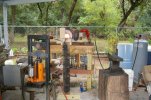
A lean to out side the shop is the way to go,A quick pic of mine.Trying to forge in a small shop is asking for CO2 poisoning.
Stan
 

Attachments

  • Smithy2 (2).jpg
    Smithy2 (2).jpg
    60.5 KB · Views: 36
I have my forge in a wooden building exactly like you.
I'm VERY careful.
The anvil has been put at the junction of two of the beams that support the floor. The only problem is that with heavy forging the whole building shakes.
I'm thinking about a concrete base...
 
Thanks for the advice!
I am looking at a lean to, but there may be very light flooding of the area the lean to would be during very heavy rains (maybe once a year). I am trying to decide if it is too much risk (although I doubt my anvil would wash away:rolleyes:).

The ground is at a slight slope (about 8"-10" in 12'), would that be too much of a problem? Would I want to put down any specific type of gravel?

Also, has anyone with this type of open setup ever had stuff stolen?
 
I'd frame a work area 12x12 in front of the shop and fill it with 1/2" gravel with finings, agrilime, or crusher run.
any of these will pack down firm and give you solid, flat footing and will absorb shock instead of transmitting rebound back up like concrete would.
 
For the forge area, make sure when you put in the support columns you bed them deeply enough in concrete if there's flooding there. Before you see actual standing water you've probably got saturated ground and you don't want things shifting.
 
Back
Top