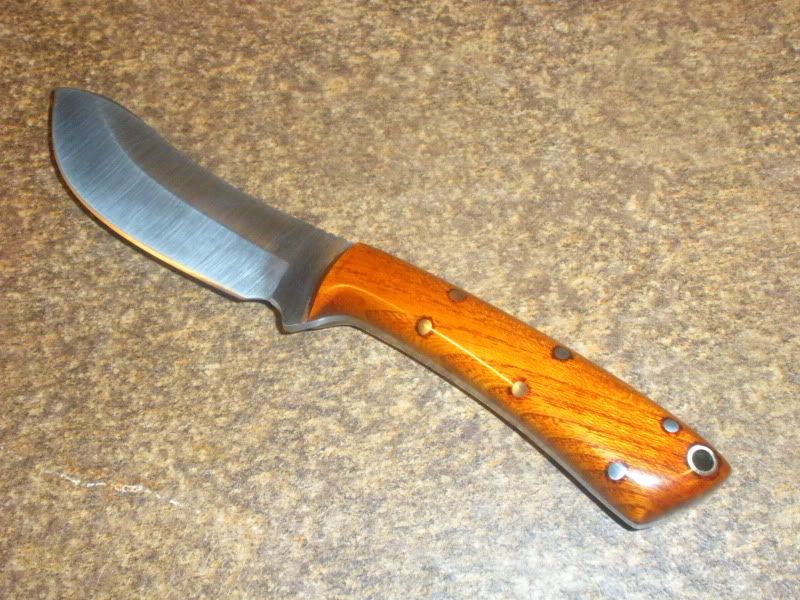
Wooden Handle Finishes, Suggestions?

Joined
Oct 13, 2011
Messages
377
I've been making knives with predominantly hickory or walnut scales and I've been using Formby's Tung Oil. I love the finish. After 5 or 6 coats, the handles are beautiful. I wonder how it will stand up to use however. Is there a finish that anyone prefers or suggests? I have some spar varnish as well. Will that seal the wood fairly well? Can it be used in conjunction with tung oil? I know that a bunch of questions. Any advice would be greatly appreciated.
 
Spar varnish has to be sanded and refinished every so often. For walnut, I use the London style gun stock finishing kit from Brownells. It is basically what Tru Oil wants to be when it grows up. :D
 
If my material has not been treated, I start with Tu-Oil which dries quickly. I smoothe it down with 0000 steel wool, then hit it with a quick, light spray of Deft with dries quite hard and within seconds. But I prefer treated walnut which few do and fewer do well. Gallery Hardwoods in Eugene, Or treat it right and keep the natural color.
 
Different woods require different finishes. Hard, dense, oily woods like cocobolo, ironwood and the like can be simply taken to a very high grit and waxed with paste wax and lightly buffed.

I love tung oil finishes on the right woods, unstabilized walnut looks great with tung oil. Or Tru Oil, both make good finishes.

I don't think a spar varnish would work well for a user knife....you want your finish to be IN the wood not ON it. Now for a display or shelf sitter, spar varnish might work well.
 
I use a lot of different woods, exotic and domestic. There is no one finish that works well for all. For your walnut try Tru Oil. You can get it at most gun stores. You also want to use the filler/sealer they make on the walnut too. I made a damascus knife for a working cowboy in Montana. Iit had walnut scales. I used about 4 or 5 coats of the sealer and 8 coats of the Tru oil. I received this knife back after some years of very hard use. He'd dropped it from some height accidentally and it had snapped some of the tip off upon landing on the rocks. So he asked if could reshape it for him which I was able to do. What impressed me was how well this finish had held up to very hard use. This knife had seen some wear and tear and I mean boy howdy! The walnut was still in great shape and looked good. I had switched to another finish and seeing this knife with the tru oil mnade me switch back.
 
I'm been soaking the handle scales in a 50/50 mix if mineral spirits and tung oil in a jar under vaccuum. Then I let them dry for a couple of days and do finish sanding. After epoxying on to the knife and what not I do coats of more 50/50 tung oil. I sand between every 3-5 coats with finer and finer grit working up to 1500. Usually takes about 15-20 coats this way. Then I finish with a coat or two of straight tung oil and buff. Comes out very clear and shiny and seems to hold up well using maple, ebony, and walnut. I'm a novice so if anyone would critique this technique I'd appreciate it.
 
That's amazing Horsewright. I guess that's what I'll go to with my walnut handles. What about stabilized woods? Do they require a sealer and finish as well?
 
No, the resins used in the stabalization process will polish up with a high grit finish sanding and light buff with something like matchless white or no-scratch pink compound. Or you can even just sand them to very high grit and hit them with a paste wax.
 
A good stabilizing job buffs bright enoughthat no finish is needed. However, not all stabilizers are created equally. I recommend K&G in Arizona and Gallery Hardwoods in Eugene, Or. No finish needed.
 
Some of your ultra hard/dense woods don't need stabilizing. That's why I love working with Osage Orange, Cocobolo and Ironwood (just to name a few). Beautiful woods that are just fine on their own.
 
We have quite a bit of Osage Orange here in Missouri. I knew that they were a very hard using wood, much like yew, and commonly found in self bows. Does it make pretty good handles? What about grain pattern? Is it rather plain or can you get some fancy stuff
 
It makes a hell of a handle! I think it is the hardest wood native to North America. You can find some great grain patterns. Plus, you can take a pencil torch and "toast" the wood to bring out a beautiful orange/red/brown grain accent.

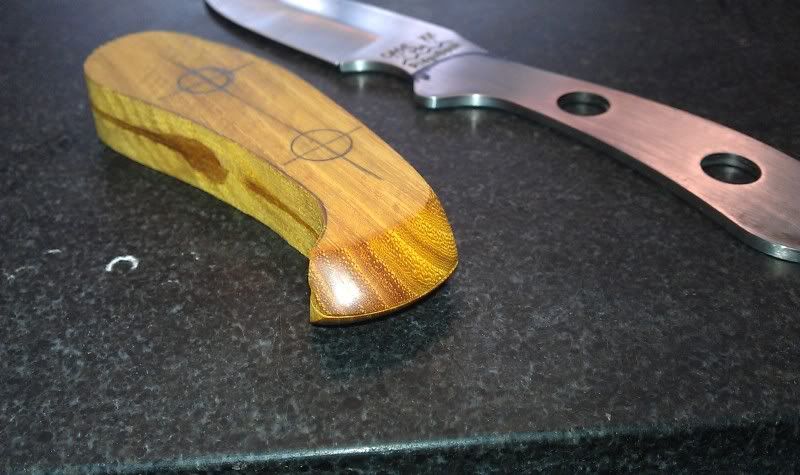
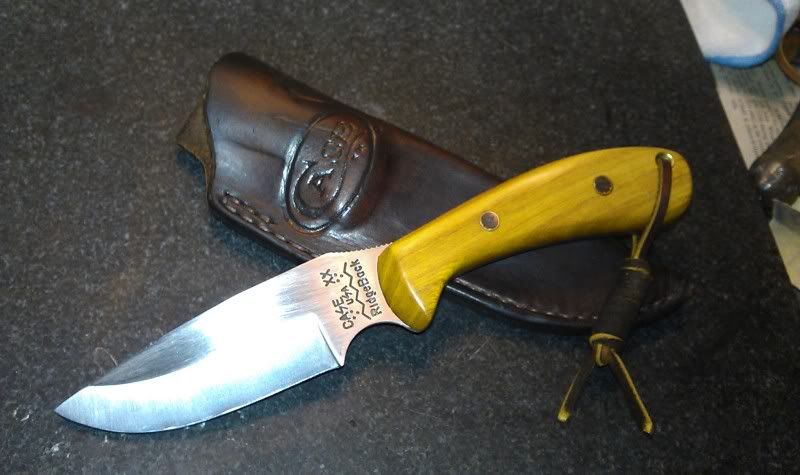
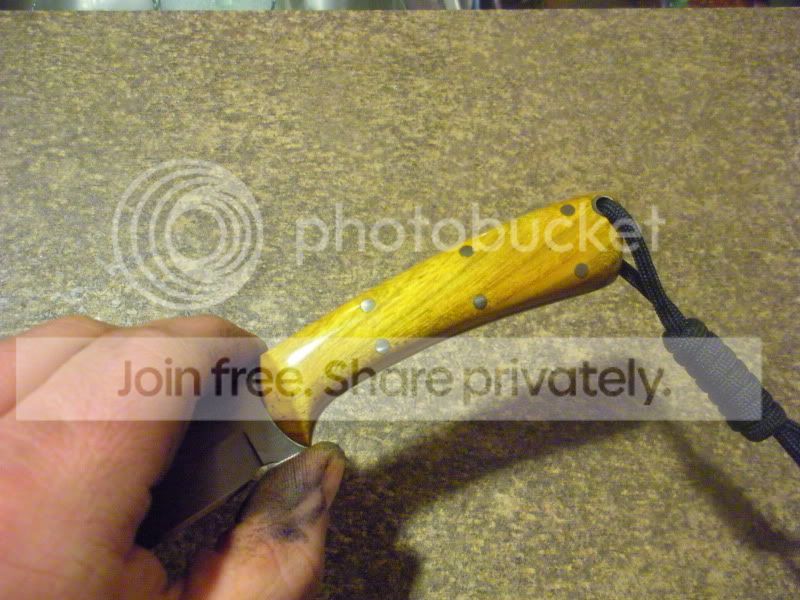
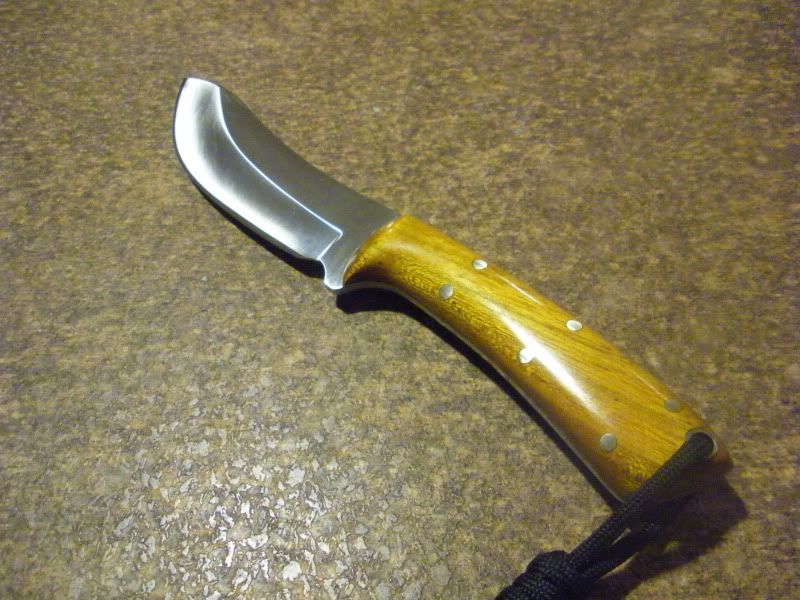
Here are a few pictures of handles I've done.
IMAG0290.jpg

IMAG0344.jpg

DSCN4066.jpg

DSCN4064.jpg


These scales were hit with a light wipe of lt.brown leather dye to make this beautiful orange/brown.
DSCN4043.jpg


One of the things I like most about it is what happens when you look at it in the sun. The chatoyance of the grain is incredible and turning it in different directions makes it look like lights are going on and off inside the wood.

Now, it will...down the road...age to a really pretty rootbeer brown without losing any of it's depth or grain character. It's just the nature of the wood. I have heard of someone using a UV blocking wooden deck protectant, but it only prolonged the color a bit vs no UV blocking finish...not worth the effort. It is accelerated by UV exposure, so if you keep it from just sitting in the sun you should be fine for a while.
 
Nope, the hardest wood native to North America is lignum vitae. But you're definitely in the ballpark.

Nice knives, by the way.:thumbup:
 
Samael- I had to double check this :). There is, in fact, a species of Lignum Vitae that is native to the Florida area. I did not know this. But, I was unable to find the Janka hardness for that version of LV. The most common LV found in Europe has a Janka rating of 4500....quite a bit more than Osage Orange at 2690.

Calvin- I sanded to 400 dry. From there I wetsanded 600, 800, 1000, 1200, 2000 (on the one with the 6 stainless pins) on the Case XX redo I wetsanded to 1000 then used the finest side of a microabrasive pad used for finishing pens on a lathe....just an experiment to see how it differed from going to 2000 grit paper. After that, I put on a coat of Johnson's paste wax and buffed, by hand, with a microfiber towel.
 
It's amazing that the wood isnt damaged from the wetsanding. I'm definitely going to have to look into it. I think I know where there is quite a bit growing. hmmmmmmmm
 
Actually, wetsanding wood can be beneficial in that it raises the fibers so they can be sanded off and smoothed down. A lot of gunstock makers will sand to a high grit then wipe down the stock with a wet cloth. This causes the previously burnished/sanded fibers to raise up so they can be sanded down for an ultra smooth finish.

Make sure what you use has been thoroughly dried first, best to find a dead fall that you know has been there for a while. Or cut some and put it up for a year.
 
Back
Top