nozh2002
BANNED
- Joined
- Jun 9, 2003
- Messages
- 5,736
If you check Wootz production process:
http://playground.sun.com/~vasya/Bulat-Achim.html#English
You may see that result of first 3 steps would be something like home made D2, which has already needed for wootz amount of Carbon and Vanadium. Why then not to skip that process which most likely metallurgical plant will do with better quality then it can be done at home and get instead D2. Then heat cycle it:
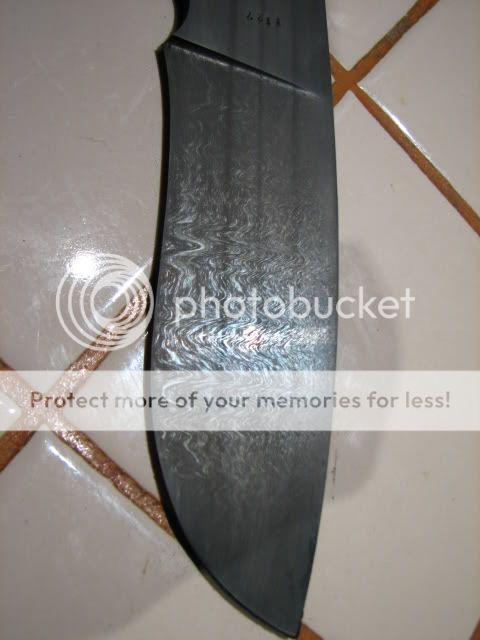
"The next step, the ingot is heated to a temperature about 50° to 80° C below austenitizing temperature, then cooled to about 700° C and then heated again. During those heat cycles the ingot is forged to shape. At the same time, in every heat, a part of the iron carbides is dissolved and attaches to the vanadium carbide seggregations during the cooling. In the next heat, another part of the carbide is dissolved and so on and so on. In the end, most of the iron carbides will be attached to the carbide clusters that form around the vanadium seggregations. It is those carbide clusters that we can see as bright lines on the surface of a finished, etched wootz blade. The number of heat cycles necessary to result in a visible design is at least 50. First small carbide points and stripes can be seen after about 25 heat cycles. But a normal blade with really good designs will need at least 100 heat cycles." (by Achim Wirtz")
I am wondering if somebody tried this?
It seems like heat cycling does not require a lot of special equipment and can be done with one used for regular heat treatment.
Thanks, Vassili.
http://playground.sun.com/~vasya/Bulat-Achim.html#English
You may see that result of first 3 steps would be something like home made D2, which has already needed for wootz amount of Carbon and Vanadium. Why then not to skip that process which most likely metallurgical plant will do with better quality then it can be done at home and get instead D2. Then heat cycle it:
"The next step, the ingot is heated to a temperature about 50° to 80° C below austenitizing temperature, then cooled to about 700° C and then heated again. During those heat cycles the ingot is forged to shape. At the same time, in every heat, a part of the iron carbides is dissolved and attaches to the vanadium carbide seggregations during the cooling. In the next heat, another part of the carbide is dissolved and so on and so on. In the end, most of the iron carbides will be attached to the carbide clusters that form around the vanadium seggregations. It is those carbide clusters that we can see as bright lines on the surface of a finished, etched wootz blade. The number of heat cycles necessary to result in a visible design is at least 50. First small carbide points and stripes can be seen after about 25 heat cycles. But a normal blade with really good designs will need at least 100 heat cycles." (by Achim Wirtz")
I am wondering if somebody tried this?
It seems like heat cycling does not require a lot of special equipment and can be done with one used for regular heat treatment.
Thanks, Vassili.


 In regards to "Why then not to skip that process which most likely metallurgical plant will do with better quality then it can be done at home and get instead D2".