
Cliff Stamp
BANNED
- Joined
- Oct 5, 1998
- Messages
- 17,562
One thing that stands out pretty quickly when working through the fish is that it would be better to use two knives and have two people doing the work. The main tasks are to open up the underside, remove the insides, cut out the sounds, make the vertical slits along the top of the heads, cut out the gills and split the heads in half and then section the fish going through the backbone. They can also be filleted but these were going to mainly be baked and cooked as steaks.
To make the underside cuts and remove the sounds requires a very sharp knife which is fairly light and small with a precise point, similar with removing the gills. However cutting through the top of the head and especially through the jawbone means going through a lot of bone and the doesn't have to be very sharp and won't be after a few fish anyway. The jawbone cutting it also much more effective with a chop.
Most effective if I was using one knife was the Ratweiler because I could leave the tip very sharp for all the precision work, make the head cuts through the main body of the blade and chop through the jawbone with the part near the handle. With other knives like the Roselli there was not enough length to keep the cutting apart and thus the bone cutting would dull the rest of the blade :
The Roselli after doing the work on a few fish had lost the precision cutting ability needed to do the lighter cutting well and was slipping. It was however fully polished and for this type of work a much rougher finish is optimal. A Military with the same edge angle (<10 degrees) but with a 15 degree 600 DMT micro-bevel was many to one times more effective. Much of this due to the more coarse micro-bevel. Neither blade was visibly damaged by the bone cutting which required at times over 100 lbs of force to rock the blades through the cuts.
-Cliff
To make the underside cuts and remove the sounds requires a very sharp knife which is fairly light and small with a precise point, similar with removing the gills. However cutting through the top of the head and especially through the jawbone means going through a lot of bone and the doesn't have to be very sharp and won't be after a few fish anyway. The jawbone cutting it also much more effective with a chop.
Most effective if I was using one knife was the Ratweiler because I could leave the tip very sharp for all the precision work, make the head cuts through the main body of the blade and chop through the jawbone with the part near the handle. With other knives like the Roselli there was not enough length to keep the cutting apart and thus the bone cutting would dull the rest of the blade :
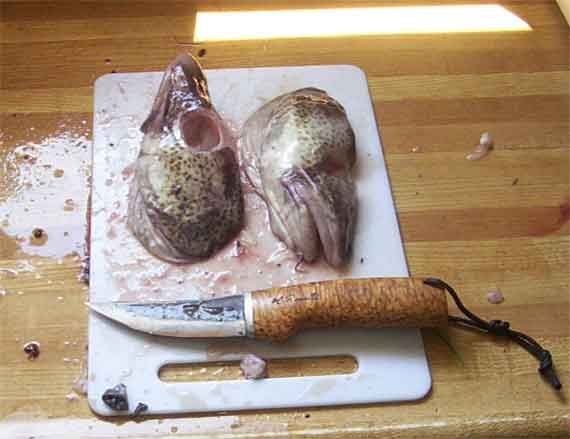
The Roselli after doing the work on a few fish had lost the precision cutting ability needed to do the lighter cutting well and was slipping. It was however fully polished and for this type of work a much rougher finish is optimal. A Military with the same edge angle (<10 degrees) but with a 15 degree 600 DMT micro-bevel was many to one times more effective. Much of this due to the more coarse micro-bevel. Neither blade was visibly damaged by the bone cutting which required at times over 100 lbs of force to rock the blades through the cuts.
-Cliff


