Working with mammoth tooth

Joined
Jan 28, 2014
Messages
554
Hello all,

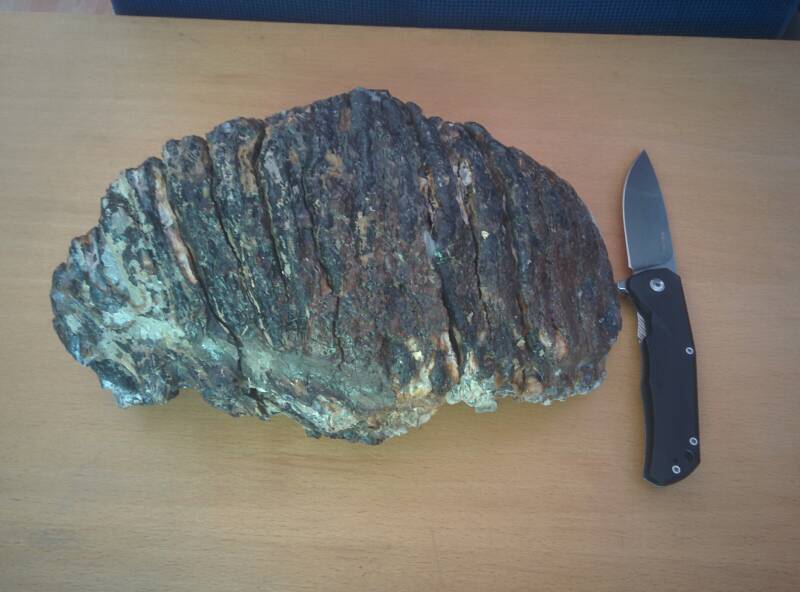
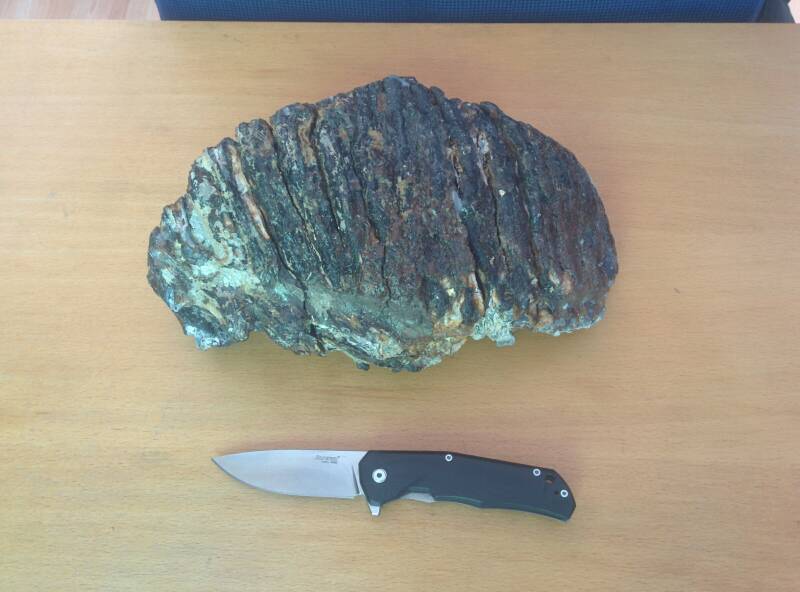
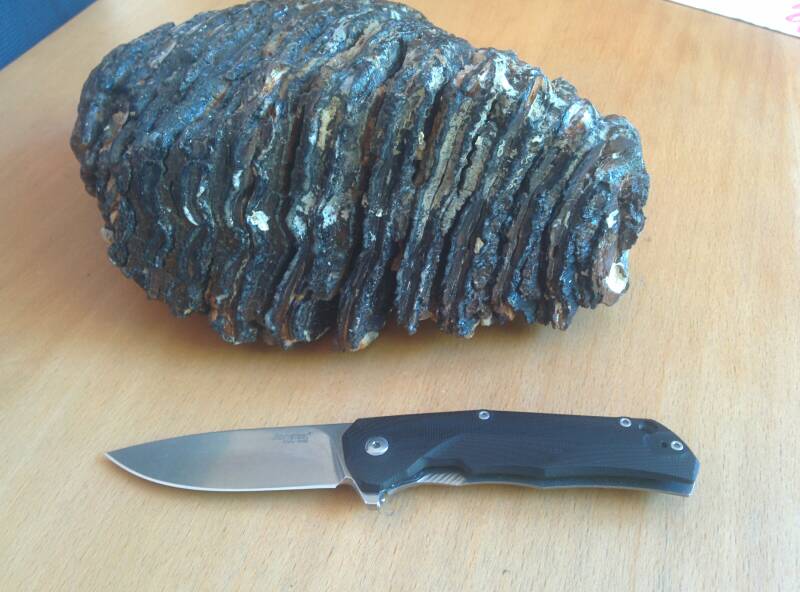
I bought a mammoth tooth a few days ago for a good price and I was wondering if it would be possible to cut it up.

I'm sure it needs stabilisation first to fill everything up and maybe cast it in a resin for the bigger gaps? I have a pressure tank and working on a vacuum tank too so that's not a problem.

What resin would I use to stabilize this?
And what's the best way to cut it after stabilizing? With or without coolant?

Thank you for reading.
c0325b59ebfc3238dcd99a396fbb4145.jpg


8e87ca170117eac2621d58bf84d13bda.jpg


9ba895bfca501f3ec7e45fb47ad75f1d.jpg
 
Mammoth tooth will make you curse. If you don't know how to curse, it will teach you.

I think it is just about the worst material for home stabilizing. I would send it to one of the folks who stabilize mammoth if you hope to get anything usable.

If you want to do it at home, I would first completely saturate it with thin CA. Flood all the surface and cracks and let dry a day. Repeat over and over again for at least ten days. When it is fracture filled, send it to Masecraft or one of the places using alumilite for casting. You can cast in alumilite yourself if you want to buy the resins and dyes.

Even with all that, it is likely to break apart in cutting ( you need special saws). After you make slabs, glue them to a G-10 backer. This at least holds them together as you work the scales. You will need to flood the surface and cracks with thin CA again after cutting up and putting on the backer. You will likely need to put on more CA as you grind and shape the tooth scales. When finally shaped, flood again with CA and do the final sanding.

My favorite use for slabs of mammoth is to back them and use for display bases for small knives, or stands for pens and razors.
 
Mammoth tooth will make you curse. If you don't know how to curse, it will teach you.

I think it is just about the worst material for home stabilizing. I would send it to one of the folks who stabilize mammoth if you hope to get anything usable.

If you want to do it at home, I would first completely saturate it with thin CA. Flood all the surface and cracks and let dry a day. Repeat over and over again for at least ten days. When it is fracture filled, send it to Masecraft or one of the places using alumilite for casting. You can cast in alumilite yourself if you want to buy the resins and dyes.

Even with all that, it is likely to break apart in cutting ( you need special saws). After you make slabs, glue them to a G-10 backer. This at least holds them together as you work the scales. You will need to flood the surface and cracks with thin CA again after cutting up and putting on the backer. You will likely need to put on more CA as you grind and shape the tooth scales. When finally shaped, flood again with CA and do the final sanding.

My favorite use for slabs of mammoth is to back them and use for display bases for small knives, or stands for pens and razors.

Thank you for the reply. I'm from the Netherlands and there isn't much around here with stabilizing. I might try to do it myself with the right resins/dyes.
I will stock up on thin CA glue! First some more research as I'm not in a hurry.

Thanks!
 
Well for sure all of what Stacy said is true. I've been told that cutting with a diamond saw is the way to go. A regular tile cutting saw will work fine.On some the inside can have very large voids. I have been given some of these so this is first hand information. As well the pieces when good can still be full of cracks that will need filling .I use first the thin and then the thick CA glue for this work. I believe doing the stabilizing on each individual piece would be a good way to go. and even done first, before trying to treat the outside.
I use a fair amount of mammoth tooth. The working of it to fit and finish can be a big deal . I use silicon carbide belts for working this material which can be very hard to very soft. The usual ceramic belts don't do too much. Drilling holes is something I'm still ten years later, trying to find an answer for since you can have layers that are very hard and very soft.
I believe you will be doing the right thing to keep that as a specimen and but some from Charles Tournage on Ebay. Your first cut with a saw will mean it may be destroyed if the inside is not useable. I purchased a large tooth from North Sea Ivory several years ago and st it off to be cot by him. There certainly wasn't many sets that came out of it.
Frank
 
Well for sure all of what Stacy said is true. I've been told that cutting with a diamond saw is the way to go. A regular tile cutting saw will work fine.On some the inside can have very large voids. I have been given some of these so this is first hand information. As well the pieces when good can still be full of cracks that will need filling .I use first the thin and then the thick CA glue for this work. I believe doing the stabilizing on each individual piece would be a good way to go. and even done first, before trying to treat the outside.
I use a fair amount of mammoth tooth. The working of it to fit and finish can be a big deal . I use silicon carbide belts for working this material which can be very hard to very soft. The usual ceramic belts don't do too much. Drilling holes is something I'm still ten years later, trying to find an answer for since you can have layers that are very hard and very soft.
I believe you will be doing the right thing to keep that as a specimen and but some from Charles Tournage on Ebay. Your first cut with a saw will mean it may be destroyed if the inside is not useable. I purchased a large tooth from North Sea Ivory several years ago and st it off to be cot by him. There certainly wasn't many sets that came out of it.
Frank
Thank you for all the information! Mine came from the Netherlands too from what the owner told me. Probably somewhere south where I live. From what I've heard is that the Russian teeth are better because of the permafrost. The one in the North Sea for example might be less quality because of all the water?
 
Bosch roto-zip tile cutting bits will drill and enlarge holes in tile, porcelain, granite, travertine, and have worked very well even on hardened steel for me, made for freehand rotary tool work like cutting outlet holes into tile. My carbide bits are only safe in a drill press, but the carbide tile zip bits can be used in any dremel or a die grinder and they work very well at enlarging holes as well as drilling, might be worth a try on tooth.
 
Yes, the people at North Sea have always been very good at saying they sell specimens and not material for cutting into scales. The materials from there can be seriously degraded. On the other hand I've had some terrific scales from there with blue and orange. It's not that the material is so hard to go through . When you are trying to drill holes for very small screws, not 1/4"bolts, the consistency of the material will often decide what sort of hole you make.
Frank
 
Back
Top