

- Joined
- Dec 31, 2005
- Messages
- 2,984
When I first got my BWM CG it came with a half decent edge sharpness wise but was a bit obtuse on the angles .... the classic Busse edge really .... one that is designed for abuse as well as use .... you could have a go at a breeze block with it and not worry about tearing any metal off the edge. In normal use tho' it can still deliver respectable performance ....
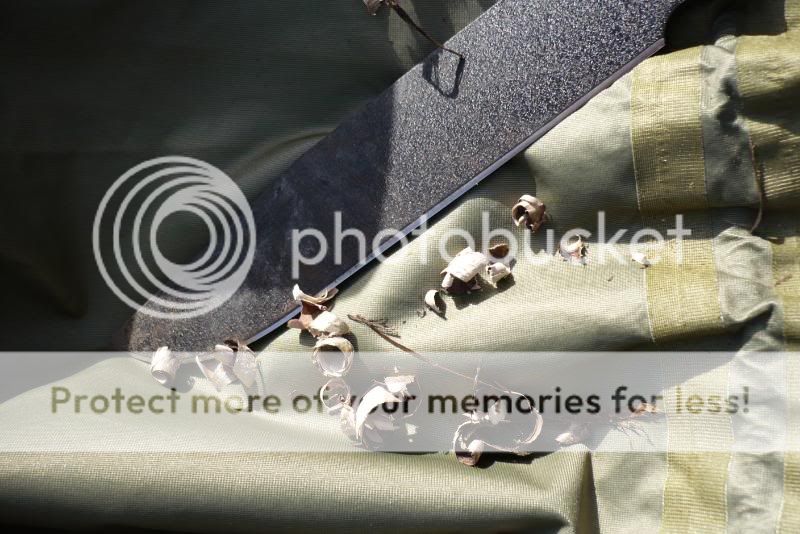
If you were after making fuzz sticks or curls of wood to act as kindling to get the fire to start you could certainly get them from the knife "as is" from the factory ....

These will certainly get a fire going ... even if you were in need of using a ferro rod they will still "take" the spark to a flame if mixed in with some dry dead standing reeds or twigs .... but what this type of edge looses compared to a more acute sharper convex grind is the element of control on the cut ....

It will easily remove the wet bark from sticks as above but when you go to make a fuzz stick it is likely that you will get one or two curls going and then when going for the third the blade might hang up a little and need a bit of "umph" to keep the cut going and once done you find you have powered through at the base of the cut and lost all three curls to a full whittling cut and if they are on the wet floor the benefit of them being "dry" is lost. That's why when cutting fuzz sticks I do it with a jacket on the ground to catch those curls which go astray .... sometimes if wanting the job done quicker it is easier to just go for collecting the curls on the jacket from the start ....
On the chopping front the factory blade is good .... the knife has that "key" feature of feeling nicely blade heavy which combined with the advantage of a light overall weight means the knife should chop well .... it certainly had no problems with smaller tinder ....
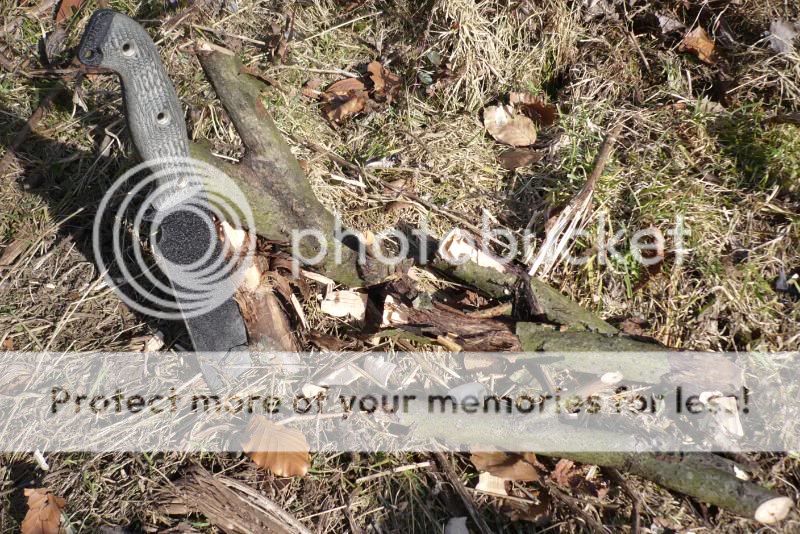
On my example I noticed the grips had a few edges on the pattern which I would prefer to smooth down but for smaller stuff like that above it did'nt matter .... it is only when tackling a job of much bigger girth or needing multiple sections of log cutting that the grip comfort really gets noticed ...
and on batoning it works well as is ....
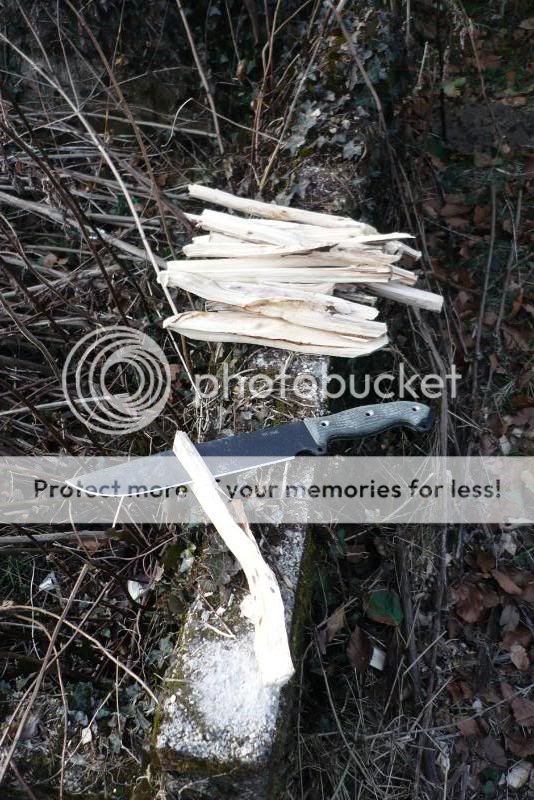
But inside the knife their is a fair bit of potential which is simply not "tapped into" .... bring on the paint stripper .... apply some careful work on the belt sander and you have a ghetto satin finished blade which you have fully convexed from the spine in a slight very acute curve to begin with as the blade is only 3/16 thick .... so just enough to remove the Infi dimples and clean up the scratches .... then nearer the edge give the blade a steeper tapering appleseed edge right to the apex so that it can really bite into the wood without encountering much resistance but leaving enough metal behind the edge to keep the knife strong .... here is a pic of the blade after I had finished the process ....

You can see if you look carefully where the final edge taper begins and with the handles a little smoother from sanding the knife was ready for me to see just how it would cope with something bigger ....

I had this old stump lying around which needed sorting out and I had burnt the remaining log section a fair bit just to harden up the wood underneath to see how the edge on the blade would cope ....

The knife did really well .... amazing really on the improvement .... it was able to bite very deep into what was quite hard wood just under the bark where the heat had really dried it out .... then as we progressed down to the softer inner wood which had not taken the heat it really started to show what it could do ....

If you look at the pic above and the side of the log which was not heated ...just below the blade is the V section I could cut out on the softer side using my normal method of rotating the log/stump to take the cuts from all sides .... much quicker than trying to power through the centre in one simple V cut .... and the depth of those cuts on the softer wood was quite an eye opener for me on how the re-profiled edge had seriously improved the knife ....

Visible again on the remaining stump section above you can see where the first slice on the softer side had sunk right up to the spine ... the harder section on the other side was the only thing preventing the knife from going through this section of wood in around 16 chops ....as it was it took about 20 but if you allow for the KZ taking about 16-18 on perhaps a much more through hardened and more burnt section .... it does show how well the BWMCG can chop if you make the most of the thinner 3/16 steel stock and taper the blade down to a good convex shape ....
If you were after making fuzz sticks or curls of wood to act as kindling to get the fire to start you could certainly get them from the knife "as is" from the factory ....
These will certainly get a fire going ... even if you were in need of using a ferro rod they will still "take" the spark to a flame if mixed in with some dry dead standing reeds or twigs .... but what this type of edge looses compared to a more acute sharper convex grind is the element of control on the cut ....
It will easily remove the wet bark from sticks as above but when you go to make a fuzz stick it is likely that you will get one or two curls going and then when going for the third the blade might hang up a little and need a bit of "umph" to keep the cut going and once done you find you have powered through at the base of the cut and lost all three curls to a full whittling cut and if they are on the wet floor the benefit of them being "dry" is lost. That's why when cutting fuzz sticks I do it with a jacket on the ground to catch those curls which go astray .... sometimes if wanting the job done quicker it is easier to just go for collecting the curls on the jacket from the start ....
On the chopping front the factory blade is good .... the knife has that "key" feature of feeling nicely blade heavy which combined with the advantage of a light overall weight means the knife should chop well .... it certainly had no problems with smaller tinder ....
On my example I noticed the grips had a few edges on the pattern which I would prefer to smooth down but for smaller stuff like that above it did'nt matter .... it is only when tackling a job of much bigger girth or needing multiple sections of log cutting that the grip comfort really gets noticed ...
and on batoning it works well as is ....
But inside the knife their is a fair bit of potential which is simply not "tapped into" .... bring on the paint stripper .... apply some careful work on the belt sander and you have a ghetto satin finished blade which you have fully convexed from the spine in a slight very acute curve to begin with as the blade is only 3/16 thick .... so just enough to remove the Infi dimples and clean up the scratches .... then nearer the edge give the blade a steeper tapering appleseed edge right to the apex so that it can really bite into the wood without encountering much resistance but leaving enough metal behind the edge to keep the knife strong .... here is a pic of the blade after I had finished the process ....
You can see if you look carefully where the final edge taper begins and with the handles a little smoother from sanding the knife was ready for me to see just how it would cope with something bigger ....
I had this old stump lying around which needed sorting out and I had burnt the remaining log section a fair bit just to harden up the wood underneath to see how the edge on the blade would cope ....
The knife did really well .... amazing really on the improvement .... it was able to bite very deep into what was quite hard wood just under the bark where the heat had really dried it out .... then as we progressed down to the softer inner wood which had not taken the heat it really started to show what it could do ....
If you look at the pic above and the side of the log which was not heated ...just below the blade is the V section I could cut out on the softer side using my normal method of rotating the log/stump to take the cuts from all sides .... much quicker than trying to power through the centre in one simple V cut .... and the depth of those cuts on the softer wood was quite an eye opener for me on how the re-profiled edge had seriously improved the knife ....
Visible again on the remaining stump section above you can see where the first slice on the softer side had sunk right up to the spine ... the harder section on the other side was the only thing preventing the knife from going through this section of wood in around 16 chops ....as it was it took about 20 but if you allow for the KZ taking about 16-18 on perhaps a much more through hardened and more burnt section .... it does show how well the BWMCG can chop if you make the most of the thinner 3/16 steel stock and taper the blade down to a good convex shape ....

 but it certainly now "shines" .... I would put it up there with the BWM LE .... there won't be much to choose between these two now ....:thumbup:
 :thumbup::thumbup:
 I went off the "logical" spelling of wheat ...
