Workshop wall armor

Joined
Oct 21, 2011
Messages
40
Hey guys :D
My dad and I are building a workshop to do smithing/knifemaking in, and it is 8 x 12' , so not that big. I have a Chili forge (propane) which has an opening in both ends, so flames come out both ends ;) I need to put it up against the wall to save space, but it has wooden walls and I don't want it to burn down.
So... kind of a stupid question but, what would you use? We were thinking either a big piece of sheet metal (2/32" thick or so) or a kind of trap door. The sheet metal might heat up quite a bit , but so would the space around a door.

Thanks for advice,
M
 
I would use a piece of cement tile backer board and cover it with sheet metal. You might still have to leave some standoff space between the opening on the forge and the wall.
The backer board is availible in home improvement stores in the tile section.
 
Covering the walls and floor with drywall, cement board, something like that, some are more heat resistant then others.
and covering with steel siding is nice

Do the whole inside of the building- angle grinder sparks go a long way & white siding will help keep it bright.


Also

Wheels on your forge, move it out to use, back to store.

Maybe you can close the back forge hole with insulating fire brick.
temporary doors with stacks of brick are popular.
 
Placing a forge within 24" of any flammable wall is asking for trouble. Putting something over the wall will only slow things down by the degree of insulation value of the covering.

A better solution would be to place the forge on a rolling welders cart and roll it outside the door when in use, and in a corner when not. Running a forge inside a small shop is not a good idea, regardless of the walls.

http://www.harborfreight.com/welding-cart-90305.html
You can store all your tongs and hammers on the cart, and hang the propane tank on the back.

When you and your dad build the shop/shed, put a "awning" roof sticking out 6-8 feet from the front. All you need to add is two 4X4 upright posts, a few 2X4s , and some corrugated roofing sheets. ( or use plywood and roll roofing for a sturdier roof)
 
A C Richards' entire hot shop with his forge, oven and power hammer is completely lined with cement board. I have an 8'x16' mobile office trailer that my boss gave me. I'm pulling all the wood paneling and lining the walls and floor with cement board. I also am adding an 8'x16' awning for my forge and 2 of my anvils outside.
Don't forget the other carbon that we produce, carbon monoxide...... If you do it inside, make sure you have plenty of ventilation. I am using the sheets of 1/4" Hardibacker board as they are thick enough for sparks and easier/lighter to work with.
 
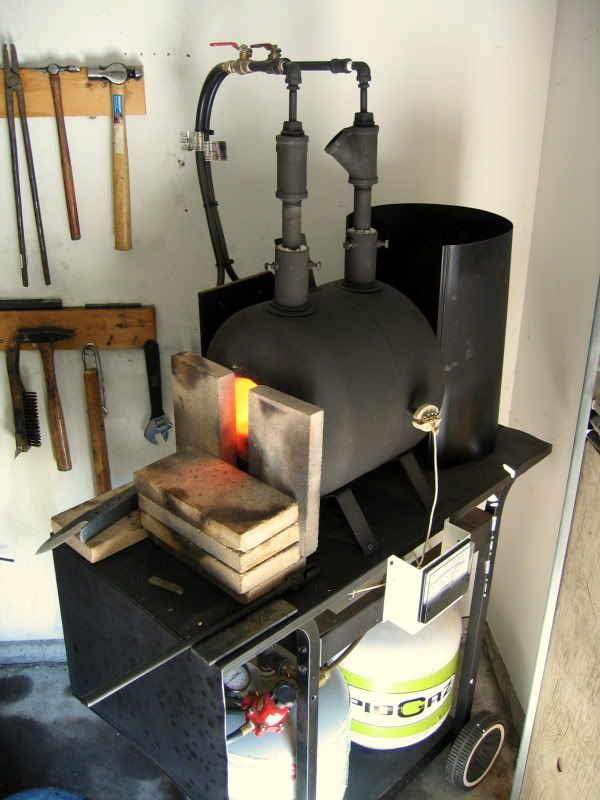
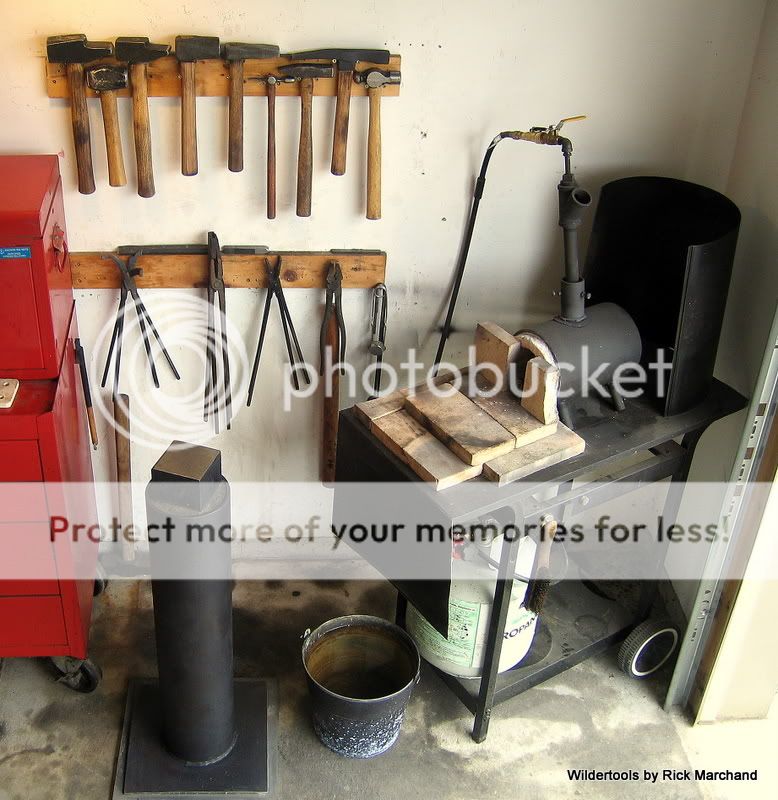
I put mine on a BBQ cart and use a split section of stovepipe as a baffle/shield. I don't like wall mounted flashing as you never know whats going on behind it. If I'm doing a long sword I can pull the cart out.

IMG_0093-2.jpg
 
Hey Ric, won't that stove p[ipe baffle cause the heat to come up onto your gas lines? Just concerned for your safety. Frank
 
I think Rick has a good point there about seeing behind your heat shield. I like the idea of an obstacle to radiating heat, such as sheet metal over hardy board, with good air space between it and the wall.

I think the best idea posed above is having wheels under your forge, though.

Oh wait, wait... yeah, this is brilliant.

LINE YOUR SHOP WITH KAOWOOL! Of course, you don't want ceramic in the air so you'll have to coat your walls and ceiling with Satanite. You'll end up having the biggest forge of all of us. Just get a surplus jet engine or two for a burner and away you go!

Better make that two layers of Kaowool.
 
I think Rick has a good point there about seeing behind your heat shield. I like the idea of an obstacle to radiating heat, such as sheet metal over hardy board, with good air space between it and the wall.

I think the best idea posed above is having wheels under your forge, though.

Oh wait, wait... yeah, this is brilliant.

LINE YOUR SHOP WITH KAOWOOL! Of course, you don't want ceramic in the air so you'll have to coat your walls and ceiling with Satanite. You'll end up having the biggest forge of all of us. Just get a surplus jet engine or two for a burner and away you go!

Better make that two layers of Kaowool.

Do you use satanite over it? Hell you can even go for a venetian plaster look!
 
Hey Ric, won't that stove p[ipe baffle cause the heat to come up onto your gas lines? Just concerned for your safety. Frank

Thanks Frank.... I can hold a bare arm over that area indefinately(or until my arm gets tired). It is hard to tell from that pic... but the black pipe extentions after the elbow are about 8 inches long. It is all very safe....... well as safe as 40lbs of LP being shot through a homemade burner can be, anyway.

Since I got my digital kiln... I've switched back to my little single burner forge. It is so much better for localizing heat where I need it.

IMG_0046-4.jpg
 
Your forges sure look neat and tidy, but I just had to say that in case it was a brand new set up you had just started to use. Good stuff, Rick. Frank
 
I like the forge on wheels idea as well, I'm also in a small space and have a Tabasco Chile coming in the next week or two. Incidentally Chile recommends NOT blocking either hole.. because it somehow impedes the efficiency of the forge. I plan to experiment of course.. but I thought I'd throw that out there.
 
Incidentally Chile recommends NOT blocking either hole.. because it somehow impedes the efficiency of the forge. I plan to experiment of course...

Like a car engine, the exhaust is just as important as the intake.
 
Rick that's very true. I notice your forge has a large portion of the openings closed off, and I'm sure you have good reasons for this. I'm just curious in what way it benefits you?
 
I found that my forge runs well at 7-10psi with about 4 square inches of opening on the small single burner and 6-8" on the double at 7psi. It takes a while to fine tune it but after a few months of using it 3-4hrs a day, you get to know your forge. I can close the opening as I lower the gas pressure but only so much. Venturi forges are different than Blown units. Venturi are naturally aspirated and won't work properly if there is any back pressure working against the burner. If you close the opening you will inhibit the intake air from being drawn into the burner, but not the propane flow. This will result in raw gas filling the chamber and being forced out of the spaces around the doors and burner, where it will burn..... Not to mention, the large volume of unburned gas may explode.... which is bad, I hear.

If Chile Forge suggests not tampering with the chamber openings, I would go with that.

Rick
 
Last edited:
Back
Top