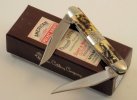
Your thoughts please regarding Schatt & Morgan 420 steel

Joined
Nov 15, 2007
Messages
3,372
Hello guys and gals, I had put my eye on Schatt & Morgan knife, I love everything about it but the steel is stainless 420.
I have no real experience with stainless steel except with Case SS, but this is not the matter. My concern is with the 420 SS, from what I have read it is rather inferior steel. The knife will be in my EDC rotation but not supposed to do hard cutting jobs, just the regular urban guy jobs :) With shipping the cost will be way above 100$ so I would like to have your thoughts whether I am doing mistake spending this amount of money on 420 SS blades and whether this steel will have any effect on using the knife.

Thanks
Mike
 
Mike I can't answer your question directly as I don't have any 420 SS. I will say that the knife I've had in my pocket every day for the past 20 years has a SS blade. I don't know what type of stainless, but I do use my knife hard. It regularly cuts fiberglass, heavy cardboard, etc. and hasn't seen sharpening stones in probably well over a year. I do however strop it every day without fail and as I type this it will still shave my arm. I guess what I'm saying is if you like the aesthetics and ergonomics of the knife it only takes very little maintenance to keep it sharp. That is unless it was made with absolute junk steel which I really doubt Queen would do.
Happy Easter,
Bob
 
Buck, Case and Queen (Schatt & Morgan) use 420HC steel, but the heat treatment is different for each. In my experience Buck's is the hardest and best edge holding, Queen's is next best, and Case's Tru-Sharp is a little softer yet. All work well for pocket knives, but for a harder use fixed blade I would want Buck's.
 
Buck uses 420 steel and their knives can take some hard use, I've read here that Case uses 420 in their SS knives - I've experienced no issues with my Case knives. I think quality knife companies steel will be fine (unless you are one that is preoccupied with specific steels). OH
 
Hello guys and gals, I had put my eye on Schatt & Morgan knife, I love everything about it but the steel is stainless 420.
I have no real experience with stainless steel except with Case SS, but this is not the matter. My concern is with the 420 SS, from what I have read it is rather inferior steel. The knife will be in my EDC rotation but not supposed to do hard cutting jobs, just the regular urban guy jobs :) With shipping the cost will be way above 100$ so I would like to have your thoughts whether I am doing mistake spending this amount of money on 420 SS blades and whether this steel will have any effect on using the knife.

Thanks
Mike

I wouldn't worry at all. For the use you've specified, any of the 420HC blades from Case, Buck, Schatt & Morgan (Queen) or other respected brands will be fine. It'll easily handle the 'urban guy' tasks, and is a cinch to sharpen up and maintain sharp. Choose the knife you like based on the aesthetics; the steel will be very easy to live with, both in use and to maintain. I think the 420HC knives from Case & Buck are about the easiest & most worry-free stainless steels to get along with. Neither is bullet-proof, and they will require some touching up; but it's very easy to do so, with simple tools and minimal effort.

A lot of the negative opinions about the steel are heavily biased and often uninformed. There's also an important distinction to make, in that 420HC is head & shoulders above the standard '420' or '420J2' steels, the latter two of which may influence many uniformed opinions about the 420-group as a whole. 420HC's slightly higher carbon content, at ~0.5% or a little more sometimes, makes a big and critical difference in edge-holding. That 0.5% threshold is what the steel industry establishes as the minimum for any steel to be called 'high carbon', versus the other low- or medium-carbon steels that won't be able to perform in the same way ('420' and '420J2', for example). The extra carbon content is what allows Buck Knives, Case and other quality brands to get some decent or good results out of the heat-treat. And the quality of the heat treat (impacting hardness & grain size) is what matters most, more often than not.


David
 
Last edited:
Thank you all for your informative reply it is great help. I think I am ready to add a new knife to my small collection.

Mike
 
A realistic comparison is Swiss Army Knife steel. It isn't the greatest, but it does the job and sharpens right up easily. There is one person here that detests SAK steel, but everyone else is reasonably happy with it.

I think you will enjoy the knife.
 
Mike, I'm certain it will be OK for everyday pocket-knife tasks. I sometimes wonder WHAT people are cutting when they demand 'better' steels??? Wire hawser...endangered species hides...:D:eek: I understand that some prefer carbon over stainless/vice-versa but provided the steel is treated properly there can't be a lot in the cutting performance for most of the tasks we demand of small folding knives. I find Buck stainless to be remarkably easy to sharpen and find it keeps sharp a long time and that's 'only' 420. It boils down to preference. I haven't found fault with Schatt's stainless at all, I have had isues with some of the finish on their knives however.

Which knife are you after?

Regards, Will
 
If it was a knife that I liked the look of and the price was fair, I certainly would not let the 420HC scare me away.

The brands mentioned above all do an adequate job with it and, while not one of the latest uber steels, will still serve you well.

That steel has been around forever and I think we will be still seeing it on knives for years to come.

Buy that knife! :)
 
IMO what you read is accurate, it is a poor quality steel.

Nonsense.
  • For one thing the term "Quality" has nothing to do with performance. It has to do with how well the material meets the spec for that material.
  • For a second thing, it's a proven fact that blade shape is more important than blade alloy. A properly designed cutting edge works just fine, no matter what the alloy.
  • For a third thing, for many cutting chores, carbide containing alloys are a hindrance to performance. For those chores, one needs an extremely fine edge. A non-carbide containing steel will retain an extremely fine edge longer than a carbide containing alloy. What one wants for those chores is a carbide free alloy hardened to about 58-59. And that is the stated hardness for both Buck and Queen.

I'm going to stop now before I forget I'm online and say something inappropriate.
 
I have used Queen's 420HC for years with no complaints. It sharpens up to a fine edge quickly. It would not be the steel I would choose for a fixed blade hunting knife. But for everyday chores it is very serviceable. I say go for it!

Dave
 
I might get a little OT, but I want to tell ya, Mike - I´ve no S&M knife, yet ;)

But I have some Bucks and older Schrade and Camillus knives that might use 420 steel or something similar (at least in performance not in names...). They are good steels when well heat treated. What Frank said above. I think for the chores a small traditional pocket knife is needed - 420 is ok. Easy to maintain and when heat treated well it will serve you very very long.

I really like Buck 420HC and Case´s TruSharp is a nice steel as well. Keeps an edge easily and holds it for a long period of time - as long as you are not planning to cut through concrete...

This is a discussion about steel and alloy that comes up regularly. I mostly don´t understand the controverses there - a knife with S30V holds an edge much longer, ok. But with simple carbon steel you can sharpen it on the bottom of a coffee mug ... when is a steel actually "better" than another... - Sorry for getting OT here!
 
OK guys thank you, I've read may discussions about steels and alloys and from time to time I got the statement that 420 SS is poor quality. Since I am mostly into carbon steel I didn't pay much attention to it, but now I thought I might get a bit into what "poor quality" is. To be honest my thought is that steel treatment is much more important than the steel alloy and I am happy most of you think the same

@willgoy, this is what I am after (it is borrowed pic)

SM gent muskrat.JPG

Mike
 
Nonsense.
  • For one thing the term "Quality" has nothing to do with performance. It has to do with how well the material meets the spec for that material.
  • For a second thing, it's a proven fact that blade shape is more important than blade alloy. A properly designed cutting edge works just fine, no matter what the alloy.
  • For a third thing, for many cutting chores, carbide containing alloys are a hindrance to performance. For those chores, one needs an extremely fine edge. A non-carbide containing steel will retain an extremely fine edge longer than a carbide containing alloy. What one wants for those chores is a carbide free alloy hardened to about 58-59. And that is the stated hardness for both Buck and Queen.

I'm going to stop now before I forget I'm online and say something inappropriate.


Not doubting you in anyway, but do we know for a fact that a) the steel is 420HC and not a lower carbon 420 and b) they push it to 58Rc (or so)? I couldn't find the information on their web site.

In any event, the list above aligns very well with my experience. The thing I would add is that for some cutting chores, one grind or another may perform better. I really prefer flat/convex ground blades and if the S/Ms are really 420HC at 58Rc, they would be very attractive to me on account of their flat grind.

Relative to some of the other discussions...

I find Buck's 420HC and Opinel's 12C27 to have a similar feel/performance.

I find Case's Tru Sharp to be a bit, but a noticeable bit softer and more prone to burr.

I find Victorinox Inox to another noticeable step down in softness and propensity to burr.

My sense is these differences are almost entirely due to differences in their heat treatment.
 
Nonsense.
  • For one thing the term "Quality" has nothing to do with performance. It has to do with how well the material meets the spec for that material.
  • For a second thing, it's a proven fact that blade shape is more important than blade alloy. A properly designed cutting edge works just fine, no matter what the alloy.
  • For a third thing, for many cutting chores, carbide containing alloys are a hindrance to performance. For those chores, one needs an extremely fine edge. A non-carbide containing steel will retain an extremely fine edge longer than a carbide containing alloy. What one wants for those chores is a carbide free alloy hardened to about 58-59. And that is the stated hardness for both Buck and Queen.

I'm going to stop now before I forget I'm online and say something inappropriate.

Those two bolded points are huge. I also thought of the importance of blade grind; this is why I've been impressed with Case's blades, in spite of the fact their steel is a little bit softer than Buck's or others. The high & thin hollow grinds on most of Case's blades enable them to cut very, very efficiently, relying less on the 'brute strength' of edge hardness or wear-resistance needed if the grind were thicker or otherwise more resistive to smooth cutting.

I have an older 6265 SAB Folding Hunter from Case, about 1965-vintage, with carbon steel blades. Case's blades at that time were likely even lower in RC hardness (blades of this vintage have been measured in the 40s on the RC scale). The first time I sharpened it up, I was somewhat dismayed at how 'soft' it felt on the hone; almost buttery. In spite of that, the characteristic fine grain of the steel really showed it's true colors, in retaining literal shaving sharpness after shredding a cardboard box into 3/4" strips. That ran counter to what I'd previously assumed about the importance (or lack of same) of RC hardness or high wear-resistance (i.e. carbides) in a given steel, used for a given task. I'd put a fairly acute convex on that blade, and the importance and value of the grind and the fine grain was an eye-opener, for such a seemingly 'soft' steel.

This is why I put much greater emphasis on fine grain mostly, in determining which blades are likely to sharpen up best, and cut accordingly.


David
 
Last edited:
Not doubting you in anyway, but do we know for a fact that a) the steel is 420HC and not a lower carbon 420 and b) they push it to 58Rc (or so)? I couldn't find the information on their web site.
(...)

The original manufacturer of the '420' family of steels (Latrobe) only spec'd 'AISI 420' steel to ~52 HRC; it's carbon content was limited to maybe ~0.4% or sometimes lower. They conservatively spec'd '420HC' at about ~55 HRC, with up to 0.5-0.6% carbon (this is the lower hardness limit of where some of Case's blades fall, I think). Their 420HC recipe was deliberately geared toward cutlery, in large part; I'm sure this emphasizes the importance of that little extra bit of carbon. Even if the hardness might be pushed a little further, such as Buck and Queen/S&M have done with 420HC up to about 58 HRC, I don't think the 'lesser' 420 steel could be taken that hard (due to the lower carbon in it). This is why I don't doubt they're actually using 420HC, as S&M specs their blades to ~58 HRC, even if they label it more generically as '420' steel.

I'd be more suspicious if Queen/S&M didn't actually publish the hardness value for their blades; but since they do, and it's spec'd as high as it is, I have less reason to worry about what they're likely using.


David
 
Last edited:
Nice pattern you opted for Mike. If you take to the Muskrat, I can strongly recommend Schatt's stablemate Queen Muskrat in Carved Bonestag, D2 and single-spring. One the THE best made production knives I'm lucky enough to own.

Thanks, Will
 
IMO what you read is accurate, it is a poor quality steel.

Proof that a degree from Google U isn't worth as much as one would think.

I hate to do it, but BASED ON ACTUAL USE, I find the S&M 420 to be quite nice. Setting aside my personal experience with Buck knives and staying directly on target of the OP's query, Queen does a great job with their 420.

I have a large whittler I bought a few years back when I thought I was going to take up whittling. I was tired of using my stockman knives to do it and Mike Latham helped me pick the S&M out. It came pretty sharp, but I got it to a razor (and I do mean razor) edge on all three blades pretty easily. And in use, it holds an edge quite well. If one knows anything about whittling, those guys demand a fine polished edge for their more exacting cuts, and this knife holds that edge very well. It is easy to touch up and doesn't immediately rust from having my sweaty hands all over the blades when I use it.

I like Queen/S&M's version of 420hc and wouldn't hesitate to buy a knife of theirs I liked with that steel. In fact, although I like their D2 best, I would be pleased to have their 420 based on my personal experience.

I don't hold much for rumor, hearsay, unfounded opinion, and these days not even well intended speculation based on generally accepted facts. At least Recurve, you put IMO in your response, so we all know what criteria was used for the statement.

Robert
 
Last edited:
This thread came out very interesting, and I thank you all for your contribution. You actually helped me as I did pull the trigger and ordered that knife.

Mike
 
Back
Top