
1/8" x 3" chefs knife with full bevel...edge thickness before heat treat?

Joined
Apr 5, 2009
Messages
169
The plan is to make a chefs knife out of 1/8" W2 for my wife. The blade will probably be in the 2.5"-2.75" width with a bevel that extends all the way to the spine.

From what I've read about W2 I should leave about .040" edge before heat treatment but I'm thinking that will leave me with too much thickness to sharpen since I want to have a super sharp thin edge around 14-15 total degrees.

I drew this up and it seems like I would end up with an edge that is around .020" tall which seems quite big to me.

Thoughts?
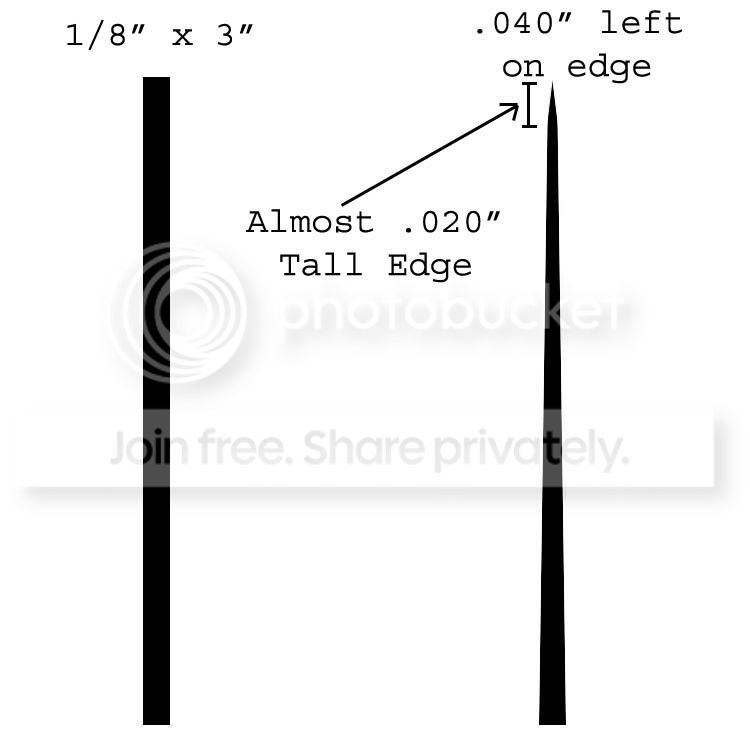
edgethickness.jpg
 
I take my chef knives down to 0.01 to 0.015 but I use stainless. With W2 .04 is probably about right since you will need to grind a bit more after HT.
 
Some like Ray Ennis and Joel Bukiewicz just profile and send to heat treat and grind in the angles after heat treat.
 
I will second the HT first. Profile it and grind after the HT will save you many headaches...I had one very recently that warped significantly and from that experience i will always HT first...
 
I've thought about heat treating first, but I would really like to make some fun hamons with the w2. It's not the reason I want to use it but I think it would be fun to try it. For those of you that have heat treated first, have you ever clayed the barstock for a hamon, grinded the blade down and then etched?

Also, isn't it going to be 10x harder to grind after heat treatment? I'll probably be working on a 2x42 grinder. I'd be worried about over heating and screwing up the blade.
 
You can get a hamon just fine using thin stock before you grind the bevels. Another option is to establish the bevels but leave plenty of steel to grind off after heat treat. Without leaving some steel to grind, the biggest issue is warping or decarb at the edge. It will be a little harder to grind after heat treat but not 10x. The abrasives on good belts are so much harder than hardened steel that they will grind it just fine but do generate more heat. It is very important to keep it cool enought that you dont start getting temper colors on or near the edge.
 
OK. I think on my first one I'll grind down to .040" on the edge with a full flat grind, then heat treat. After heat treat I'm thinking I'll try to do a convex grind to get down to the final edge.

I'm planning on using Aldo's "Skinny W2" on the final product but I'm curious what the .103"/.113" thickness means. Anyone buy this or his other products with a thickness range? What does it mean?

With 3" material that thin getting a flat grind is going to be difficult so I'll buy some 1095 as well to practice on. Anyone have advice for such a thin flat grind?

That's again to everyone! I'll be full of questions til I die.
 
OK. I think on my first one I'll grind down to .040" on the edge with a full flat grind, then heat treat. After heat treat I'm thinking I'll try to do a convex grind to get down to the final edge.

I'm planning on using Aldo's "Skinny W2" on the final product but I'm curious what the .103"/.113" thickness means. Anyone buy this or his other products with a thickness range? What does it mean?

With 3" material that thin getting a flat grind is going to be difficult so I'll buy some 1095 as well to practice on. Anyone have advice for such a thin flat grind?

That's again to everyone! I'll be full of questions til I die.

I haven't seen a thickness range before, maybe it's not perfectly flat, or the lesser number is after the scale is ground off. Sorry, that probably didn't help.

A 3" (tall?) chef knife? A cleaver can't be more than 4" tall. How about 1.5-2" tall - save some money and frustration. I found that a 9" or bigger disc grinder is really nice if you want a chef, or any knife to be flat. I didn't know what flat was until I saw it off a disc. I've ruined knives on a disc as well, so like all things, proceed with caution. If you don't have a disc get a precision granite slab and use it with sandpaper to check/get flat between grinder passes.. Get one anyway because you can roll your sandpaper over the edge and clean up your plunge lines.

EA
 
I will typically grind to about 0.04 edge to leave enough to remove any scale after heat treat. I dont take the flat all the way to the spine so there is more steel at the spine to help keep it straight. Just make sure your bevels are even to help prevent warping.

Starting on a 3" flat is a tough choice, most chef knives only need about 2" wide. I suggest buying some 1/8 wood (home depot carries) and try your hand at grinding the flat to work on technique. I would also suggest practice on mild steel from HD, pretty cheap, then go to your W2.
 
A chef's knife should not be 3" tall....at most 2 - 1/8" to 2 - 1/4" tall and that's a tall chef's knife with a 10" blade.

I HT before grinding...but to each their own.
 
I think some of mine are nearly 2.5" high, if you want to try 3" then you could, but it is taller than most.

I find the disc sander invaluable for checking big flat grinds on kitchen knives. I do the heavy grinding on the belt sander then assess it for evenness on the disc, after every 5-10 minutes of beltgrinding.
 
With the design I came up with the handle doesn't come strait off the back so the handle is actually higher than the spine of the blade by just a little. I'm guessing the blade will only be 2" or maybe a little more so this might not be as difficult as I thought at first. I just need a piece 2.5-3" tall in order to have the handle fit.

Thanks for all the suggestions and help!
 
Profile and heat treat, then grind. Also, the crazy chefs tell me that the best performance from a chefs knife will be had from some kind of convexed grind. Many high end kitchen knives start off as a "saber" grind and then the shoulder is convexed over. That way, food is less likely to stick to the blade.
 
Joe has it spot on. Full flats will give you a lot of food sticking issues. I use what i term a kitchen scandi. It is a 3/4 to 1 inch tall bevel grind and blend the transition slightly with hand sanding...I like my bevels fairly sharp to provide a sharpish edge to promote food release. Full flats are good on some smaller petty/utility knives, but i think you might not like the performance as much on a gyuto/chef's knife.
 
Joe has it spot on. Full flats will give you a lot of food sticking issues. I use what i term a kitchen scandi. It is a 3/4 to 1 inch tall bevel grind and blend the transition slightly with hand sanding...I like my bevels fairly sharp to provide a sharpish edge to promote food release. Full flats are good on some smaller petty/utility knives, but i think you might not like the performance as much on a gyuto/chef's knife.

I'm going to have to try that Mike, thanks for your insight. Although most typical chefs I see are FFG, you make sense. I saw some hammered Shun chefs lately and thought they were cool - looking and performance wise.
 
Back
Top