1084 and Hamon

Joined
Jun 28, 2011
Messages
40
I apologize in advance if this has been covered but for some reason I keep getting an error message when I try to do a search for anything.

I am new here and have been looking through the stickys and doing allot of searches (accept today it seems not to work for me) and I'm finding allot of answers to my questions. This forum has been great help.

But I do have a question I can not find an answer to at the moment.

It seems 1084 is the recommended steel for beginners since it is easy to heat treat with minimal equipment. Basically the best for home HT. Does 1084 produce a decent hamon?

I have played with W2 (I think? old files), 1095 and O1. I have been able to get an OK hamon on 1095 and W2 and obviously O1 is not in that ballgame so have not tried that. I was thinking about getting some 1084 but I am always interested in doing a hamon. So will 1084 give a good hamon? I would think it should but would like to get some insight with someone that knows first hand.

I am using a propane forge (soon to be PID controlled but does have a TC so I know the temp) and I also have a Sugar Creek kiln (that will soon have a PID as soon as I get it installed). All I have at the moment for quenchant is canola oil and water/brine. Working on getting some funds for some "real" quenchants.

Thanks to everyone here for the wealth of information. :)
 
Stephan Fowler and others get hamons on their 1084 blades. One thing about 1084 is that is is used for damascus a lot and the very thing that makes a steel hamon friendly, low manganese, is the opposite of what most guys making damascus want because higher manganese makes for a darker etch.
 
Yes, nice Hamons are possible with 1084. Not going to have nearly as much activity as W2 or 1095, though.
 
Actually........ You won't get a "real" hamon... Only a Temper line. I cut and pasted the following paragraph from one of the links in one of the above posts..... No responsibility on my part for misspelled words, punctuation errors, grammatical errors or misuse of terms like edge quench, temper line etc.... :D:D

I apologize for any confusion.. I was attempting to do a "quote" from another post to make it readily available to read, and did not make it clear. :( :)

A quote by A C Richards....from this link http://www.bladeforums.com/forums/showthread.php/761810-1084-ht

"There is a difference between a "true hamon" and a temper line. A hamon is created when blade is brought to temp and so is the clay coating then it is quenched. The clay acts as an insulator to prevent the complete transformation of austenite to martensite. The result in the transition zone is a combination of martinsite, pearlite, and retained austenite. To get a temper line the clay prevents the steel from obtaining transformation temperature and the edge is quenched thus you get a line. It is different but can look really nice. You do not get the wispy clouds that you can get with a "true hamon". I have done this on 5160, 52100, and O-1. These are all notoriously hard to get any type of hamon on. I did not understand the real process until I really began to study it. It is a never ending quest, at least for me so far. "


http://www.woodchuckforge.com
Avatar Scott Taylor Memorial Scholarship Knife
Photo by Bob Glassman
Chuck Richards ABS J.S.
OTAC USN Retired
 
Last edited:
Thanks guys. That is what I was thinking. I like the idea of trying a more "forgiving" steel as far as the HT. I have had pretty good results with 1095. I have only broke one blade, which was entirely my fault as I tried to straiten it at the wrong time.

From what I gather 1084 should be quenched in a fast oil like Park 50? So McMaster-Carr's 11sec oil should be good then? Would brine be way over kill or would it work but just not optimal? I understand most are against brine but just wondering since I have had good results with 1095 and brine but I also understand 1084 does not need the quench speed 1095 does. Is basically the only risk using brine or water, cracks or breakage?
 
A couple things...

Yes, MMC 11 second will work. I want to suggest filling out your profile with your age, occupation and location.. You might find someone local to help if you haven't already. Also, advice for a 16 year old student and a 40 year old with an engineering degree will be two different answers...(have to spoon feed the engineer)....:rolleyes:

Others can comment more on the res of your questions as I'm still learning myself.
 
You can get a fairly decent "line" with 1084 that shows up well, but because of the manganese content, you won't get those beautiful wispy clouds like you would with W-2 or 1095.

Robert
 
Hi ShadowsHamon,
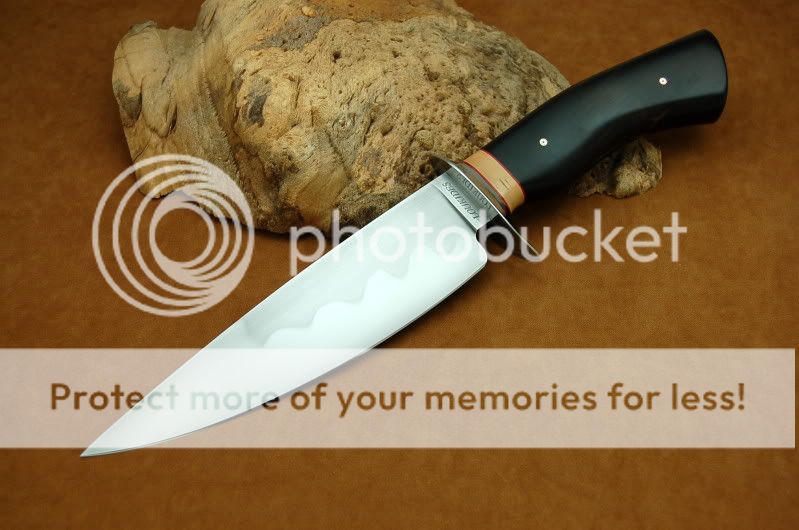
This Blade is 1084.
I Like the looks of a Hamon on W2 when done properly a lot more.
DSC_0004-14.jpg
 
Thanks very much guys. Fluidsteel, I filled out my profile. I guess I was thinking any visible line differentiating hard steel from soft steel in a blade was called a hamon. So basically a hamon is an artful and elaborate temper line? So a hamon is a temper line but not all temper lines are hamon? I guess I don't understand the difference as far as the metallurgy goes. I understand that what you are calling a true hamon is more dramatic but I don't see how the process is different. Are you saying you are not getting the clay up to critical temperature along with the steel under it, and only getting the edge up to critical temp?
 
Its not a temper line, its a quench line.... it has nothing whatsoever to do with tempering, now does it?

I feel better now... carry on.

It is only a hamon if it is done in the manner of a Japanese blade, with clay. Otherwise the Japanese sword guys get upset. That is not to say it is any different, other than the methods used to achieve it.
 
Its not a temper line, its a quench line.... it has nothing whatsoever to do with tempering, now does it?

I feel better now... carry on.

It is only a hamon if it is done in the manner of a Japanese blade, with clay. Otherwise the Japanese sword guys get upset. That is not to say it is any different, other than the methods used to achieve it.

Glad you pointed out the misuse of the word temper. It seems to be a fairly misused term.

And I still do not see the difference between a Hamon and a Quench line other than the "art" involved. I really wish fluidsteel would elaborate on his comment a little more. I am not saying he is wrong I just want to understand.
 
I think the reason many guys (like myself) are quick to point out there being a difference is there are quite a few guys who edge quench a blade, etch it heavily in ferric chloride, scuff off the oxides with scotchbrite, and advertise it as a hamon. To the guys who spent years messing with clay coating, thermal cycles, and hundreds of different polishing techniques to create and bring out a hamon.... the first version seems pretty generic. Not that it isn't nice... but they are not the same.

A rolling hamon is possible on 1084, but I've never gotten the crazy activity that I have with W1, W2, or 1095.

This one is 1084, done with clay and carefully polished out with loose abrasives.
standard.jpg


This blade is W2 done the same way
standard.jpg


This one is 1095 done the same way
standard.jpg
 
Glad you pointed out the misuse of the word temper. It seems to be a fairly misused term.

And I still do not see the difference between a Hamon and a Quench line other than the "art" involved. I really wish fluidsteel would elaborate on his comment a little more. I am not saying he is wrong I just want to understand.

To be MORE clear....

That was a cut and pasted quote by A C Richards from one of the links that was in one the first couple responses...

I will edit the post to make it clearer.....

Perhaps Chuck Richards, Nick, or someone will differentiate more clearly.
 
You could have 1084 with low manganese or high manganese, it would still be 1084 but the hamon-ability :D would change.

I think.
 
Back
Top