
1084 heat-treat question

Joined
Sep 16, 2011
Messages
51
hey guys...so i am making knives out of 1084 and attempting my own HT. What i have is an old kiln rated at 1650*, a quench in oil heated to 125* and a toaster oven for temper at 400*...here's my dilemma:

pictured below is my kiln with a table inside...
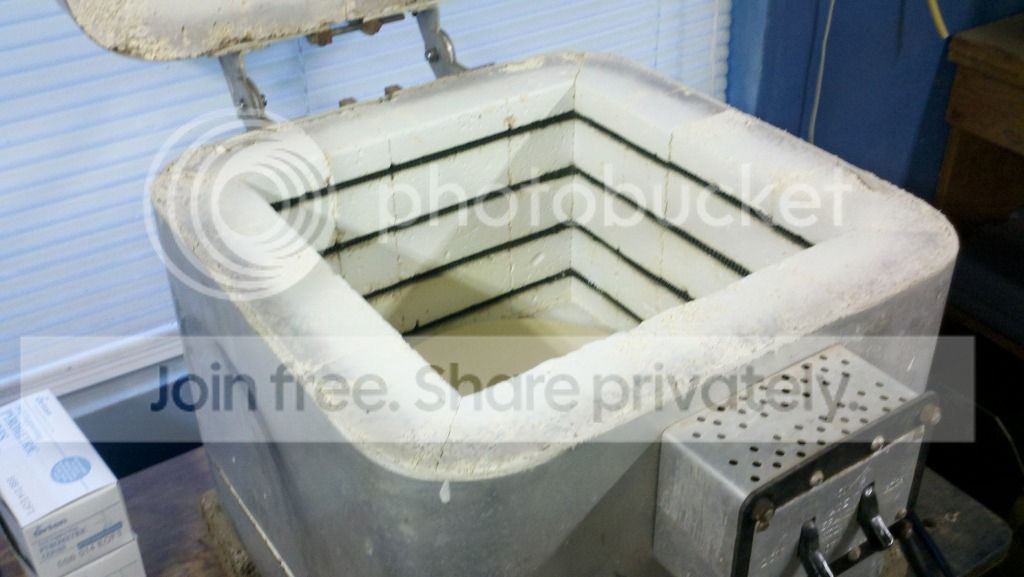
2012-11-02_16-21-33_999.jpg

...and this is a picture of what would have been the knife's orientation inside of the kiln with orton pyrometric cones 014 (1485* melted) and 013 (1539* almost perfect, slightly under-fired)...
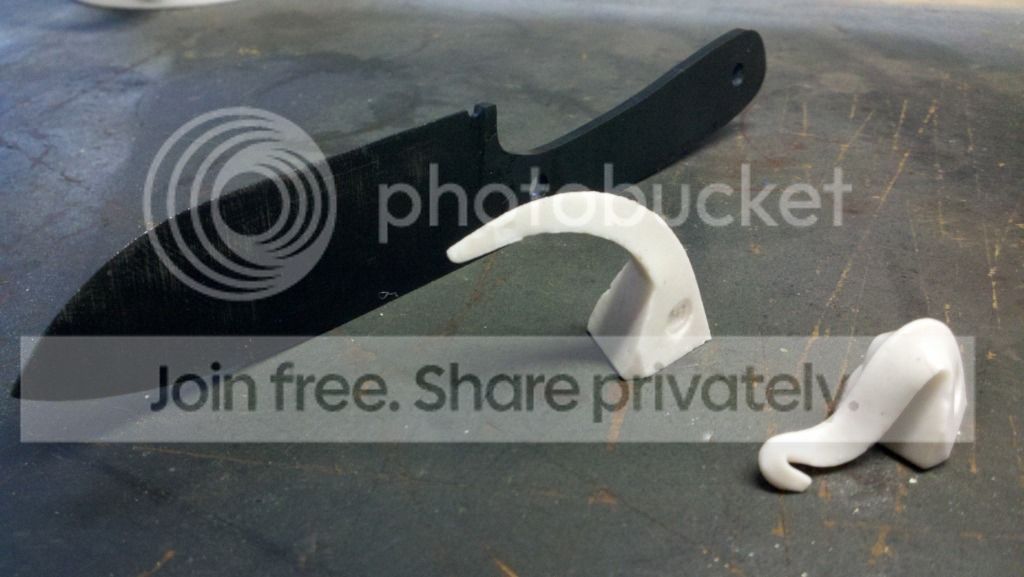
2012-11-02_16-21-21_217.jpg

...now for the nitty-gritty: when the kiln comes to temp i have to open the lid (obviously) and upon doing so the edge of the knife appears to immediately darken from the near orange color and almost appears black...there is NO WAY to bring the knife to the quenchant any faster, this is happening AS SOON AS I OPEN THE LID! is this normal? is this a problem? the steel appears to be hardening because i can pass a file over the blade without any significant "grab", as you can see in this picture...:confused:
 
assuming it stayed in long enough for the blade to reach temp entirely, not just at the edge, you're fine. You don't want to stop and smell the roses, but a few seconds is ok. Are you bringing the kiln up to temp, then putting the blade in and letting it come up to temp? I am not real familiar with the cones so I'm not sure how fast the react. You probably need a couple minutes with the knife in the kiln at the desired temp for it to get up to temp completely. If the thicker areas of the blade are still not fully up to temp they can quickly draw the heat from the edge when the temp in the kiln drops.
 
assuming it stayed in long enough for the blade to reach temp entirely, not just at the edge, you're fine. You don't want to stop and smell the roses, but a few seconds is ok. Are you bringing the kiln up to temp, then putting the blade in and letting it come up to temp? I am not real familiar with the cones so I'm not sure how fast the react. You probably need a couple minutes with the knife in the kiln at the desired temp for it to get up to temp completely. If the thicker areas of the blade are still not fully up to temp they can quickly draw the heat from the edge when the temp in the kiln drops.

thanks for your response! i am bringing the kiln up to temp with the blade already inside...about an hour up to temp and about 5-10 at temp before i open the lid...as i stated the first cone is rated at 1485* and the second is rated at 1540*(they should look like the second one at temp, about 90* angle) between the first and second cone temp is about 10 mins...
 
Running the kiln up with the blade inside it I see two issues, the first is that you are likely going to experience excessivedecarb, secondly, if you d not have the knife shielded from the infrared from the coils you will overheat the blade which has far less thermal mass than the rest of the kiln

-Page
 
Page, how much of an issue is that if you're putting it in an already heated up kiln designed like his? I can see where it would be a much different animal than a side door one with shielded coils. I'm almost thinking it might work best if he put in a few blocks AROUND the blade, maybe some thin ones front and back to not lose too much space... Shield it from the direct emissions that way. If the blade takes, say, 3 minutes to get to temp and the kiln is already at least CLOSE and just lost the heated air when it was opened, how much of an issue would it be? Obviously we can't get exact numbers without testing the exact kiln and steel, but a rough idea of "meh" to "don't do it, for the love of all that is sharp".

BCB, this same issue applies for tempering as well, you want to pre-heat, somehow protect the blade as much as practical from direct view of the heating element, and start your timer when the blade is up to temp, or just let it run long. Tempering, particularly for 1084, is not nearly so picky on time as long as you give it ENOUGH time. An extra half hour for each cycle will not hurt things and makes sure the blade spent long enough at temp. I use a toaster oven with a tray that has a grate on top, then another grate above it. I put the blade on the lower grate then a sheet of foil on the one above it. Well, I put the foil in when I start the thing up, the blade goes in once the oven is up to temp. It's not as good as a proper HT oven but I get consistent results. Don't trust the temp either, check it with a thermometer, many ovens are way off.
 
Do you think you coulds set that thing up on its side and put some fire brick on the element and get a blade fixture to hold them ? Then you can get a digital pyrometer drill a small hole in the side to put the thermocouple in. Then you could ditch the cones . I just think it would be a lot easier on you to do it this way.
 
Top loading kilns are a nuisance for heat treating, that said if it is all you have you roll with it. Certainly building a firebrick muffle inside the kiln to shield the blade from infrared is a great idea. I would make a stainless steel wire blade carrier that you could put the blade in that would hold it spine down slightly elevated off the table, preheat the kiln, place the knife in the holder, put the blade in the holder into the muffle, close the kiln for 20 or so minutes (longer with steels that require a soak) pick the blade out of the carrier with tongs and quench it then retrieve the carrier and place it on a burnproof surface. I see a serious potential for overheating by putting the blade in a cold kiln and bringing it up to temp with the blade in it

-Page
 
Page is right!

Do not bring the oven up to heat with the blade in it!

And put something in there to elevate the blade.

When you open the door, get it out and quenched ASAP.
 
I see a serious potential for overheating by putting the blade in a cold kiln and bringing it up to temp with the blade in it

-Page

how can the blade get any hotter that the ambient temp of the kiln? if you do not bring the blade up to temp with the kiln how do you know when the steel is to temp? unfortunately i dont have enough clearance to put a blade in a baffle vertically...thanks sunshadow
 
Page, how much of an issue is that if you're putting it in an already heated up kiln designed like his? I can see where it would be a much different animal than a side door one with shielded coils. I'm almost thinking it might work best if he put in a few blocks AROUND the blade, maybe some thin ones front and back to not lose too much space... Shield it from the direct emissions that way. If the blade takes, say, 3 minutes to get to temp and the kiln is already at least CLOSE and just lost the heated air when it was opened, how much of an issue would it be? Obviously we can't get exact numbers without testing the exact kiln and steel, but a rough idea of "meh" to "don't do it, for the love of all that is sharp".

BCB, this same issue applies for tempering as well, you want to pre-heat, somehow protect the blade as much as practical from direct view of the heating element, and start your timer when the blade is up to temp, or just let it run long. Tempering, particularly for 1084, is not nearly so picky on time as long as you give it ENOUGH time. An extra half hour for each cycle will not hurt things and makes sure the blade spent long enough at temp. I use a toaster oven with a tray that has a grate on top, then another grate above it. I put the blade on the lower grate then a sheet of foil on the one above it. Well, I put the foil in when I start the thing up, the blade goes in once the oven is up to temp. It's not as good as a proper HT oven but I get consistent results. Don't trust the temp either, check it with a thermometer, many ovens are way off.

its just so friggin tight in there...i dont know if i have room for a brick surround, however i will definitely go look at some bricks...as for tempering goes i am temping the toaster oven first, once its a steady 400* i toss the blade in there for a couple hours...is that enough? now i still have the apparent instant cooling issue to deal with
 
radiant heat -- ambient is an average, but the blade can heat up hotter faster than the ceramic walls of the kiln.
think about standing in front of a campfire -- ambient air temp may only be 50 degrees, but your skin, clothing, and especially any metal (zippers, belt buckles, etc,,,) get much hotter than that from the infrared radiation.

cheap 1" thick firebricks laid in edge up to make a wall around the knife blank will shield it from the IR radiation, but allow the blade to heat up to ambient temperature.
 
you can use insboard or other high temp thin refractory to make your shielding baffles. The knife should be spine down, edge up on spacers of some sort

-Page
 
radiant heat -- ambient is an average, but the blade can heat up hotter faster than the ceramic walls of the kiln.
think about standing in front of a campfire -- ambient air temp may only be 50 degrees, but your skin, clothing, and especially any metal (zippers, belt buckles, etc,,,) get much hotter than that from the infrared radiation.

cheap 1" thick firebricks laid in edge up to make a wall around the knife blank will shield it from the IR radiation, but allow the blade to heat up to ambient temperature.

of course! :dejection:
 
Running the kiln up with the blade inside it I see two issues, the first is that you are likely going to experience excessivedecarb, secondly, if you d not have the knife shielded from the infrared from the coils you will overheat the blade which has far less thermal mass than the rest of the kiln

-Page

hey sunshadow, what exactly do you mean by excessive decarb? thanks a lot for your help
 
magnets will tell you when the steel is 1414f, not when it is at Austentizing temp (around 1480) -Page
 
You need to open kiln door, grab the blade with tongs and quench. All in one quick fluid motion.

Do not take time to watch the blade edge cool. ;)
 
I have documented many of my quenches with a video camera, it may help. I try to envision the quench before I do it, you must be fully prepared every time.
 
Back
Top