

- Joined
- Feb 5, 2013
- Messages
- 194
I want to try making a small woodworking rasp. I've got some of Aldo's 1084 that is like to use for the rasp itself. How will it work for the punch? Any suggestions for how hard I should aim for when tempering it? I'll harden the tip more than the rest so it is tougher.
Noel Liogier of the Liogier company in France has shared the following photo here on bloodworms. I mean Bladeforums (my phone insists I am trying to type bloodworms. Ack!)
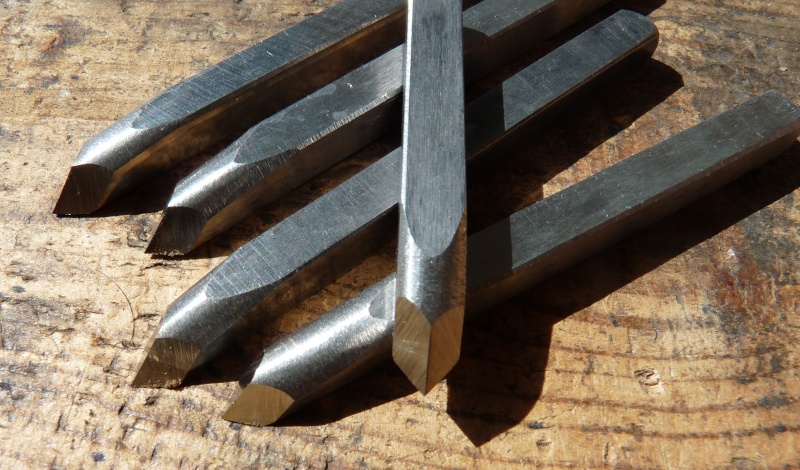
... in thread http://www.bladeforums.com/forums/showthread.php/901928-Hand-stitching-a-riffler-or-rasp-video but understandably didn't want to go into details about what specific steel they use.
Would I be better off just going right for a shock resistant steel or hss? Or, rather, is 1084 so wholly unsuited to this that I should not bother trying a punch from it first? It doesn't seem like it would be a problem but I don't have a good feel for this stuff yet. I've made a few small knives and a number of woodworking tools so far but 1084 is the only steel I've tried.
I've managed to get pretty consistent teeth and get an idea how different angles for grinding the punch and fur holding the punch effect the results when trying it out with a wooden punch on some non hardening clay I have for practicing forging. I'm sure it will differ greatly in steel but the lesson should translate a bit.
I did try grinding a center punch but it filled too much after the first hit and raised a very small tooth. I figured it would be a good start since it is used for something similar, though the conical point on the center punch is a much stronger shape with no edges involved.
This is just for the fun of trying, not out of any expectation I'll end up with a great tool. I know that although it is a relatively simple process in terms of the actual steps it takes a whole lot of skill and practice to get good results.
Thanks, any hints could cut my trial and error down.
Noel Liogier of the Liogier company in France has shared the following photo here on bloodworms. I mean Bladeforums (my phone insists I am trying to type bloodworms. Ack!)
... in thread http://www.bladeforums.com/forums/showthread.php/901928-Hand-stitching-a-riffler-or-rasp-video but understandably didn't want to go into details about what specific steel they use.
Would I be better off just going right for a shock resistant steel or hss? Or, rather, is 1084 so wholly unsuited to this that I should not bother trying a punch from it first? It doesn't seem like it would be a problem but I don't have a good feel for this stuff yet. I've made a few small knives and a number of woodworking tools so far but 1084 is the only steel I've tried.
I've managed to get pretty consistent teeth and get an idea how different angles for grinding the punch and fur holding the punch effect the results when trying it out with a wooden punch on some non hardening clay I have for practicing forging. I'm sure it will differ greatly in steel but the lesson should translate a bit.
I did try grinding a center punch but it filled too much after the first hit and raised a very small tooth. I figured it would be a good start since it is used for something similar, though the conical point on the center punch is a much stronger shape with no edges involved.
This is just for the fun of trying, not out of any expectation I'll end up with a great tool. I know that although it is a relatively simple process in terms of the actual steps it takes a whole lot of skill and practice to get good results.
Thanks, any hints could cut my trial and error down.

