1084

Joined
May 29, 2004
Messages
399
I am working with 1084 for the first time. I have been grinding perpendicular to the length of the blade and yeah, I still have a few scratch marks to remove. Anyhoo, when I hold the blade just right I can see what looks like light scratch marks running parallel to the length of the blade. I have not been grinding in that direction. The marks are very straight and randomly spaced and close together until they get up towards the tip then they start to look almost like damascus made with 2 pieces of the same type of steel. I can live with this (I'll have to, I bought quite a lot of this steel) but my question is, is this a common issue with 1084?
 
Pics would help........No, not usual, but may be isolated.
 
The marks are very faint. I honestly don't think a can pick them up with a camera. I can only see them in the reflection on the blade.
 
They will probably sand out. Where did you get the steel? Do you work with a work table on your grinder? Could the scratches be drag marks from sliding the blade across a work table?
 
I got the steel from a straight up guy (if there is a problem with the batch I will deal with him directly) and the marks definitely not from a work table. I'll try to get a pic tomorrow and post it. I also need to grind a blade from another bar of the 1084 and see if I can repeat these marks. I've made 25or so knives and this is the first time I have seen this.
 
Polish a portion to at least a 1000 grit, clean it thoroughly and give it a quick etch. Light hada in layers of folded homogeneous steel will show lightly with this technique. Truthfully, during the polish it is sometimes visible.

Good luck in figuring it out. Hope it turns out to be surface scratches. But yes, pics really are worth 1000 words.

-Eric
 
Are you 100% sure you removed all the decarb?
 
Let me guess. Good sized stock removal blade with serious distal taper? Possibly artifacts from rolling mill. Segregations in alloying from poor process temp controls? Who knows?

You did not cover your HT details here but be sure to normalize 1084 from 1650F+ in a 2 or 3X stepdown... on the next one. Have been there myself. Good luck.
 
Is the blade pre or post HT? That makes a big difference.

Lots of things can cause what you see. Anything from bad steel ( internal fractures and separations) to partially hardened steel ( from the rolling mill) to bad HT.

Lines parallel to the length of the blade are common on steels from the mill and are called alloy banding and artifacts of the rolling process. If the steel is properly spheroidized after forging or properly cycled to normalize it before HT , the bands should go away. They cause no problem on most knives in any case. Sometimes they end up looking like a hamon.
 
blade.jpg
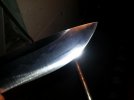
this is a pic of the most visible part. This is post heat treat. I am heating past nonmagnetic and quenching in canola oil then temper at 400 for 2 one hour sessions

I am fairly confident that I removed all decarb, and yes it is a decent size stock removal blade without much distal taper. I am going to try to sand it out today.
 
To me it looks like the band is where good metal shown through and the rest possibly decarb. Use a file, gently scratch the grind, if scratch is deeper outside of the band - bingo decarb.
 
I said "decarb" when I saw the smoky clouds. My guess is the edge was a bit thinner than it should have been at HT, and he hasn't removed enough metal yet.
 
Well, I whaled on it with 220 for about an hour and that seemed to do the trick. I had coated the spine with Sairset, a fire brick mortar, in an attempt to create a hamon. I sanded up to 1000 and etched several times with ferric chloride. I don't know about my overall HT, I think it is decent though I have no means of testing, but I did end up with a nice pattern on the blade. Thanks to all who responded, Steve B
 
I was going under the impression this was a thoroughly cycled finished blade of what was thought to be homogenous 1084 but technically unknown, and lines discovered on polish out. Outside of that circumstance the technique I mentioned above won't tell you much of anything certain. Aside from post-HT; martensite sections in plain steels oxidize darker with a FeCl etch than the non-hardened pearlite portions of the blade. Hence it will start to show a boundary layer if you were shooting for a differential HT.

A quick HT check... A file will skate on a hardened blade. The steel needs to be decarb free to check this way though.

Hope you get it all sorted. Finished pics of the blank at least?

-Eric
 
Back
Top