
-
The BladeForums.com 2024 Traditional Knife is available! Price is $250 ea (shipped within CONUS).
Order here: https://www.bladeforums.com/help/2024-traditional/
You are using an out of date browser. It may not display this or other websites correctly.
You should upgrade or use an alternative browser.
You should upgrade or use an alternative browser.
.
- Thread starter cufnij
- Start date
Could you make up some epoxy resin blocks with stacked dry leaves in them, probably...if the leaves will absorb the resin...but it may not be as strong as micarta. Part of the strength of micarta and similar materials comes from the cloth or other fibers embedded in the cured resin. The fibers add tensile strength, like rebar in concrete, and make what is otherwise just a block of plastic much harder to break.
- Joined
- Jun 13, 2007
- Messages
- 7,743
I was going to suggest the same as Mahoney. You'll end up with a resin block the strength of which will be compromised by the inclusions (the leaves). The fabric, or paper in micarta adds structural strength.
With the right resin you could make what you want, but it certainly won't be micarta.
The stuff I make with cloth and resin is relatively strong, but it's nowhere near as strong as the micarta I've used. It's pretty though.
If you do find suitable materials let us know how it works and looks. Sounds interesting.
With the right resin you could make what you want, but it certainly won't be micarta.
The stuff I make with cloth and resin is relatively strong, but it's nowhere near as strong as the micarta I've used. It's pretty though.
If you do find suitable materials let us know how it works and looks. Sounds interesting.
Last edited:

- Joined
- Apr 12, 2006
- Messages
- 2,506
You could probably make it work, depending on the leaves used and other factors. They do it with cactus: http://www.turntex.com/index.php?option=com_virtuemart&Itemid=120


- Joined
- Jul 19, 2012
- Messages
- 1,774
You might also be able to cheat a bit and use fabric for strength with a layer or two of leaves on the surface for a esthetics.

Stacy E. Apelt - Bladesmith
ilmarinen - MODERATOR
Moderator
Knifemaker / Craftsman / Service Provider
- Joined
- Aug 20, 2004
- Messages
- 38,567
Just remember that the end product will only look like a brown/grey block when you sand it. It will not look like a leaf.
About 10 years back, a fellow decided to make dollar bill Micarta. He took 100 dollar bills and laminated them as a block. Upon grinding all he had was a $100 mottled color handle.
What does work pretty well is to stack birch bark and make birch bark Micarta. The end result looks like a plywood. If you cut the block into 1X1" pieces, and stack those on a stick tang, you get a birch bark Nordic style handle that is very easy to assemble and finish.
About 10 years back, a fellow decided to make dollar bill Micarta. He took 100 dollar bills and laminated them as a block. Upon grinding all he had was a $100 mottled color handle.
What does work pretty well is to stack birch bark and make birch bark Micarta. The end result looks like a plywood. If you cut the block into 1X1" pieces, and stack those on a stick tang, you get a birch bark Nordic style handle that is very easy to assemble and finish.

james terrio
Sharpest Knife in the Light Socket
- Joined
- Apr 15, 2010
- Messages
- 22,618
Just remember that the end product will only look like a brown/grey block when you sand it. It will not look like a leaf.
Agreed. Leaves? I wouldn't even bother.
As the other fellows have said, the fibrous nature of the substrate is mainly where the strength comes from in micarta or G10 (or plywood, for that matter... specifically because plywood is built so each layer's grain runs perpendicular to the ones on either side of it). Laminated cloth and fiberglass have similar or greater strength, partly because they're woven and have fibers going both ways in every layer.... I don't know of any leaf material dry enough to absorb resin that has anything like the fibrous strength we would need in a handle.
If one wanted to encase a single cool-looking leaf in clear resin, and use that for a scale, that's a different story. Back in the day I knew a few cats who wore certain small leaves of a very specific plant
 encased in amber or acrylic as pendants... Durability would depend mainly on how hard/tough the resin gets when cured. The leaf (or bug or whatever) will have very little to do with that.
 About 10 years back, a fellow decided to make dollar bill Micarta. He took 100 dollar bills and laminated them as a block. Upon grinding all he had was a $100 mottled color handle.
Right. As for repeating patterns in a scale of homemade MyCarta... good luck. In order to get that pattern to be consistent through the piece when it's shaped and finished, every layer has to be the same and very tightly registered. This works OK with a stack of business cards or letterhead; not so much with a stack of leaves or even layers of camo cloth or dollar bills. You might get the portait in the middle and the borders to line up pretty well, but the serial numbers are going to become a blur. Not to mention, the printing on the backside is going to look weird between each layer...
I had zero success making birch bark micarta slabs a couple years ago. I've tried both "complete" bark (white papery outer layer intact) and "peeled" bark (white papery layer removed). I was mostly looking to get that gorgeous white and black look on a knife handle.
It was pretty as could be, and would possibly make a nice plaque or clock or something, but it had no strength or integrity at all. (I think) due to the oils in the bark, it never cured up properly and was easily bent, twisted and peeled apart by my
then-11-yr-old daughter. If a little girl can tear it apart, it's definitely not going to hold up on a knife. Basically useless as a scale on a full-tang knife.
However, stacked "peeled" birch-bark on a hidden tang makes a really good-looking, comfortable and durable handle! Being sandwiched snugly between some sort of guard/bolster/ferrule and a pommel with a steel "spine" through the middle of it gives it excellent mechanical integrity. The natural oils keep it soft-to-the-touch (but not mushy) even in cold weather, resist moisture absorption and greatly reduce chances of shrinkage and rotting. I'm told that BB handles last much longer than leather handles made the same way, and while I haven't proven that myself, I lean very strongly towards believing it.
Sorry to be discouraging; I'm just sharing what I've found through wasting a bunch of time and materials on this sort of thing

Last edited:
- Joined
- Jun 27, 2016
- Messages
- 4
I hate to resurrect an old thread on my first go, but it is quite do-able. With a low viscosity, slow cure epoxy I have made marquetry backgrounds & knife handles out of sycamore leaves, curly dock leaves & cigar pre-trimmings.
The tobacco is especially pretty.
Quite sturdy on its own & a bit more so when glued & riveted to a knife tang.
A little girl CAN break it if she has a sledge, but otherwise not.
My next is going to be hibiscus.
I'd give pics, but inserting an image from desktop seems to be beyond me.
The tobacco is especially pretty.
Quite sturdy on its own & a bit more so when glued & riveted to a knife tang.
A little girl CAN break it if she has a sledge, but otherwise not.
My next is going to be hibiscus.
I'd give pics, but inserting an image from desktop seems to be beyond me.
Stacy E. Apelt - Bladesmith
ilmarinen - MODERATOR
Moderator
Knifemaker / Craftsman / Service Provider
- Joined
- Aug 20, 2004
- Messages
- 38,567
Welcome to Shop Talk. Fill out your profile and tell us about yourself.
As a registered user, you have to host the photo in a site like picta or similar and then link it. If you have a paid membership, you can post directly from your computer.
The custom search engine is shown in the stickies. It will find you lots of info on how to post photos. Here it is for you as a link:
https://cse.google.com/cse/home?cx=010075513077263401476:n2uis2odrhq
Post some photos when you can.
The problem with most all resin impregnated handles that contain neat looking things is that it is only as hard and durable as the resin. It will dull and wear rapidly if used. As a paperweight, a block of resin with a scorpion looks neat and stays clear. On a EDC it would be a cloudy piece of plastic in no time at all. Pen turners find this out all too often when they turn a lovely pen in some acrylic block and it dulls from your hands in use.
I will respond to something James said that is a common misconception. Stacking something like business cards will not make a handle that shows the card writing. It will show a white handle with occasional black specs and smears. The print is only on the surface of each card. The bulk of the thickness is white paper. When you laminate it and grind to a rounded shape, almost all you see is the paper.
Using something that the pattern goes all the way through - like camo cloth - works because the pattern goes through the fabric from side to side. Camo works well because even though the final laminate pattern will be mottled a lot more than the original fabric, it still looks like camo.
As a registered user, you have to host the photo in a site like picta or similar and then link it. If you have a paid membership, you can post directly from your computer.
The custom search engine is shown in the stickies. It will find you lots of info on how to post photos. Here it is for you as a link:
https://cse.google.com/cse/home?cx=010075513077263401476:n2uis2odrhq
Post some photos when you can.
The problem with most all resin impregnated handles that contain neat looking things is that it is only as hard and durable as the resin. It will dull and wear rapidly if used. As a paperweight, a block of resin with a scorpion looks neat and stays clear. On a EDC it would be a cloudy piece of plastic in no time at all. Pen turners find this out all too often when they turn a lovely pen in some acrylic block and it dulls from your hands in use.
I will respond to something James said that is a common misconception. Stacking something like business cards will not make a handle that shows the card writing. It will show a white handle with occasional black specs and smears. The print is only on the surface of each card. The bulk of the thickness is white paper. When you laminate it and grind to a rounded shape, almost all you see is the paper.
Using something that the pattern goes all the way through - like camo cloth - works because the pattern goes through the fabric from side to side. Camo works well because even though the final laminate pattern will be mottled a lot more than the original fabric, it still looks like camo.

- Joined
- Oct 3, 2002
- Messages
- 12,297
This thread is Worthless with out photos. Would really like to see some of the tobacco stuff.
james terrio
Sharpest Knife in the Light Socket
- Joined
- Apr 15, 2010
- Messages
- 22,618
The print is only on the surface of each card. The bulk of the thickness is white paper. When you laminate it and grind to a rounded shape, almost all you see is the paper.
Yup, whether or not you can see the pattern or read it depends largely on the thickness of the substrate it's printed on. For instance, doing it with lightweight (no more than 20# bond) paper works sort of OK... assuming everything is perfectly registered and depending on the angle at which it's cut/ground. Heavy cardstock will just look like...cardstock soaked in epoxy.
I learned this by accident when I worked in the printing/converting industry; sometimes you shear a stack a bit off... sometimes it looks kind of cool, mostly it's just a mess.
Short answer... printed material "mycarta" is not worth the trouble except perhaps for a novelty item like a paperweight or scales that aren't ground to much of a contour.

KnuckleDownKnives
Time to make the doughnuts..
- Joined
- Feb 12, 2015
- Messages
- 1,715
Yes please try to post some pictures. I have thousands of acres of tobacco growing near my house.

- Joined
- Jan 1, 2011
- Messages
- 1,798
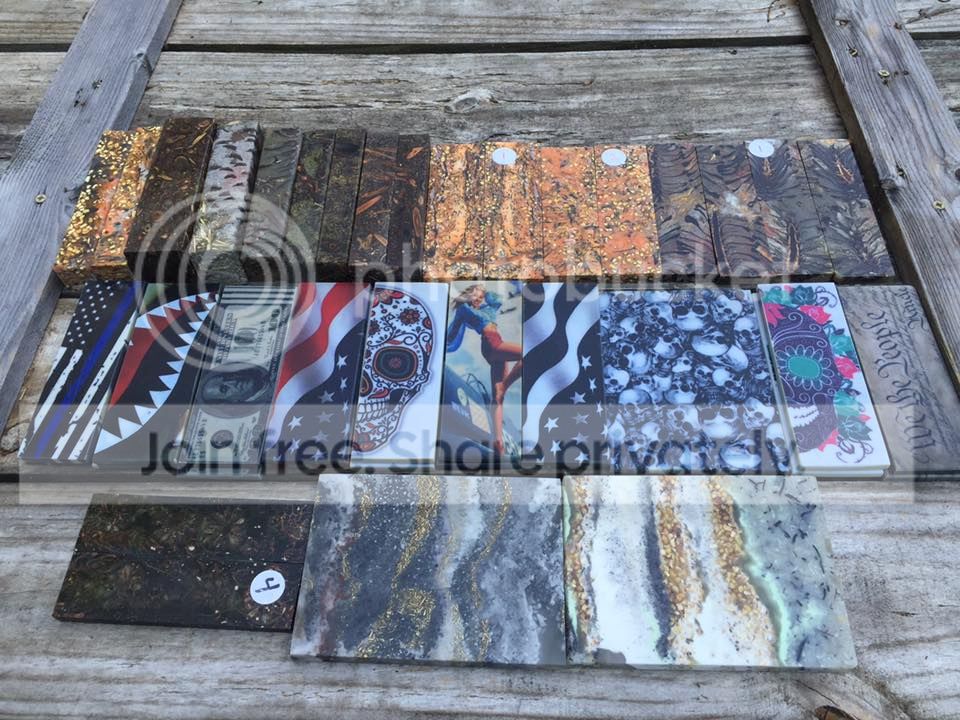
Check out Robert Belchers plant stone and his paper micarta It's cool stuff and keeps the figure through out.

- Joined
- Jun 27, 2016
- Messages
- 4
Did a onedrive link to one of the tobacco handles. the pic doesn't show when you get there you have to click "download".
If I needed to make a living as a photographer I would surley starve.
https://1drv.ms/f/s!AllEvGXHVs2_gQX9xpLvpQ7oOmBr
low viscosity & slow set is really key. It needs time and ability to soak in.
I did 2 batches of blue denim; 1 with polyester & 1 with slow set epoxy. Polyester worked, but did not soak clear through & therefore did not get as hard as it could / should be.
Still made decent handles though. I turned them & drilled out for pin-vises to make gravers.
If I needed to make a living as a photographer I would surley starve.
https://1drv.ms/f/s!AllEvGXHVs2_gQX9xpLvpQ7oOmBr
low viscosity & slow set is really key. It needs time and ability to soak in.
I did 2 batches of blue denim; 1 with polyester & 1 with slow set epoxy. Polyester worked, but did not soak clear through & therefore did not get as hard as it could / should be.
Still made decent handles though. I turned them & drilled out for pin-vises to make gravers.
- Joined
- Oct 3, 2002
- Messages
- 12,297
You are right and same with posting ptotos.Did a onedrive link to one of the tobacco handles. the pic doesn't show when you get there you have to click "download".
If I needed to make a living as a photographer I would surley starve.
https://1drv.ms/f/s!AllEvGXHVs2_gQX9xpLvpQ7oOmBr
Thanks man, from what I see I really like the tobacco stuff.