15lbs W pattern billet SCRAP

Joined
Apr 14, 2006
Messages
3,816
I just spent 3 days putting together a huge billet of W pattern with the intent of feathering it. I made up 2 billets since one would be too big to fit in the forge for the amount I wanted to end up with. I was going along just fine and after the final weld I decided to cut and look at the pattern to ensure of a proper cut for the feather. The first cut looked fishy. It was full of porosity:mad::mad:. It was only in the center of the coupon, the edges were fine. SO I decided to cut half way down the billet, EVEN MORE:grumpy::grumpy:. There is so much porosity it looks like it was burned. The problem is it was only in the middle. I even thought it might have been one of the 2 billets but the pinholes cross all borders. This really sucks as the pattern is great and was exactly what I wanted. Well back to the drawing board monday. Now I have to go fill up the propane again and prep 2 new billets. I will not be using the angle grinder on this billet. I will go back to letting the billets fully cool and surface the sections on the mill. I am at a total loss as to what the heck happened. Oh well, lifes a #### sometimes. Good thing I have until Aug for this order.
 
I've never had or heard of this before. Do you have a picture of the porosity? I have my share of problems with feathers but this hasnt been one of them. Do you flux or dry weld?
 
That really bites!

Oh,well, just cut it down the middle, square up the two pieces, round it, twist it,and either flatten it into a twist billet and get your money back for the steel,or make some utilitarian items from it that won't have a problem with a few pits.

If you aren't going to save them, send them to me (I'll pay shipping) and I'll make something out of them. Hmmm, damascus fireplace tools????
 
Bruce

I was dry welding.... I have never seen this before either. I will try to get some shots. I also have a couple of pieces I left out so I will do some investigating. I did do ONE weld wet on one billet. This seems to have effected both billets I used.
 
I have had cold shuts, delams, and inclusions but I have never seen anything like this. I am wondering if I might have worked it too hard and possibly too cold. If it had burned I would have expected the skin to have pitted. Since this occurred in the center of the billet I am at a loss. I might be able to salvage a little bit of the material like Stacy suggested. I will have to give that a try. I know it has nothing to do with the pattern. I have made a few also and a few hundred other billets/patterns without anything like this happening before. I still need to do another billet since I talked a customer into a feather pattern for his order. I will try to get some shots of the porosity this afternoon. I did find one inclusion line on my second cut. But it looks completely different and is secluded to one of the two billets I used in the whole. I normally just let things like this go and not bug me. But this time I cannot tell what happened so it is driving me nuts.
 
Chuck,
I have seen this before, and I would say you overheated both billets causing grain growth to the point of porosity. I work big billets all the time and sometimes I run the forge a bit hot to keep my cycles short, and on a project last year I had 2 billets do the exact thing you are talking about. You may scoff at first, but I went through every procedure quite extensively, and eliminated everything but overheating.
Thanks,
Del
 
Del makes a good point and was a thought I had also.

Such a huge billet, maybe you gave an extra long soak at welding temp? Too long?
 
Possibly. I normally let them soak for a good 45 minutes on the first heat. The only thing that bugs me is that it was in the center of the billet and not out at the edges. If I had overheated would it not be distributed throughout the billet? I am not disagreeing with the notion just perplexed as to why it was only in the center.
 
Its probably not the first soak that got you it was near the end, when you started to work to right after the heat that did the damage you tore and shifted those large grains, the outside cooled off enough, from your dies or just being outside the heat source, that most of the damage was in the center of the billet. This is speculation, but I think it fits.
Thanks,
Del
 
I think it was towards the end of the process. I did a couple of looks during the assembly and it all looked OK. I am going to find the pieces I cut off and look at them again. I did change the propane bottles towards the end and the heat came up quite a bit. Too much heat makes sense, just the first time I have seen it. Thanks for the input, I was hoping someone had seen this before.
 
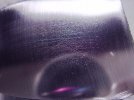
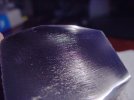
Here are a couple of shots of the end of the billet. After looking at the billet again it appears the most damage was in the direction of the most stress. I think Del had the answer. If it was not grain growth then it was too much work in one direction without restoring the shape of the material. I wonder if it can be salvaged. I may have to give that a try by pressing it all back together at heat. I don't think I will trust it in a blade but the material will make some great belt buckles. That is if things go back together right.

Thanks for all the ideas. I just needed to vent a little.
 

Attachments

  • DSC05736.JPG
    DSC05736.JPG
    64.4 KB · Views: 130
  • DSC05745.JPG
    DSC05745.JPG
    51.2 KB · Views: 130
You can pattent it as FOOTZ. Fethered Wootz.
That way when someone else messes up a billet they will owe you money .
 
That's a new one on me too Chuck...I thought Del was on the right track (I've overheated some stuff as he described myself), but that doesn't look like it to me. The only time I've ever seen porosity like that was with powder in a can that hadn't been vibrated down enough in the initial layup and left voids. Weird indeed...

-d
 
Stacy I like It. I think I will call it FUFOOTZ though (FOULED UP FEATHERED WOOTZ). You can insert you own F. Describes it better.

Deker. I really think these are more stress related. Only pressed in one direction so I could grind off the welds from sealing the stack. If you look at the picture you can see were the billet bulged and that is were most of the damage is. I have done similar damage to higher alloy steel by working it too long on the press. It was throughout the steel though, this center only damage threw me for a loop. Moral of the story is, take a little more time and don't cut into it before the billet is formed to proper dimensions. I am going to see if the damage can be reversed while I am working on a NEW billet.
 
Back
Top