1st experience with AEB-L

Joined
Feb 1, 2009
Messages
421
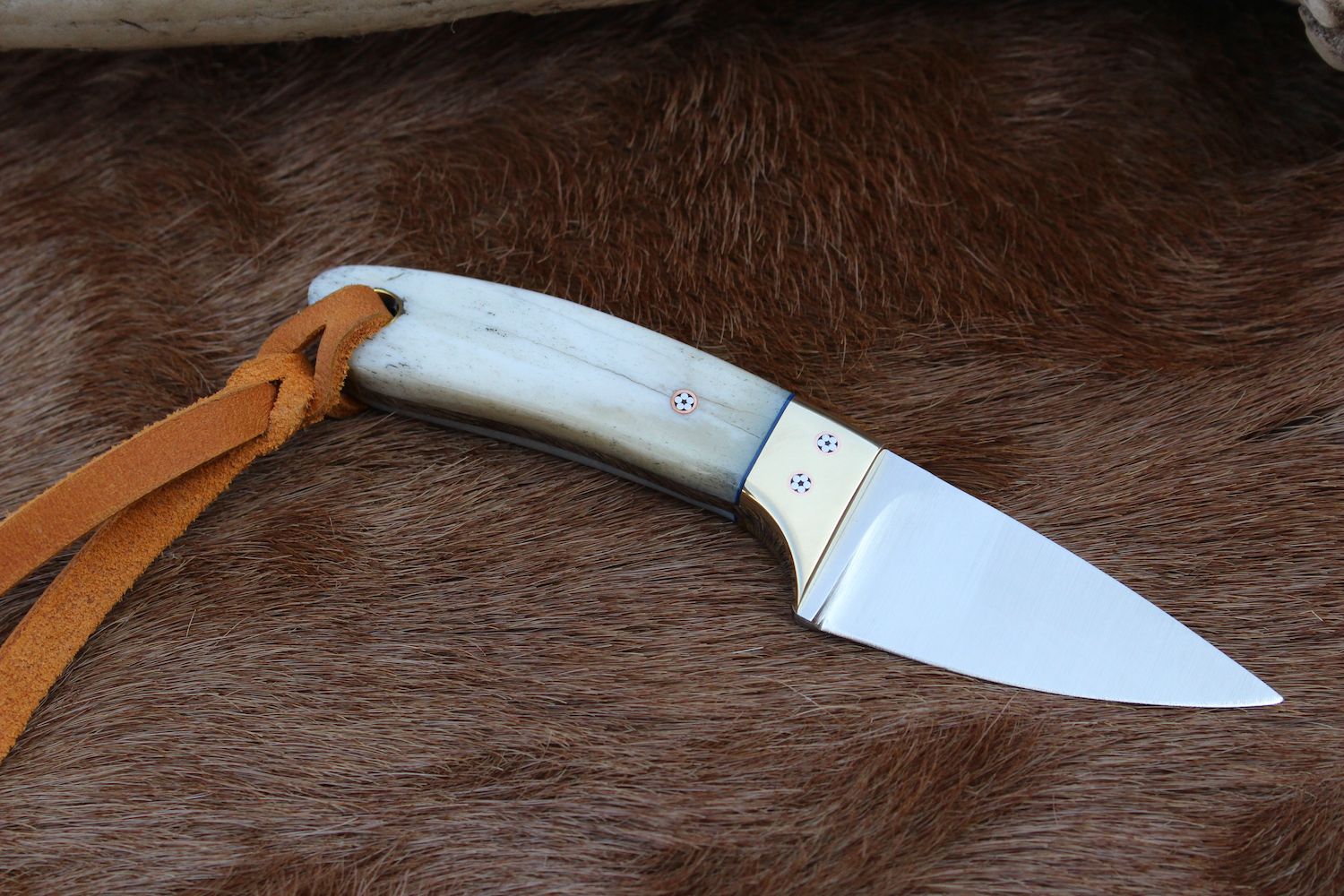
Little bit ago I posted a pic of a knife I made for my wife for Christmas. While the handle was kind of blocky.
http://www.bladeforums.com/forums/s...made-composite-scales?p=15537364#post15537364

I finally got around to sharpening it up. I was amazed at how sharp the AEB-L could get. I imagine it does not have the wear resistance as some of the higher carbon steels, but this truly is "Razor" steel unbelievably sharp!!

Those with more knowledge. For general gutting and skinning deer will it hold up well, or will it need continuing sharpening? It was tempered to 61 RC.
 
I haven't used AEBL in the field personally, but for gutting and skinning deer it will be more than adequate. Now, to be real, some animals hides (especially feral hogs) have all sort of sand and contaminates, and a more wear resistant steel may be preferred in such a situation. But for the most part, you're cutting protein, which doesn't require a super wear resistant steel. Then there is sharpening in the field to consider, and AEBL will touch up extremely easily. Seconds to restore back to a razor edge. For me personally, when it comes to protein cutting, higher rockwell hardness seems to be very helpful, more so than vanadium carbides or what have you.
 
Ive used it on deer,squirrel,rabbit,chicken and all manner of fish from gill's and trout to flatheads..I was happily surprised at how well it held up at 61rc...I was afraid it would chip on bone bit it did not. Though I was careful about hard bone contact.
I carry a small homemade strop in my pack but if I use it enough in the field I just unbuckle my belt, take out a loop or two and strop it on my britches belt..Right back to very sharp with a few strops..
 
W2 at 60+ works incredibly well on dirty, nasty feral hogs. So does Aldo's original 1084FG at those higher hardness levels. So you don't need a "special" steel for that application.
I haven't used AEBL in the field personally, but for gutting and skinning deer it will be more than adequate. Now, to be real, some animals hides (especially feral hogs) have all sort of sand and contaminates, and a more wear resistant steel may be preferred in such a situation. But for the most part, you're cutting protein, which doesn't require a super wear resistant steel. Then there is sharpening in the field to consider, and AEBL will touch up extremely easily. Seconds to restore back to a razor edge. For me personally, when it comes to protein cutting, higher rockwell hardness seems to be very helpful, more so than vanadium carbides or what have you.
 
Everybody needs to stop going on and on about how great AEB-L is! Dagnabbit guys, yer gonna drive up the price...

:p
 
I made two hoof knifes out of AEB-L @ 62 rc for our local vet (left and right hand knives). He's had them since Aug. He was here last week working on one of my horses who had whiteline disease (infection/abcesses in part of the hoof) in his right hind. The Doc put on his farrier apron and grabbed his knives and started in on the hoof. I was amazed at how effortlessly he was slicing through. I asked him about the knives and he said that he'd used them at least once a day since Aug and this time of year more often as he sees a lot of abcesses etc in the winter months. He said he had yet to resharpen them. I asked him if he wanted me to touch them up while he was here and he said nope, don't need it. Now theoretically AEB-L wouldn't be the best for a hoof knife cause not only are you are cutting a hard abrasive substance (heck horses run around on em) but always you are cutting through dirt, mud, frozen mud/snow/grime/nasty as well as the hoof. His specific request when he asked me to make the knives was edge holding ability. Think we got it. So not only is this a report from the field but a report of cutting through the field as well so to speak.
 
Thanks for that, Dave. with what you are saying I will feel much better about trying it for hunting knives for use on animals small and large.
Frank
 
I made two hunters for guys at work. One has done two moose and doesn't need sharpening yet and the other did one elk and one deer and would probably do two more before it needs to be touched up. I heat treat to 62Rc.
 
Some people want it a little thicker then .130. Something like .182. I sure like it and will be making more from it.
I am thinking it is not actually in the bush craft line although could be used for it, so maybe there would be no need for the added thickness. Thoughts?
 
I am thinking it is not actually in the bush craft line although could be used for it, so maybe there would be no need for the added thickness. Thoughts?

Europeans and Scandinavians use alloys similar to AEB-L for bushcraft/survival knives with great success. They are far ahead of us stubborn Americans in that regard.
 
The most common carbon tool steel used by the bushcraft folks still appears to be O1. The Mora stainless knives are mostly made from 12C27, IIRC, which is AEB-L's lower carbon, allegedly slightly tougher cousin. What we have seen recently with AEB-L is people taking it to higher hardness levels than previously used in those appliacations. Several years ago, I don't believe that there was such a thing as a user knife made from AEB-L at 62 Rc. Hell, I think some would have told you that you couldn't' even get 62. But funny things happen when knife makers/mad scientists start fooling around even with old materials. :D
 
I noticed immediately when I got my knives back from HT. The 1084 was easily clean up in a couple of areas with a file the AEB-L which was at 61 and cryoed. Well a file would not even touch it. Skated across all I attempted to do with it.
 
You're welcome Frank. I've been using AEB-L for a few years now for "cowboy knives" with great results. Job tasks are similar in ranching to hunting.
AEBl-L Stainless Gordo with bone handle @62 RC:

qI9t2bO.jpg


And in its Beltless sheath horseback:

ShBdtUP.jpg


Also use it for specialized leather knives. Both round knives and skivver knives at 63RC. They are cuttin' sons of guns.

XuGd6xt.jpg
 
The most common carbon tool steel used by the bushcraft folks still appears to be O1.

By far and away yes..Then probably 1095 and so on. Bushcraft folks like their carbon steels.Nothing wrong with that of course, I like em' too.We have been slowly changing some minds on the common perceptions of a bushcraft knife..That it does not always have to be 3/16" thick with a chubby convex grind..
Most good steels can take much more abuse than many folks realize ground flat and thin..I think more and more people are realizing that..
 
Chubby convex grind? Nah. Go with a chubby scandi grind. We got both kinds....country AND western. :DAs best as I can tell, the complaint omgnst the Bushy crowd is that you can't strike a flint with a SS blade. Seeing that most of them carry 18 different fire starting tools on their body including at least one ferro rod in the sheath, I don't see what the problem is. :p
By far and away yes..Then probably 1095 and so on. Bushcraft folks like their carbon steels.Nothing wrong with that of course, I like em' too.We have been slowly changing some minds on the common perceptions of a bushcraft knife..That it does not always have to be 3/16" thick with a chubby convex grind..
Most good steels can take much more abuse than many folks realize ground flat and thin..I think more and more people are realizing that..
 
By far and away yes..Then probably 1095 and so on. Bushcraft folks like their carbon steels.Nothing wrong with that of course, I like em' too.We have been slowly changing some minds on the common perceptions of a bushcraft knife..That it does not always have to be 3/16" thick with a chubby convex grind..
Most good steels can take much more abuse than many folks realize ground flat and thin..I think more and more people are realizing that..

Agreed. The more serious "bushcrafty" types I meet, the more I notice they generally don't want super-stout "mini axes"... they want light, handy knives that can take a very fine edge and cut really well.

I'm not talking about TV or youtube gurus, I'm talking about folks I've actually sat around a campfire with. They already know various ways to chop and split large pieces of wood, and many of them happily carry a hatchet or big knife for those tasks. What really makes their eyes sparkle is a comfortable knife they can make fine feather-sticks with, or carve a spoon, or clean a fish or small game animal.

People who actually spend time in the boonies are not nearly as concerned about "striking a spark from flint" as youtube or TV might suggest... as mentioned above, they know several ways to start a fire and they do not seem to mind scraping sparks off a ferro-rod with whatever's handy. (I have yet to meet one of them who didn't already own a ferro-rod of some sort... those who carry bits of flint are much fewer and farther between)

I really think the old "carbon vs. stainless" battle is on the way out.

That's great news for a knifemaker, because small, keen, handy knives like that are an awful lot of fun to make. :)
 
I think the chubby convex is a leftover from the days of crap heat treat and Rc55-57 blades. Proper steel condition, heat treat, and geometry open a world of sharp options for people.
 
Back
Top