2 HT questions: do I need to crimp my foil better, and how often do you test hardness?

Joined
Sep 29, 2012
Messages
56
After years of either buying pre-HT blades or sending knives off for HT, I finally dropped the money on an evenheat Lb 22.5!
I ran my first HT cycle on some cutoffs and they are currently tempering. Right after cold treatment I ran a file over the coupon and it definitely skated, but it also looked kind of crusty and maybe unevenly heated?

Q1) Is this scaling preventable by a better crimped foil packet (I did a pretty lousy job) or normal scaling?
Q2) How often do you test hardness, each knife, each batch, or just every once in a while? My guess is after I've been doing this a while and get a string of good results I won't worry about it.

Appreciate the feedback.

3b2326d6e02f6c37bda67703845583c11fc10a3f00b746e432e7d15401d12f74.jpg
 
I always double crimp my foil. Did you also add a little piece of paper or something similar to burn up all the oxygen in the package?
 
There should be no "scale" if you sealed it well. Usually the knife will have oxidation colors.

Personally, I have always triple folded SS packets. And I would say about 80% of the time the seal is so good the foil welds onto the blade. The knife comes out without any oxidation colors whatsoever.

I like to get the blade into the "cryo" bath ASAP, so if I see that the SS foil welded to the blade, I just put the blade into the cryo with the jacket still on, removing it afterwards.
 
I use a sheetmetal bending tool(trick from JVknives) and double crimp then run the flat face of a hammer over the seams. I sprinkle a little talc (real talc) not the cornstarch baby powder in the packets. You might get some cool looking colors on the blades but there should be no black or scale on them.
 
The foil question was answered sufficiently above.

When I started heat treating I poked every blade at least 3 times. Now after hundreds of knives I do at least one blade from every bar. This is after straightening and refining the surface finish to at least 220 grit. I mostly work with air hardening steels. For oil quenching steels I test every blade.

The reason I test at least one blade from every bar is because I’ve had mislabeled bars and that’s how I’ve caught it. If I get a result that’s unexpected then I proceed to test the same blade more times and test additional blades.

Also I’ll do more in depth testing when trying new protocols.
 
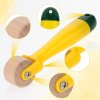
I use a wooden roller to help seal the folds and tap them down with a hammer after rolling. The sheet metal folding tool makes the folds much easier to press/crimp down, too.

I run Magnacut at 2150 and haven't had any issues with the 309 foil welding to the blades. I used to use baby powder, but it made the pouches puff up a lot, so I skip the powder completely, but I do have a jar of 100% talc if I want to powder the blades in the future.
 
The one little nuance i can add, if you cut off too little of SS foil, you tend to ''squeeze'' the steel in because of how little space in SS foil you have left, esspecially if you double fold (which is necesary as mentioned above). So because of this you can actually damage the foil if you roughly try to fit the steel in, has happened to me when i first started HT some coupons, i was confused because i did not see any damage, however there was a small hole hiding from me, and that's all it takes. So to cut it short, check for damage!!!
 
The foil question was answered sufficiently above.

When I started heat treating I poked every blade at least 3 times. Now after hundreds of knives I do at least one blade from every bar. This is after straightening and refining the surface finish to at least 220 grit. I mostly work with air hardening steels. For oil quenching steels I test every blade.

The reason I test at least one blade from every bar is because I’ve had mislabeled bars and that’s how I’ve caught it. If I get a result that’s unexpected then I proceed to test the same blade more times and test additional blades.

Also I’ll do more in depth testing when trying new protocols.

This. I used to send out blades. Then I got an oven recently and a hardness tester at the same time. I worked with a simple bar of 1084. I followed all the recommended temps and quenched in the recommended oil and used recommended temper. Cleaned off scale and It tested at 55! So did a coupon I added in with it. I was aiming for 6”-61. I did another piece and this time checked it immediately after quench. This time it was 61. Im not sure whats going on but all I know is that ill be testing between every step from now on. I also want to mention that I tested a previous batch I had sent out just to confirm if the machine is reading correctly and those were spot on at 59.
I dont regret buying a hardness tester one bit and I will use it to test often. And in different locations.
 
Just to make sure you know the proper procedure:
The rules -
Wear leather gloves - HT foil is thin stainless steel and will cut like a razor ... especially after HT.
Use a pair of scissors your wife does not want - HT foil is hard ... buy cheap scissors at HF and when dulled toss them. Wear gloves when cutting foil.
Work on a firm smooth work surface - a slab of granite from a sink cut out is perfect, but a board works. A rough workbench or other surface may have bits of metal and stuff on it that may cause tiny punctures.
Use a hard rubber, plastic, or wooden mallet - The fold needs to be crimped tight, but a metal hammer and too much pounding can make tiny holes.
Don't try to be a tightwad on using HT foil - cut off enough for easy folding. HT foil is not cheap, but a minor cost of making a good blade. Scrimp and the blade may be ruined.
Use the right foil... 321 (309 is not for most stainless HT temps). Buying a full roll is costly, but cheaper by the foot in the long run.
Folding the side two times and then the ends can make the corner split. Folding - side, end, side, end - lessens the stress on the corner.


The process-

1) Cut a sheet of HT foil that is at least 2.2 times the width plus 5" , and 1.2 times the length plus 5". On a 10"X2" blade that would be about 10" wide by 18" long.
2) Fold in half lengthwise, crease with your glove, and place blade in the fold.
3) Fold the side in so the edges are now is about 0.5" from the blade. Smooth the packet flat to the blade and tap the fold down firmly.
4) Fold the ends in to about 0.5" from the blade and tap firmly
5) Fold the side in about 0.5" and tap tight
6) Fold the ends in about 0.5" and tap tight.

7) Go around the seams again to assure all they are down snug.

Additional advice:
1) You will read about putting in pieces of paper to use up the oxygen. It is not necessary IMHO. I find it makes more problems than it solves.
2) If plate quenching, don't take the blade from the packet. Instead, put the whole packet in te quench plates.
3) When cutting the packet open, WEAR GLOVES ... the HTed foil is hardened steel that is thinner than a razor blade.
4) Don't try to reuse a foil packet. It is too brittle to fold again.
5) The foil will sometimes weld itself to the blade, especially with strong quench plate clamping. If it does not peel off easily, it will grind away quickly in the final grinding steps. Some folks dust the blade with talc if this is a regular issue with their HT protocols. The simples way to avoid this is to wait about 60 seconds or so before placing the packet in the quench plates. This gives the foil enough time to cool a bit before being pressed hard onto the 2000°F blade. There is no rush to get the packet into the plates, as the steels we put in HT foil are air-quench types and don't need a fast cooling rate.
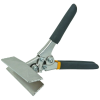
6) A set of sheet-metal bending pliers is useful, (but not a necessity). They cost between $10 and $20. HF and most places like that have them. You can make a pair long enough for knife packets by welding two pieces of 1/8"steel to a pair of cheap vice grips. See image below.


1772451919859.png
 
I use similar pliers as Stacy, but a slightly different brand/look, but they perform the same. They make folding and working with the foil much easier!

Wooden seam roller to push down the seams.
71zGx0FT7XL._AC_SL1500_.jpg


But the 321 is the 2000 degree temp foil and 309 is the 2240 degree temp foil IIRC?
 
all aeb-l blanks straight out of the foil


always double fold the seams the goal is to create an airtight packet

I just use the edge of the table/worksurface to start the fold then once it’s fully over i’ll use a hammer to finish the seam by running it along the fold kinda like ironing clothes
 
That worked, I tried another piece with a better crimp and some hammering to seal it up and there was some discoloration but very little.


Wow, really appreciate all the thoughtful responses. My most recent aeb-l coupon looked like Hella Breads and was very hard. I have a set of those basic hardness testing files coming in soon. Better than nothing.
 
Where are you located Direstrats220? Check out Fb marketplace; I was able to find a used wilson hardness tester for dirt cheap on there! Matt Parkinson also makes some hardness chisel files in 2 HRC increments that will be more accurate than the files, but only a bit more expensive than the files.

I usually test every blade I make for HRC; you never know when something may be off! I had one of my wires in my oven disconnect, so I pulled and quenched blades as fast as I could, but some were at 60 HRC instead of the 62-63 I was aiming for after tempering.
 
Where are you located Direstrats220? Check out Fb marketplace; I was able to find a used wilson hardness tester for dirt cheap on there! Matt Parkinson also makes some hardness chisel files in 2 HRC increments that will be more accurate than the files, but only a bit more expensive than the files.

I usually test every blade I make for HRC; you never know when something may be off! I had one of my wires in my oven disconnect, so I pulled and quenched blades as fast as I could, but some were at 60 HRC instead of the 62-63 I was aiming for after tempering.
I'm in east TN
 
Ok, I burnt the tip because I crimped the packet too tight around the closure (yep you guys warned me and I did it anyway, what can I say, I'm a rebel), but does that discoloration indicate something as well, or is that just surface scale?

16c434173d7b442db2c89800ed87292f7c1de5957bb93c3b65a853b49c25caba.jpg
 
Ok, I burnt the tip because I crimped the packet too tight around the closure (yep you guys warned me and I did it anyway, what can I say, I'm a rebel), but does that discoloration indicate something as well, or is that just surface scale?

16c434173d7b442db2c89800ed87292f7c1de5957bb93c3b65a853b49c25caba.jpg
it’s just a layer of scale and decarb
 
Back
Top