
3 part wood question

Joined
Nov 25, 2015
Messages
66
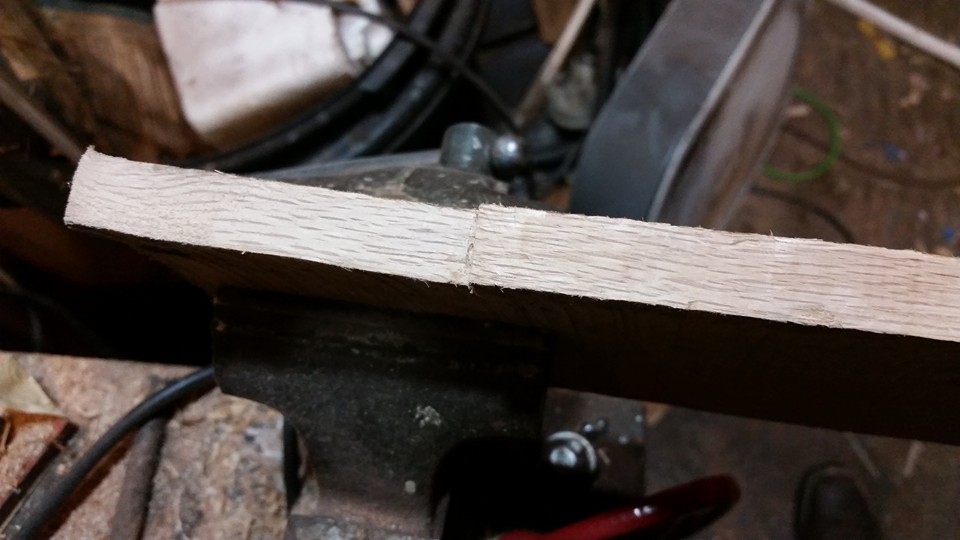
1) I started putting an interior wall up in my shop/shed yesterday, using pallet boards, when I noticed this board:
Jts811V.jpg


I wish I knew more about different woods. I could not figure out what it is with Google, but I figure one of y'all will know in a heartbeat.
I have another board of it that is flat, and I like the look of it. I'm guessing it needs stabilization first though.

2) Could it be suitable for scales, or is there reason pallet wood shouldn't be used?

3) If I were to glue up different woods for the same handle, would wood glue be suitable for the wood/wood bonds, or should I still use epoxy?

Thanks in advance guys.
 
It's probably rubberwood. There is no reason it Couldn't be used on a handle "we use oak, walnut and maple all the time" but it's not very strong, it's not very stable and it pulls up a lot of fluids. Not the best choice over all.

There is nothing that makes pallet wood unusable, but the qualities knife makers want "very attractive, high stengtg, high weight and capable of taking a high polish" are all factors that make wood expensive, and you don't often find expensive woods used asome pallet woods
 
i am going to guess oak ? i judge wood by trying to sink my fingernail into the wood, usually you can actually feel it sink in,and sometimes will leave a mark. (try it on a 2x4.) if it doesnt sink in its hard enough to be a good scale, and doesnt need stabilizing in my opinion. i would use epoxy for the wood to wood joints. most wood glues are water soluble. just my 2 cents.
 
Call me crazy but it looks a bit like Oak. As far as I know, Oak is commonly used for pallet materials. If we could see the other side of the piece we could get a better idea of what it is. Assuming it is oak, yes, it would be great for handles. I don't know if you should stabilize it though. I know you have to stabilize oak burls, but I'm not sure about "plain old" oak. Someone else will weigh in on that I'd be willing to bet.

As for the gluing pieces together, Yes you can use regular wood glue. Just make sure your joints are rough and clean. Stacy recently enlightened me on this very topic; Titebond ll works very well for these sort of bonds and there is also a wood glue by Titebond that is a darker color for gluing up darker woods.
 
Last edited:
for sure that's red oak-it looks white. white oak looks tan/brownish before finishing. try indenting the edge with your fingernail, that should tell you if it's a hardwood or (k)not. if you have real lumber-yard around(scarce beasties-somewhat like a unicorn) take it there, and they should be able to tell you. as mentioned above a picture of the face of the board would be helpful. thanks, Neal
 
Oak is common for pallets, and the board does have the open pores common to oak.

As already noted, oak, maple, and walnut are commonly used hardwoods in North America. The pores in oak can be filled, or if you get some ebony dye from Lee valley, it can resemble bog oak. It's just very common, and somewhat plain, so you won't see it on high end knives.
 
Sorry guys, i wrote this in the middle of the night studying for midterms! Yes, now that i really look at it it would probably be oak. But my little thing about pallet woods stands. The kinds of woods you use for pallets are not the kind of woods you use on knives. Would it work? Yes. Would it be the best? Certainly not.
 
Sorry guys, i wrote this in the middle of the night studying for midterms! Yes, now that i really look at it it would probably be oak. But my little thing about pallet woods stands. The kinds of woods you use for pallets are not the kind of woods you use on knives. Would it work? Yes. Would it be the best? Certainly not.

That reminds me... I should probably be studying for history and doing my English homework :eek: What's that saying? Knives before homework? That must be it :D
 
Red Oak makes sense, and looking at google, that looks about right. Feel kinda goofy snice that's such a common wood, but oh well. Thanks for the info guys.

I like the look the pores give it, are there any denser woods with a similar feature, that yall would suggest I look into?

And though oak isn't preferred for handles, theoretically, would stabilizing it make it as good as any other material? Not that I'm going to, just curious. For instance would stabilized balsa even be strong enough to use?

Sorry if this reads weird, I'm stuck on my phone...
 
No one said oak wasent the useable. A maker in Europe on the forums made a beautiful knife with pore filled oak. And homestly, I wouldn't stabilize it. Not worthat the cost
 
Red Oak makes sense, and looking at google, that looks about right. Feel kinda goofy snice that's such a common wood, but oh well. Thanks for the info guys.

I like the look the pores give it, are there any denser woods with a similar feature, that yall would suggest I look into?

And though oak isn't preferred for handles, theoretically, would stabilizing it make it as good as any other material? Not that I'm going to, just curious. For instance would stabilized balsa even be strong enough to use?

Sorry if this reads weird, I'm stuck on my phone...

Sycamore, ash, and white oak all have similar looks. Hawaiian silky oak has some nice effects in it, especially if you get some spalting or burl pieces. Padauk and mahogany can gave open pores, and gave very rich color. Even purple heart has pretty open pores. Lots of options.

For the amount of work it is to make a knife, go to the local wood store (in my area it's Windsor a Plywood) and get some Padauk. I've never seen anyone say they didn't like it. It's not very expensive, doesn't need stabilizing, finishes well, and is very durable. For $20 or $30 you will get a ought to do at least 6 knives.
 
I'll definitely see if any locals have Padauk. As it turns out I had a shipment of tamarind/marblewood/bocote waiting for me when I got home.

of course the bocote is warped...
 
Nick, I manage a large saw department at a pallet company in NC. Having only a picture to judge from is tough, but it is almost certain to be Oak. Oak is very common in pallets. Finding handsome knife wood in used pallets is pretty tough. But finding highly figured pieces of curly maple or walnut in a pallet company is pretty easy. Just about every knife Ive made has had scales from lumber Ive pulled off one of the lines at work. I often run across old stock thats been sitting in the weather to long and has become spalted. These are some of my favorite due to the black lines and color seperation. We have a pretty large step down transformer that stays at a constant 130 degrees, 24 hours a day. When I run across a piece I want to use, I simply lay it on the transformer for a month or so to dry out. This gets it down to about 10 % mosture content. Then an hour or so in the toaster oven and they are ready to stabilize. Im sure this was more info than you were looking for, just wanted to share.
 
if you get a chance, check out wenge- super dense, probably wouldn't need stabilizing(don't know for sure on that tho'),and it has beautiful grain on edge, while the flats look (to me) like stained ash. oh yeah, it's brown/black in color,except for the edges where it almost looks like there is white mixed in to the layers of grain. thanks, Neal
 
if you get a chance, check out wenge- super dense, probably wouldn't need stabilizing(don't know for sure on that tho'),and it has beautiful grain on edge, while the flats look (to me) like stained ash. oh yeah, it's brown/black in color,except for the edges where it almost looks like there is white mixed in to the layers of grain. thanks, Neal

I've used Wenge as a substitute for bog oak when bog oak wasn't available. It's a great wood too.
 
Back
Top