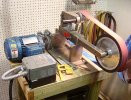
3-phase help question

Burchtree

KnifeMaker & Moderator
Moderator
Joined
Mar 15, 2002
Messages
5,368
What is the best way to test a 3-phase motor? I've got one hooked up to a motortronics VFD controller but keep getting an error when I hit "run" on the controls. The troubleshooting says it could be: 1. motor is shorted, 2. motor is grounded, or 3. transistor module is damaged.

Anyway to check this stuff without having to take it into a shop? Thanks.

(thanks John for all the help too with the wiring. :D)
 
Michael,

Check each input phase to ground or motor case with an Ohmeter as to reveal shorted or open windings. Or try another motor.

Good luck
 
Hmm .. . any tips on how one does that? :o I'm pretty retarded when it comes to electric motors. Thanks -- :D
 
Get your hands on a meter and set it to measure resistance in Ohms.
Disconnect the motor completely.

Touch one meter lead to the input winding wire and one to ground. There should be some deflection of the needle on the meter to read a resistance value. This value should be very near the same for each input wire. If there is a big disparity, bad motor.
 
might be a dumb question...but have to ask anyway....

is the motor grounded? as well as the controller?
 
Thanks --

Daniel -- the motor is grounded to the controller, the controller is grounded through the plug.
 
A very rough guide without a meter is the smoke test. Smell the motor and the controller see if you can smell burning varnish. Motor faults are normally
assosicated with burning insulation .
Again a dumb thing to say but have you checked all the 3 fuses are intact.

Make sure all the power is off and check all the connections are tight.

I was an electrician in a past life but not much else I can say without being
on your side of the world.
 
I'll probably recheck all the connections tonight. One thing I don't understand about the error it tossed is "motor is grounded" is one of the problems associated with the code in troubleshooting. The solution is "remove grounding point." What does this possibly mean?
 
Micheal

The fault may be in your VFD, your motor or in both.

1) Disconnect all wires connecting your motor to your VFD.

2) Disconnect the power to the VFD. Have a good look at the VFD to see if there are any black, burn marks, soot or any loose plastic or metal fragments laying around on the heatsink. Have a sniff and see if there is a burnt smell. Both of these are indications of possible transistor module damage. You will have to get professional help to repair the VFD if you find this. If it is helpful, I can attach a picture of this when I get home this evening.

3) Check the operation of your VFD using a meter set to measure AC volts. Start the VFD. Connect the meter leads to two of the outputs of the VFD at a time. They are usually labelled something like L1, L2, L3. You should measure 220V or 240V across combination of outputs if the VFD is working properly. If you have a slow/long ramp up time, you may have to give it a bit of time to stabilize. All three measurements should be within a few volts of each other. If they are not, the VFD is likely damaged.

4) Check your motor using a meter set to measure resistance (Ohms). Connect the meter leads to each other. You should measure a value that is a fraction of an Ohm (less than 1 Ohm). Connect the meter leads between pairs of the input wires. You should measure some low value but higher than with just the meter leads. All three combinations should be similar for a good motor.

5) Connect one meter lead to the Ground wire from the motor. Connect the other meter lead to each of the three motor inputs in turn. If the motor is one that can be wired for 240 and can be rewired for 480, you should get some very high value in the MegOhms (or Overload if the meter is digital). Otherwise, you may get three high values or three low values depending on how the windings are configured (delta or star).

6) Reconnect the motor to the VFD. Try to run the motor. Set the meter to measure AC voltage and monitor the voltage across pairs of outputs. You should get values similar to those obtained in step 3. If not, shut it off and seek more help.


It appears that the manual for your VFD has a trouble-shooting section that helps you interpret the fault codes and it is indicating a possibility that the "motor is grounded". In a normal four-wire three-phase system, the three wires will have roughly equal voltages with respect to the Ground wire. In some rare instances, a three-wire system is used where one of the three wires is connected to the ground potential and is used as the system ground. Most VFD's are designed to work in a four-wire system. Connecting them to a three-wire system will short out one of the three outputs, possibly leading to damage of the transistor modules, or worse. Make sure that only the ground wire of the motor is connected to Ground. None of the other three motor leads should be connected to ground regardless of how the windings are configured. Look at the actual wiring. Depending on the configuration of your motor, the resistances may be very low, maiking it difficult to check this with a meter (see step 5).

Let us know how it goes and if you need more help. Good luck!

Phil
 
Testing three phase motors is something I've been doing for the past 30 + years, so...........

Assuming a 208-240 volt motor your wiring should be T1 & T7 tie together, T2 & T8 tie together, T3 and T9 tie together....these are your input leads L1, L2, L3. Motor leads 4,5, & 6 are tied together and insulated. Once running, to reverse direction of rotation simply swap any two sets of 't' leads at the L1, L2, L3 (sometimes shown as U, V,W) of the VFD.

Now to your problem.....

Get an ohm meter. Set it to the R x 1 scale (the lowest scale). After adjusting the zero, read between motor leads T1/T7 and T2/T8, then between T2/T8 and T3/T9, then between T3/T9 and T1/T7. The readings should be VERY close to the same and (idealy)less than 5 ohms (assuming less than ~5 horse power), or nearly full scale deflection. It is VERY rare for a small HP motor to read below one ohm. The most important thing here is that they are nearly identicle. Sometimes on small HP motors this reading will be some what higher, perhaps as much as 10-15 ohms(though I would be suspicious of the motor at this reading) but it must be even. This test the windings themselves (not to ground).
The problem here is that this is not completely trustworthy.....since you are dealing with a very low (almost zero ohms) resistance a shorted winding can also give the same reading. What this will certainly determine is the presence of an open winding.
Next, set your ohm meter to it's highest 'R' scale, set the zero again, and check each motor lead (one at a time) to ground. Here you should see a VERY high resistance, near infinity (no meter deflection). Now for the kicker.........
I've seen many instances where an ordinary ohm meter would show a motor as being good when it was not, because the meter only tests at very low voltage---usually 9 vdc or less. A higher voltage tester known as a megger will give a much more reliable test for grounding, ususally testing at 500- 1000vdc.
Better yet, there should be a motor shop somewhere fairly close to you. They almost certainly will test your motor free of charge. This would be the most certain way for you to know if the motor is at fault.

Hope this helps.

Mike
 
I just hooked up another 3ph motor to a band saw yesterday.
one point you haven't been asked is
do you have all the wiring that mike just mentioned? or just 3 at the motor.

if you have the one Mike as talking about with Motor leads 4,5, & 6
do not use these as a ground just tie them together and use a wire nut and tape it up tied together and insulated from ground, these complete the circuit I believe. the ground should be right to the case of the motor Green lead, remember also no grounding of the 3 input leads, supply wire,, white, black, and red.

now if you have an old motor you'll have just 3 wires on the motor
an easy one to hook up, 3 lives in L1 L2 L3 , green ground to motor case.

the one Mike is talking about as with the one I hooked up yesterday
is made to wire is a high (460) voltage or low voltage( 208-230) motor that why all the wiring..

Mike am I close to the way it is?
you said ( 208-240) mine says ( 208-230) for the low..I know that is not a biggie.. :)

BTW mine is working great, I have two of the older motors working and this new type now.
 
Dan Gray said:
BTW mine is working great, I have two of the older motors working and this new type now.

Oh sure, rub it in. :D :D

Thanks for all the help fellows -- it still isn't running, but I checked all the leads, connections, etc. It is hooked up right and getting all the juice it needs, but not sure about the motor. I looked at my crappy Radio Shack digital voltmeter and it had about 5 settings for ohms. I sat it down and took the wife out to dinner instead.

The fellow I bought the VFD from has contacted and has offered to walk me through it. I'll give that a try and if that doesn't work, I'll take the motor in to get checked on.

Thanks again -- :thumbup:
 
Mike

Are any of the 230/240V motors made with their windings connected in the star configuration? If so, is the ground connected to the star point or is it only connected to the motor chassis? The motors that I have used in the past to test VFD's have all been set up for 480V. Here at Toshiba, they are mostly designing much larger motors (50hp to 1000hp) for 480V and higher and importing the small stuff from China.

Phil
 
Michael,quick question,you say the motor is 3 phase and the controller is it a 3 phase also ??? will that run a 220......I boughta 3 phase motor and a 3 phase controller and I need a Rotoary phase converter to run it?????on a 220
 
Nathan,

Many (but not all) VFD's will run just fine on either 3 phase or single phase and still give three phase output. Some that do will require a de-rating factor of upto 50%. For example, it would take a 10 hp VFD to run a 5 hp motor. Some of the lower hp VFD's are strictly single phase input/3 phase out put.

Phil,
NEVER hook a ground wire to the motor leads on any three phase motor. This would not be good! Always ground the chasis only.

Dan,
You bring up a point that dawned on me today at work. I'm so used to dual voltage motors that I did not consider the possibility of a single voltage motor when describing the motor terminations. You are absolutly right, not all three phase motors are designed for dual voltage capabilities.
Also, 230 or 240 volts is all the same in this application--some motors will show a low voltage of 240, most show 230, all within the design tollerance of the motor.

Mike
 
I want to second testing the VFD, as I have found them to be less robust than the motors. Make sure that you are getting full rated output voltage between legs, check all three possible combinations. If you just measure from ground to each leg you may be mislead into believing that it is ok (you would read approx 120 vac in this scenario), but when you measured leg to leg only 1-15 volts. Sometimes the electronics get fried and the phases are no longer 120 degrees out. In this case its back to the manufacturer or into the garbage bin with the VFD. I am tired and this may not make sense when you read it.

PS~ Nathan, refer to micad's response. VFD up to maybe 1.5 horse are sometimes 120 vac, single phase input. Higher output are 208-250 vac, single phase input (two hots), or three phase 208-480vac input The devil is in the details, double and triple check your manuals. When in doubt get a good electrician that understands such things. I say good because I have had to correct wiring done to our production equipment by outside electricians. :(
 
Mike good thread this has come up more than once so
I'm adding it to the knife making page
under Technical, motor questions, BFC

http://www.knivesby.com/knifemaking.html
:)

anymore defined answers pertaining to this subject would be good.

I'm going to start another thread on making a 3 phase rotary converter
this may interest some of the guy that have motors but no money for converters
if you have motors you have all you need to make a converter now :D
 
Mike

You are right. I finally caught up with the Motor R&D Manager here at work. He told me that the star-point in the motor is internal only so that one cannot connect to it.

Connecting any of the three output phases of the VFD to ground is definitely a bad idea. I have a picture showing the result and it isn't pretty.

Phil
 
alrighty -- after taking everything apart again and re-connecting things, it is running. The motor is mouse-quiet and it works like a champ. Thanks everyone for the assistance. :)
 

Attachments

  • VFDsetup.jpg
    VFDsetup.jpg
    58.6 KB · Views: 46
I have a motor that I recently got that is not working. Do these resistance readings look normal?

leads 7,8,9 all have 5 ohms resistance between them.
leads 1 and 4 have 2.8 ohms resistance between them.
leads 3 and 6 have 2.4 ohms resistance between them.
leads 2 and 5 have 2.4 ohms resistance between them.

I am reluctant to connect this directly and bypass the contactor switch without knowing this are ball park figures.

The contactor is a mechanical switch with on and off push buttons and I don't seem to be getting connections through the switch. Is there also a method of taking those switches apart for cleaning? Thanks.
 
Back
Top