
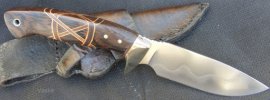
Pics of my first knife handle are attached. This is the 3rd and last blade from my first batch of 4. The first two had antler handles (1 shown on previous post) and the 4th blade was warped and won't straighten. This last blade is the only knife I have made that has not gone to someone else on completion. I am keeping this one as a souvenir from my first batch.
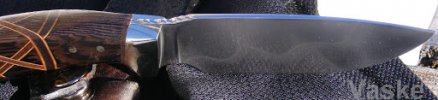
1095 blade with hamon
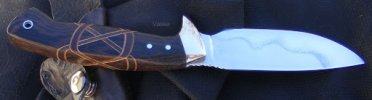
Rope filework on thumb depression
4 1/8" blade length, 3 3/4" cutting edge and 9 1/2 overall length
Wenge handle with walnut and maple inlays in a celtic knot pattern
Nickel Silver bolsters, pins and tube
Was getting ready to make some kitchen knives on my next run but have requests from buddies of my first 2 knives to make 3 more of these. Hoping to talk one of them into a clip point and will probably reduce the width of the blade on the next run. Also may try to go bosterless on at least one to simplify assembly.
Anyone who is interested in doing the celtic knot can google it under "woodturners celtic knot". There are several methods, I used the one that leaves a sliver of wood in the blank after each cut. This requires a table saw but makes lining things up during clamping and gluing a lot eaier. The required miter jig is simple to make, especially for someone who is already making knives. I used a scap piece of angle iron for my jig.
Interested to hear from the hunters out there who use skinning and hunting knives.
For a general pusose hunting knife - Do you prefer a thiner or thicker blade width?
Critique to help improve the design & build for my next round is welcome.
Thanks for looking.
Barry
1095 blade with hamon
Rope filework on thumb depression
4 1/8" blade length, 3 3/4" cutting edge and 9 1/2 overall length
Wenge handle with walnut and maple inlays in a celtic knot pattern
Nickel Silver bolsters, pins and tube
Was getting ready to make some kitchen knives on my next run but have requests from buddies of my first 2 knives to make 3 more of these. Hoping to talk one of them into a clip point and will probably reduce the width of the blade on the next run. Also may try to go bosterless on at least one to simplify assembly.
Anyone who is interested in doing the celtic knot can google it under "woodturners celtic knot". There are several methods, I used the one that leaves a sliver of wood in the blank after each cut. This requires a table saw but makes lining things up during clamping and gluing a lot eaier. The required miter jig is simple to make, especially for someone who is already making knives. I used a scap piece of angle iron for my jig.
Interested to hear from the hunters out there who use skinning and hunting knives.
For a general pusose hunting knife - Do you prefer a thiner or thicker blade width?
Critique to help improve the design & build for my next round is welcome.
Thanks for looking.
Barry

 Thanks Fred. Always thought thinner was better. To me, a thinner blade looks better visually, also keeps the weight down to help with ergonomics. Thanks for the design advice.
