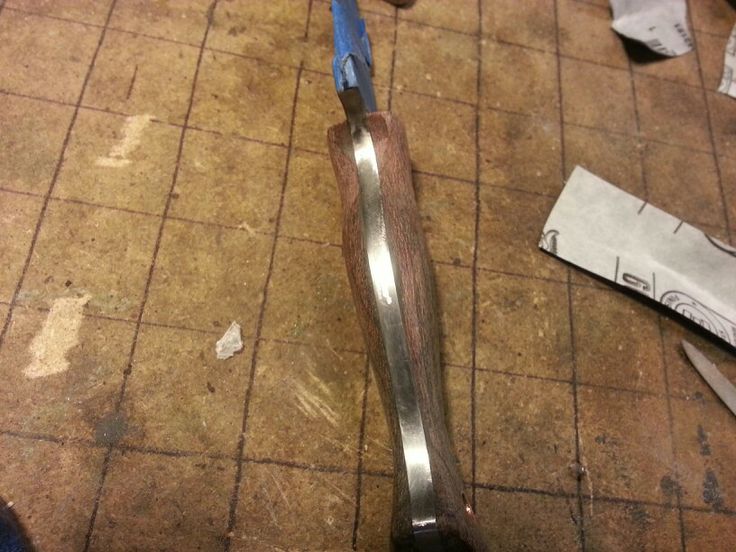
3rd Knife - Is the blade too tall?

Joined
Jun 13, 2013
Messages
948
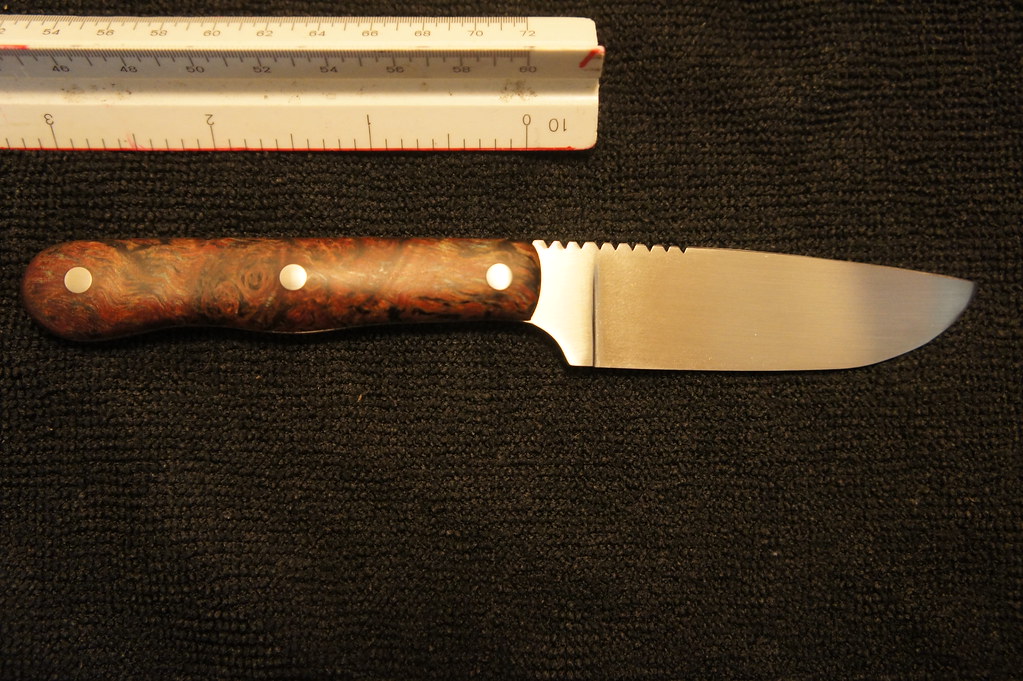
Well, I started on my third knife yesterday. Practicing my free hand bevels with a 2 foot bar of mild steel for a day helped me considerably. Thanks to all who gave me some tips the other day on doing free hand bevel grinds better. Although I did a FFG and kept this knife's style basic (not outside the box) and not as cool as my last knife (in MY opinion), I'm pretty much happy with it. BUT...

I am looking for some styling advice. Yes, this time I am actually asking for styling input but I am ONLY concerned with one thing. Everything else I am happy with in regards to the knife.

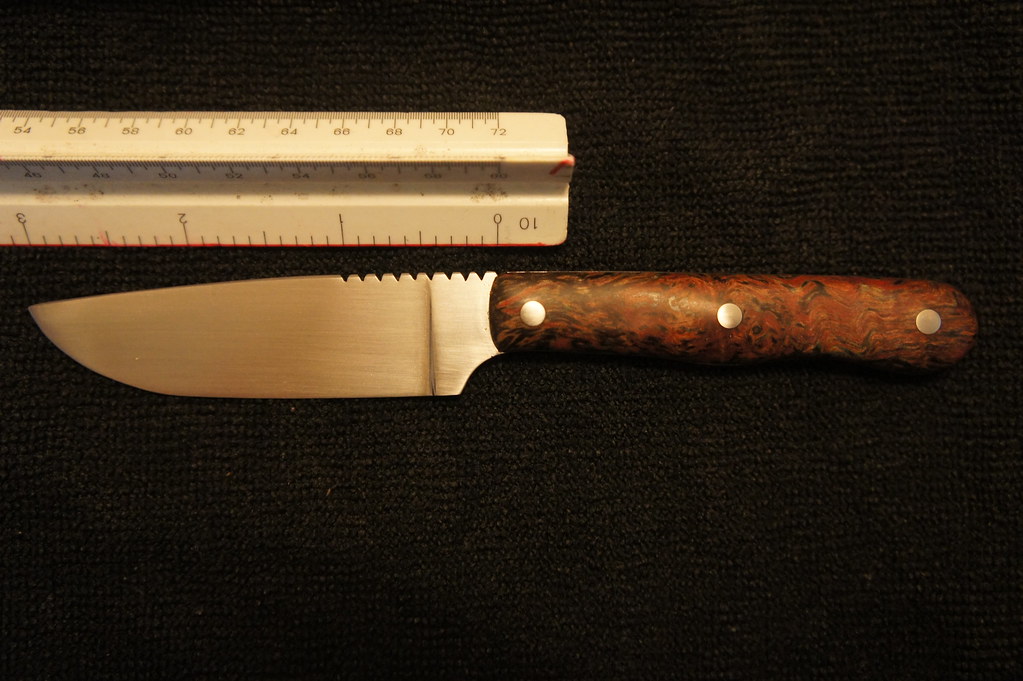
Here is the issue: Now that my third knife is done, the handle seems really small in height. The length is perfect but the height of the handled versus the blade seems weird to me.
Does anyone have an opinion on whether the knife would look better if the blade wasn't so tall? I wouldn't loose much cutting length if I changed it and there is plenty of belly to spare.

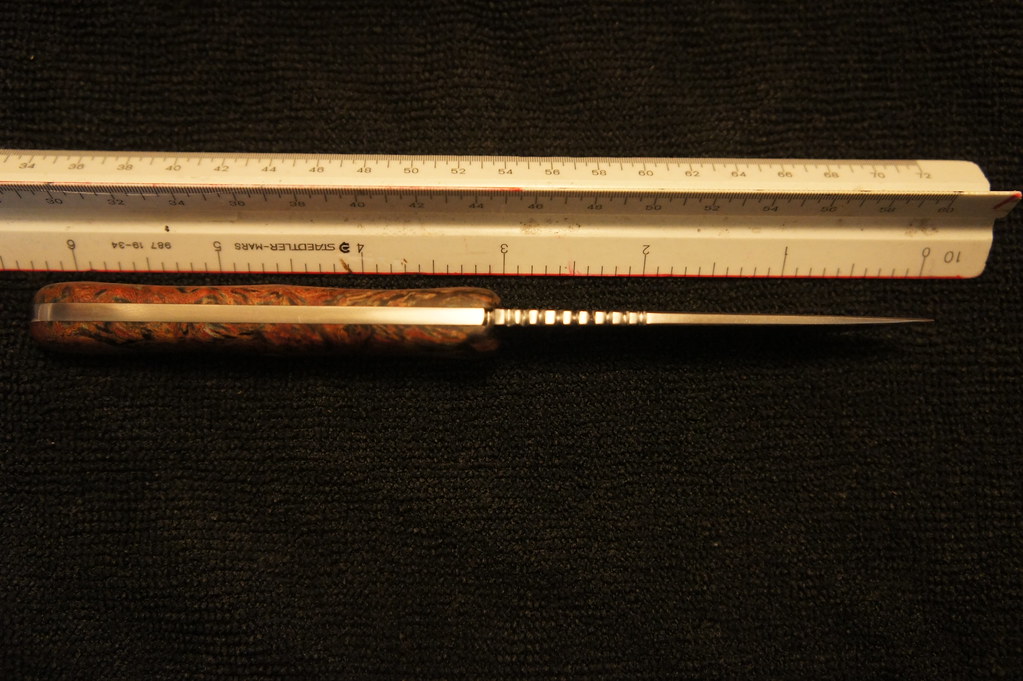
It's not a big knife, as you can see by the photos. Blade is perfectly just a tad under 3". So I don't mind if the blade is not as tall, if it makes it look better or "more normal".
12380425655_ff02d6e9bc_b.jpg


12380873974_9d3da6cecd_b.jpg


12380427185_fe98f4a771_b.jpg
 
Blade is not too tall, but the handle might be a tad skinny. It looks about as wide as it is tall.

The jimping looks like a series of stress risers, they should be like a U and not V notches.
 
Glad to see you inside the box this time. j/k Please take all criticism as constructive...

No, not too tall at all. That actually makes for a handy EDC blade IMHO. It allows the edge of the knife to be below the knuckle line. Which translates to: it makes cutting on a flat surface a bit easier. It also makes the blade seem to fall away from the hand. It also keeps it from looking like a steak knife... ;)
Where the blade edge being even with the hand line is important is in a knife where you will be pushing the blade through material only. Like a wood carving knife. Then the leverage of the lower edge isn't working against the hand.

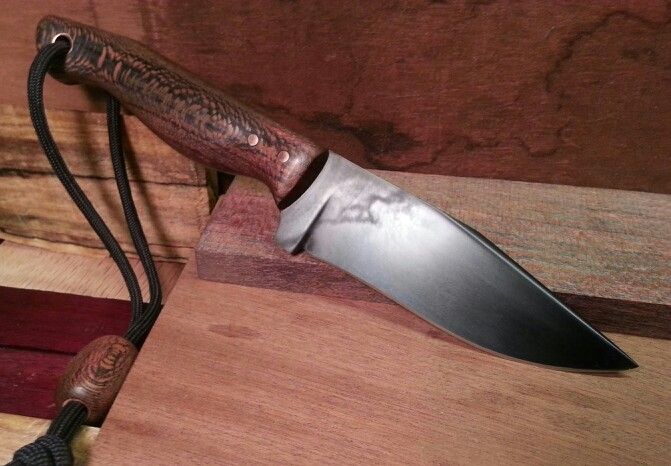
This is an edc knife I completed for a customer that has a similar ratio of blade to handle width. He requested this handle specifically, as it was literally formed to his hand. The blade was my choice. A proper EDC needs to be a bit pointy IMO as it might just get pressed into service as a defensive weapon. It is a 1095 steel, sycamore and copper creation. 4.5" recurve FFG blade. The diagonal quench line was brought out to show the differential hardening, but is a bit 'outside the box' (see, I remember you like that...) due to its location. The reason, however, is that this knife will also serve some outdoor function. Which will include batoninng through wood. I have discovered blades left with a soft back tend to deform over time when used in this manner. So I fully harden the blade on these knives. If the blade length gets extended however, I go a more traditional direction...

e568918e011863987bb7da43b1c7d776.jpg


And although you consider this knife too 'inside the box' and uncool, I like it significantly more than your first. It is a clean example of a fixed blade EDC type knife. And I also know critiquing anything you haven't asked for can hit a sore spot, I will say a couple things. Not directly design related: I'm not a jimping guy, but yours looks evenly spaced and all. In the future avoid sharp corners in the steel as stress risers start there and provide a point for a failure. Design related: I like the handle material, is that one of the simulated wood products? I have seen quite a bit of that lately and like the results. And the pin placement looks nice and even. Nice uniform finish on the blade as well.

Edit: Zooming in a bit the bottom of the V in your jimping looks rounded enough to negate any stress riser issues. Disregard.


-Eric
 
Last edited:
I like tall blades.....as long as proportions fit well with the overall knife.
 
Nice work. I see what you are saying. If you were to drop the back of the handle some and widen that dropped part I think it might flow a tad better. Eric could probably draw that in for you. I have no idea how he does that. Changing just that part of the handle would still leave the knuckle clearance and not change how the knife works. Just might be a tad more pleasing to the eye. Well yours and mine anhoo.
 
If you put your index & thumb together and curl in those fingers you will see that our hands are designed to grasp more of a oval or egg shape than a round. Try this on your next one where the handle will be taller than it is wide and I also agree with some drop in the rear.

I also am all for knuckle clearance!

You are doing great for your first few knives. I didn't have resources like this when I started.
 
Last edited:
Sorry it took a while to get back here....
I see that when you post a knife on here having people critique every aspect of the knife is unavoidable. lol
In regards to the handle material, my dad held onto the knife and said the same thing, "Is this synthetic?. Its actually just stabilized and dyed maple burl. It had a lot of blue and orange in it but the part of the chunk that I used didn't have much blue. I found it at a knife show and grabbed it because it had an ultra tight/fine grain structure. I have some left over and the next knife I make with it will have orange liners, which will help bring out the orange in it.

In regards to the jimping, it is indeed rounded and the entire spine of the blade is beveled from the tip to the end of the jimping /start of the handle. Athough the jimping doesn't go well with the knife, it is very useful with such slick handles and such a small form.

The handle is pretty boring and plain on this knife to me too. I wish it were bigger. I too like the size of the blade, it just doesn't seem to match up all that well with the handle to me. Too bad I can't make the handle bigger again! I guess I will leave it as is. In regards to the changes recommended for the handle; I don't know if you saw my first two knives (my tactical steak knives) but the rear of the handle was dropped and was fatter.

Rhino: When you say "oval shaped", do you mean, width wise, having a skinny front and rear of the handle? I usually like to have the rear of my handles dropped, but like I said, with this knife, it was plain jane. I uncharacteristically did not put much thought or creativity into the handle shape.

Stacy, I love curves on the knife you posted. No offense but, It captures a style similar to what I try to draw up a lot. I was going for that style on my tactical steak knives. May I ask how you had your bevel grind smoothly transition into the upper portion of the blade near the spine? Was it by accident when finish the knife? Also, if you don't mind giving away your methods, how did you go about getting the finish on your knife? Is it finely sanded and then bead blasted? Acid washed?

Also a basic question that has been bugging me....what is the black area from? Is that from heat treat or acid or?
 
Nice work. I see what you are saying. If you were to drop the back of the handle some and widen that dropped part I think it might flow a tad better. Eric could probably draw that in for you. I have no idea how he does that. Changing just that part of the handle would still leave the knuckle clearance and not change how the knife works. Just might be a tad more pleasing to the eye. Well yours and mine anhoo.

I dare not draw on dzlvs8's work... He doesn't like any critique besides that he asked for. I am trying to avoid the cluster the last critique thread ended in. HAH! ;)
I just stick the photo in paint, and draw over top of it. It seems to be easier than trying to describe what I am trying to say. I hope nobody takes the red line like a teacher's red pen... that screaming reminder that you pooched up when you were in school....

Sorry it took a while to get back here....
I see that when you post a knife on here having people critique every aspect of the knife is unavoidable. lol
In regards to the handle material, my dad held onto the knife and said the same thing, "Is this synthetic?. Its actually just stabilized and dyed maple burl. It had a lot of blue and orange in it but the part of the chunk that I used didn't have much blue. I found it at a knife show and grabbed it because it had an ultra tight/fine grain structure. I have some left over and the next knife I make with it will have orange liners, which will help bring out the orange in it.

In regards to the jimping, it is indeed rounded and the entire spine of the blade is beveled from the tip to the end of the jimping /start of the handle. Athough the jimping doesn't go well with the knife, it is very useful with such slick handles and such a small form.

The handle is pretty boring and plain on this knife to me too. I wish it were bigger. I too like the size of the blade, it just doesn't seem to match up all that well with the handle to me. Too bad I can't make the handle bigger again! I guess I will leave it as is. In regards to the changes recommended for the handle; I don't know if you saw my first two knives (my tactical steak knives) but the rear of the handle was dropped and was fatter.

Rhino: When you say "oval shaped", do you mean, width wise, having a skinny front and rear of the handle? I usually like to have the rear of my handles dropped, but like I said, with this knife, it was plain jane. I uncharacteristically did not put much thought or creativity into the handle shape.

Stacy, I love curves on the knife you posted. No offense but, It captures a style similar to what I try to draw up a lot. I was going for that style on my tactical steak knives. May I ask how you had your bevel grind smoothly transition into the upper portion of the blade near the spine? Was it by accident when finish the knife? Also, if you don't mind giving away your methods, how did you go about getting the finish on your knife? Is it finely sanded and then bead blasted? Acid washed?

Also a basic question that has been bugging me....what is the black area from? Is that from heat treat or acid or?

I'm not Stacy, hence why it says '-Eric' at the bottom of my post. ;) Bldsmth is Stacy. Your friendly neighborhood forum moderator...
But, I will answer your questions about my knife as best I can.

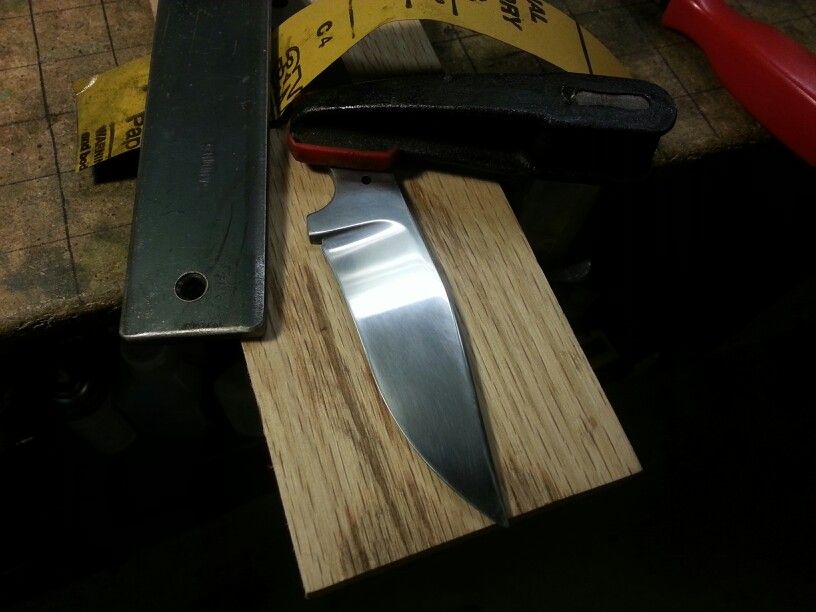
First, nothing on my knives is by accident. Not being snobby, but if something happens by accident, it is probably a mistake, and will thus be fixed... I used to have pleasant surprises with some knives, but I think I have passed the part of the learning curve where I will be pleasantly surprised very often. If you look closely, you will see the bevel fades into a gentle curve. Here is a pic during polishing prior to final finish. Maybe it will be more clear. (This kind of stuff is why we were pushing you to learn the basics. It isn't an insult, it just allows you to use your toolset more effectively.)
121a34346edfa100f663617b6bdc8b54.jpg

This is done by feathering the blade slightly during the final few passes during the primary grind. I have a platen liner that has one side with a perfect 90 degree break and the other with an 1/8" curve edge. I break the belt over the side to finish the bevel. Combine that with feathering my passes, and the curved edge, and you get this profiles with a bevel. I make sure the semicircular bevel isn't such a radius that it would extend past the choil, as having a fat primary edge on the heel of the blade would be counterproductive.

My handles are fit to the end user's hand in two ways. I either generally fit the handle to a customers hands by making sure the high and low points land where they are supposed to, or I make the handle basically a copy of their hand squeezing a wad of clay, just smoothed out a bit. This one, I actually did a combination of the two. The butt is flared to create a mechanical lock on the handle when squeezed tightly, (hole in hand smaller than handle, etc...) and the section just behind the finger indentation is a ball shape. This makes the handle both comfortable during routine use, or when grasped delicately. The balance point is right on the index finger. It makes the knife light in the hand IMHO. This is what Rhino was talking about with holding an oval or an egg. It also resembles the shape of a fish, and since the dyed sycamore resembles the skin of a brook trout, and it will do some service as that type of knife, it all kinda naturally fell into place.

And for the record, I fought against the lanyard tooth and nail, but in the end it looks 'aight... I turned the matching bead which has a flared copper thong tube that narrows from front to back, locking it down against the paracord... In the future, I will do the paracord in two tails instead of tied together. Another member here pointed out that two tails allows the bead to be run up behind the handle, and not leave a loop dangling behind. See, it helps to take a little constructive criticism... ;)

The finish is a simple etch. I polish to 2000-2500 grit completely, then etch briefly in a 3:1 FeCl/distilled water etchant. Then remove, polish with 0000 steel wool and repeat. I am watching for the resultant finish seen here. It is a semi-hamon in this instance. I say semi, as it is not as polished and refined of an appearance as a true hamon. Here it is simply an attempt (a successful one) to show the quench line and highlight the very fine structure of the martensite in the blade, and the grainier pearlite in the handle. Repeated etching reveals this as the pearlite etches a little quicker than the martensite, and the transition zone etches quickest of the three. Hardened carbon steel will darken with oxides when etched in FeCl. If removed from the final etch and placed in a boiling baking soda and water solution it will preserve this dark oxide. Then polish this out carefully with 0000 steel wool and either mineral oil if it is going to be used with food (this one was) or Remoil with teflon. My chosen lubes... It does resemble a media blasted finish when done.

I like the scales on your knife. It has a very interesting look for natural maple. That same kind of oddity is why I went for the sycamore on this knife. It is a dyed snakeskin sycamore that I luckily still have a small bit of which is going on another recurve EDC with black paper micarta bolsters and stainless spacer. I am always impressed with the appearance that can be achieved with modern dying and stabilization techniques when combined with interestingly figured wood.

Sorry guys, that was a wordy one.

-Eric

 
Last edited:
If you really want to redo the handle, you could knock the scales off, go back to the grinder, and make it a hidden tang...

Edit: I was trying to find a pic that demonstrated the 'egg holding' concept a little better and remembered this one. It makes for some interesting shaping to copy this many compound curves onto both sides, especially since I don't measure or use jigs... This is honestly one of the most comfortable handles I've made to date. I know it's not everybody's style, but it is the end user's style and that's what matters most...
070e028ef40bef6dce8125d83a15e44f.jpg

-Eric
 
Last edited:
Thanks for the info. It looks like I'm going to have to look more into the finishing process that is on your knife. That is quite a lot of steps.

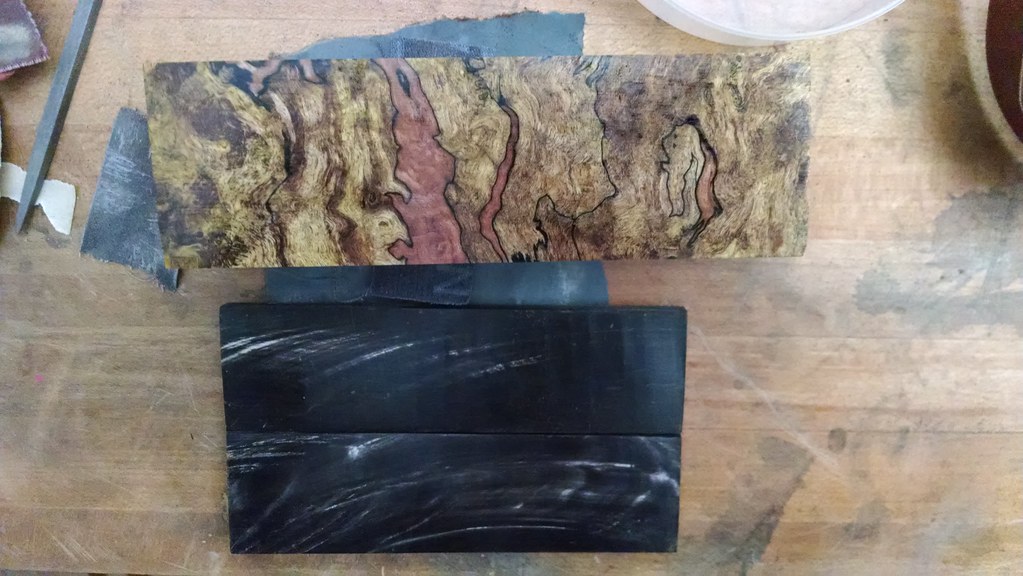
The handles were purchased at a on nice collectors show from a person that stabilizes handles for AG Russell and Buck. They are based out of Michigan but don't have a store front online. I have a feeling I was getting his "factory seconds" but they are great for $20 for a 2x6 piece.

Here is the other stuff I got from him. I'm not sure what I can do with the water buffalo since I don't do anything with bolsters.

12411452635_363fbf1558_b.jpg
 
Hey I just thought I'd add somethin really quick. I think what rhino was talkin about when he said "egg shaped" handle was actually the handle cross section.. I made a little picture really quick just to show an eggsample ;) so this pic is as if you were lookin at the butt of the handle, with the tang in the middle and the scales on the sides.. (obviously) :D


sorry Eric, not tryin to correct you or anything, I just think this is what rhino was reffering to :)

-Paul
__________________________________________
(some of my knives and other knifemaking related vids.. www.youtube.com/Lsubslimed )
 
OHH, now I see where the egg thing comes from. Makes sense. Ugly though, on a knife like mine with such small handles to begin with.
 
sorry Eric, not tryin to correct you or anything, I just think this is what rhino was reffering to :)

-Paul
www.youtube.com/Lsubslimed )

No worries Paul. I thought he was meaning both directions, literally egg shaped. If I could do an animation I would as I don't know if it is apparent in the photo... My handle there is fat up top and thin on bottom like your cross-sectional drawing, but actually takes it one step further by indenting near the index, flaring mid grip, and thinning in the rear near the pinky... Hence why I said it was a bear to duplicate those compound curved surfaces on both side of the knife.

Nice illustration BTW. and dzlvs8, it might not be the most striking design, but it is the most comfortable one. You have to draw a line somewhere between comfort and appearance. For my knives, comfort always wins out...

-Eric
 
No worries Paul. I thought he was meaning both directions, literally egg shaped. If I could do an animation I would as I don't know if it is apparent in the photo... My handle there is fat up top and thin on bottom like your cross-sectional drawing, but actually takes it one step further by indenting near the index, flaring mid grip, and thinning in the rear near the pinky... Hence why I said it was a bear to duplicate those compound curved surfaces on both side of the knife.

Nice illustration BTW. and dzlvs8, it might not be the most striking design, but it is the most comfortable one. You have to draw a line somewhere between comfort and appearance. For my knives, comfort always wins out...

-Eric

What Paul said and his diagram is what i meant, mine are a little more rounded at the top of the oval but that also depends on the size of the knife and a few other factors. I was in a dentist's chair for most of the day and am just now on line.

Now then there are what i call a total EGG handles that are entirely an egg shape that i put on a few hideout type fighters but that is another discussion.

Get some plastic modeling clay and take an Appox, 5-6' long x 1 1/2" square piece an squeeze it in your palm and see what kinds of oval shapes you find comfortable?

A coke bottle Palm swell and finger notches can be good too! I have my customers put their hand flat on a piece of paper and trace all the way around including the size of their wrist to have a reference whle I am shaping their handle scales once its fixed to their knife.

One thing i can tell you with full certainty is that a handle is better a little big than a little small cause when they are too small you are always trying to grasp it better and its fatiguing on the users hand.
 
Thats a good method and what I use as well. If there is a customer whom I can't meet in person, like my last overseas purchase, I have them trace their hand and send it to me. It isn't as good as having someome put their hand on a paintstick with clay on it, but close.

A little big IS always better. You can always take off material too, but not put it back on. I handled a Becker BK-7 someone had rehandled that had the most awkwardly huge handle... So too big happens, but is much more rare than a handle too small.

-Eric
 
Thanks for the info. I'm not sure if I'm ready to worry so much about comfort as I suspect it would make melding the comfort into the design of my knives even more difficult to nail down a design that I am happy with. I have drawn and redrawn countless knives. ...not just quick sketches, but very detailed/specific....well...sketches and I have only found two that I felt were 100% worthy of having a knife made. I acutally became so frustrated with coming up with designs that just didn't hit me right, that I took my last bit of 1080 yesterday and had two finger choils drawn out and that was all. I just shaped the damn thing on the grinder until I saw and felt something that I liked. I still isn't up to par in my opinion though. Back to the drawing board.
 
Back
Top