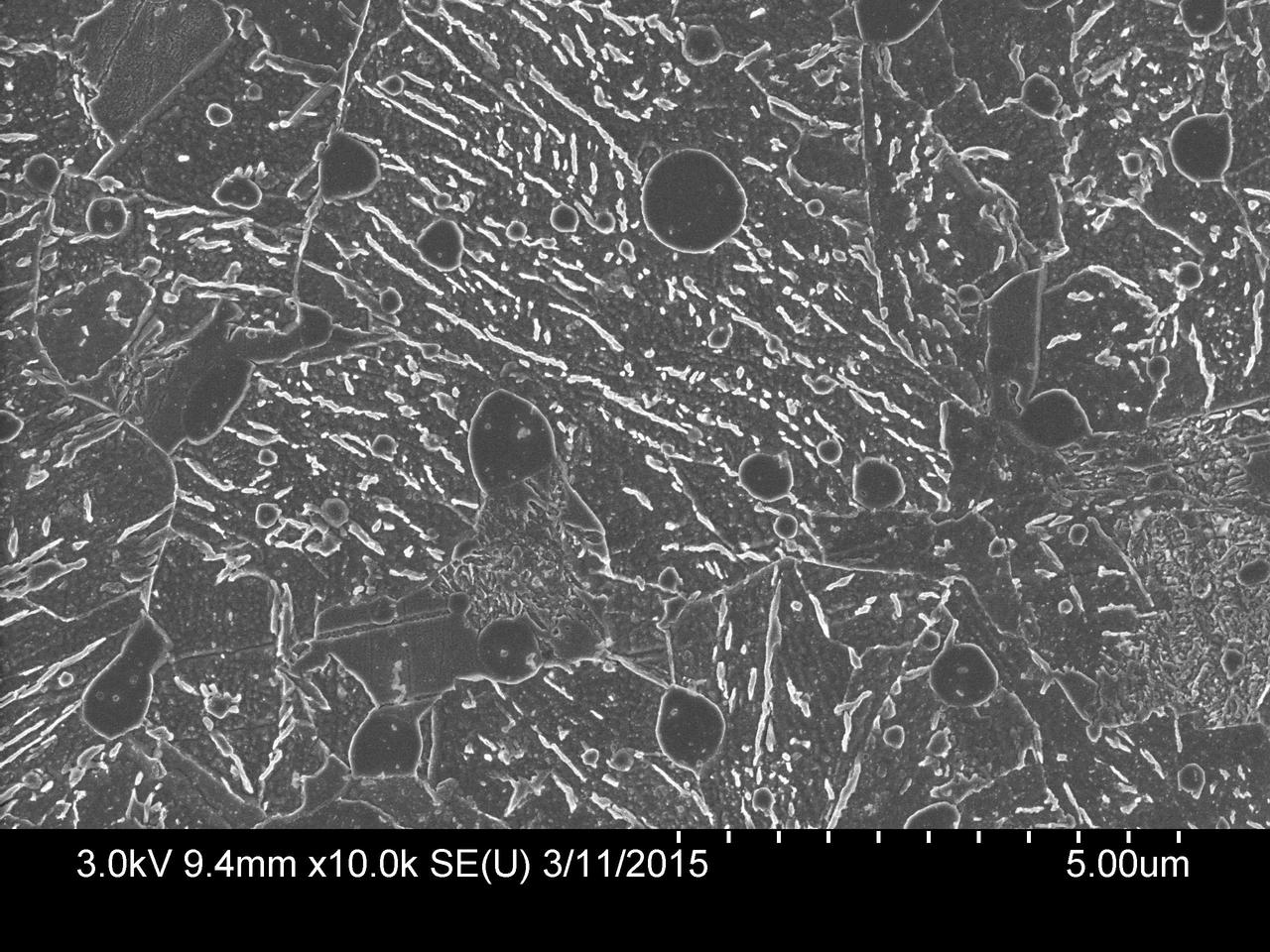
I derived & innovate my ht based mostly public research w/ SEM & TEM images. Along with a few private SEM pics. My results are mostly interpreted (tried to be non-bias) using combination of readily avail tools: triangulation, macro pics, sharpen & test, 400x usb microscope, hardness tester. Recently (after a long BO) I got Nital 3%, sadly can't resolve much with my 400x (~50x linear) usb.
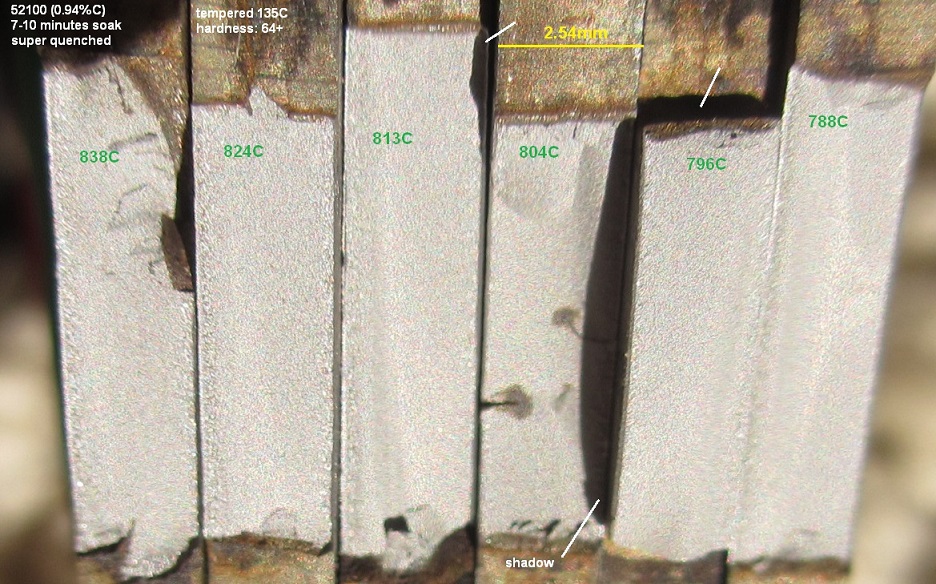
Stuart, thanks for correctly rephrased my terse 'ballooned' statement. Here is a macro pic (where 804C = 1480F)
Macro for 1440F look like 1480F. Ditto after nital etched. Martin/HeavyHanded generously offer to take 2K optical pics for me. I suppose to send out samples but decide to hold up until I complete this experiment. I told Martin if with good result, I will acquire a 2.5K optical, otherwise my leaky theory need serious re-examination.
Warren - thanks for sharing your experiment result. My 52100 samples hardness drop below 67rc when aust temp around 1450F(7 minutes soak), however got 67rc with 1440F with 20 minutes soak. Good reason for me to try 1440F & below with 10 minutes soak.
stezann - I hear you on the saying "don't fix if ain't broken". To spice ht life, I goes for the saying (Red Green Show) "if it's not broken, you are not trying". Could be that, I learn how & why things break, then fix, might register as skills. I forgot most of my theoretical math & comp sci. because lack of applied/context.
Matthew - Your open minded professionalism is well appreciated. You are right to assessed my tendency to draw conclusions and worse with on possible falsely assumptions. Am I suffering from a grandiose disease? OK, don't answer that, just give me med

Now looking at my (sample of 2) 1440F 20 minutes soak 67rc and macro structure look like 1480F. I concluded that plenty of carbon in solution at that temp + soak, and possibly too much. So I will cut soak time to 10 minutes, I aim for AQ hardness be around 65rc. Which might indicate (again assumption/guessing) just
barely sufficient carbon in solution. 1435F, so on would reveal -via interpolation- the amt of carbon in solution. 3 key benefits/reasons from this data provide:
1. I want non-solution carbon stay in particle/carbide/etc form to nucleate grain and at the same time provide more wear resistant.
2. Minimize carbon & other elements diffusion, avoid aus grain size regression from prepared state.
3. Higher percentage (95+%) of Lath martensite to gain extra toughness.
*. (edit added) obvious but worth considering. A 0.6%C martensite instantaneous goes into aust at temp say - 1440F for a minute or 2. Temporary precipitation & dissolution cancelled itself out on the ramp. It's reasonable to expect 0.6%C in solution, agree? Spheroidize structures (fine & large) are lower potential energy which require higher temperature to break them apart to release carbon. then, is 1475F optimal?
***
Catching Shrimp with Bare Hands book - if anyone curious and time permits, while on Amazon click 'Look Inside' and free preview up to 40 pages. It took Michelle over 8yrs (~4 fulltime years) to write it, time spent is not always equate to quality, prudently/thereby my preview recommendation. Thank you.



 . We need people to ask questions and test the results. Have you ever considered getting in touch with Kevin Cashen or Roman Landes regarding your steel? Kevin was quite helpful with me at a hammer in last year and let me know about the equipment I will need to look into the steel in more detail in the future, which I cannot afford this year. Might be worth an e-mail or two to see where it goes.

 . And there were quite a few regression/going-backward knives & blades = into recycling bin. W/o a doubt, thermal cycling indeed will refine grain but don't push beyond point of diminishing or declining return.