70 lbs lateral force

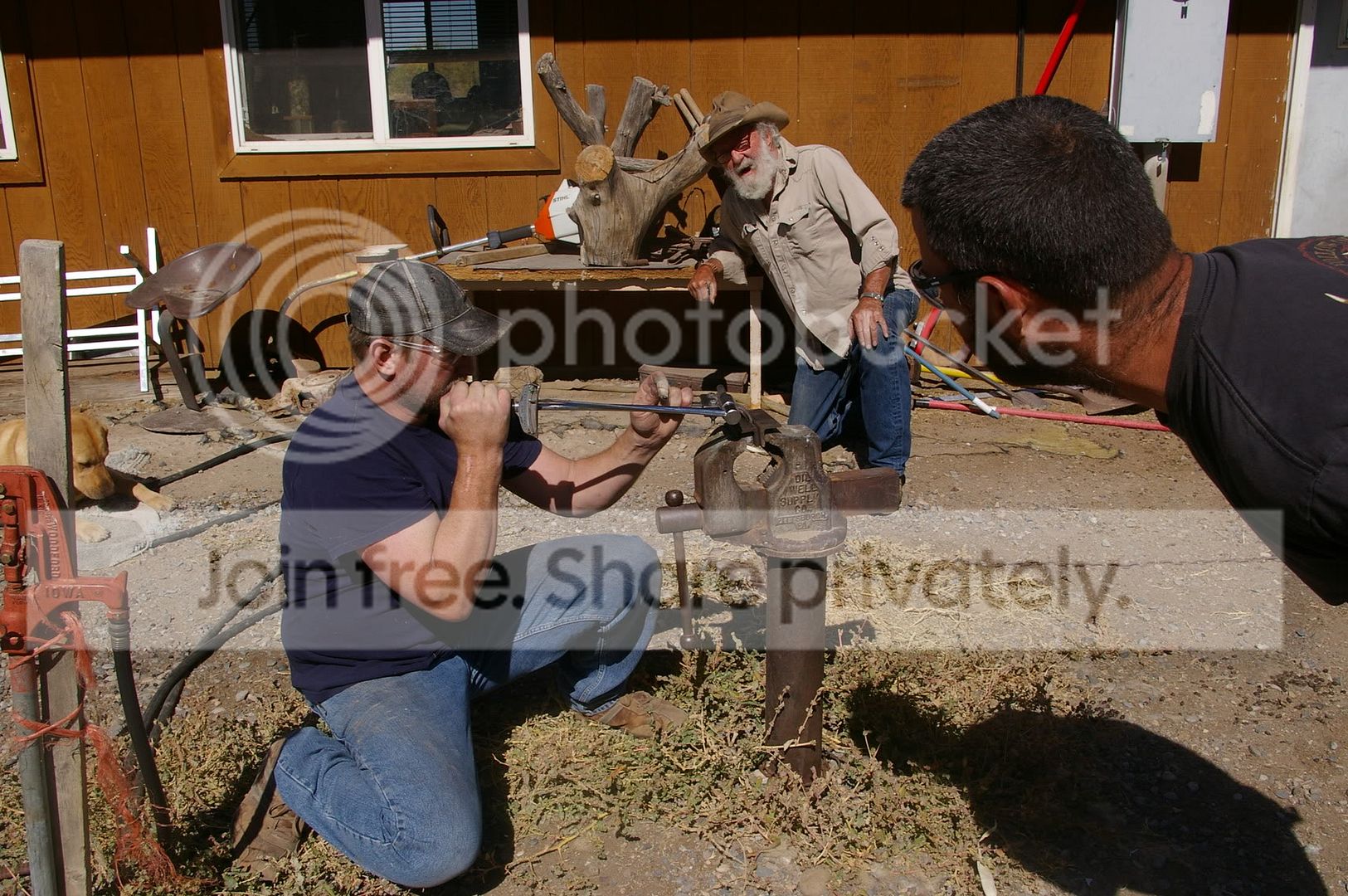
You don't have a picture of how you attach the torque wrench do you? Would help a bit in understanding how you are applying force to the blade, would also help me to replicate your testing.:)
 
I have a photo, but do not know how to post it, if someone wants to post it I can send it to them.
 
So if Noss stands on the handle and bounces up and down a little.... ;)
 
First my apologies for falling down on the job, was late to getting these photos hosted.
Thank you Ed for sending them to me.
Ed Fowler said:
Mark Reich flexing seminar test blade, Chris reading torque value on wrench, I am watching for degrees of flex. This blade showed 70 ft lbs throughout the 90 degree flex.
IMGP3992.jpg


IMGP4030.jpg
 
Allcaps321: Thanks for posting up the photos.
There are some safety rules we need to follow when testing blades for lateral force.
Safety glasses are a must, they have never been needed, but we always make sure everyone in the immediate area is wearing them.

Never push a blade, if it should break you can fall into it. ALWAYS pull the torque wrench toward you and be ready in case it fails catastrophically. This was a differentially hardened, then tempered blade so there was not much danger of it catastrophically breaking in to two pieces. This can be achieved with fully hardened and tempered blades with the right heat treat.

If a blade has a deep vertical scratch on its side, be sure and sand it out. A vertical scratch can act as a stress raiser and your test will not be a fair test for the blade.

Blades can twist in the vice and the person doing the flex needs to control the wrench, this is why Mark has his left hand on the side of the torque wrench.

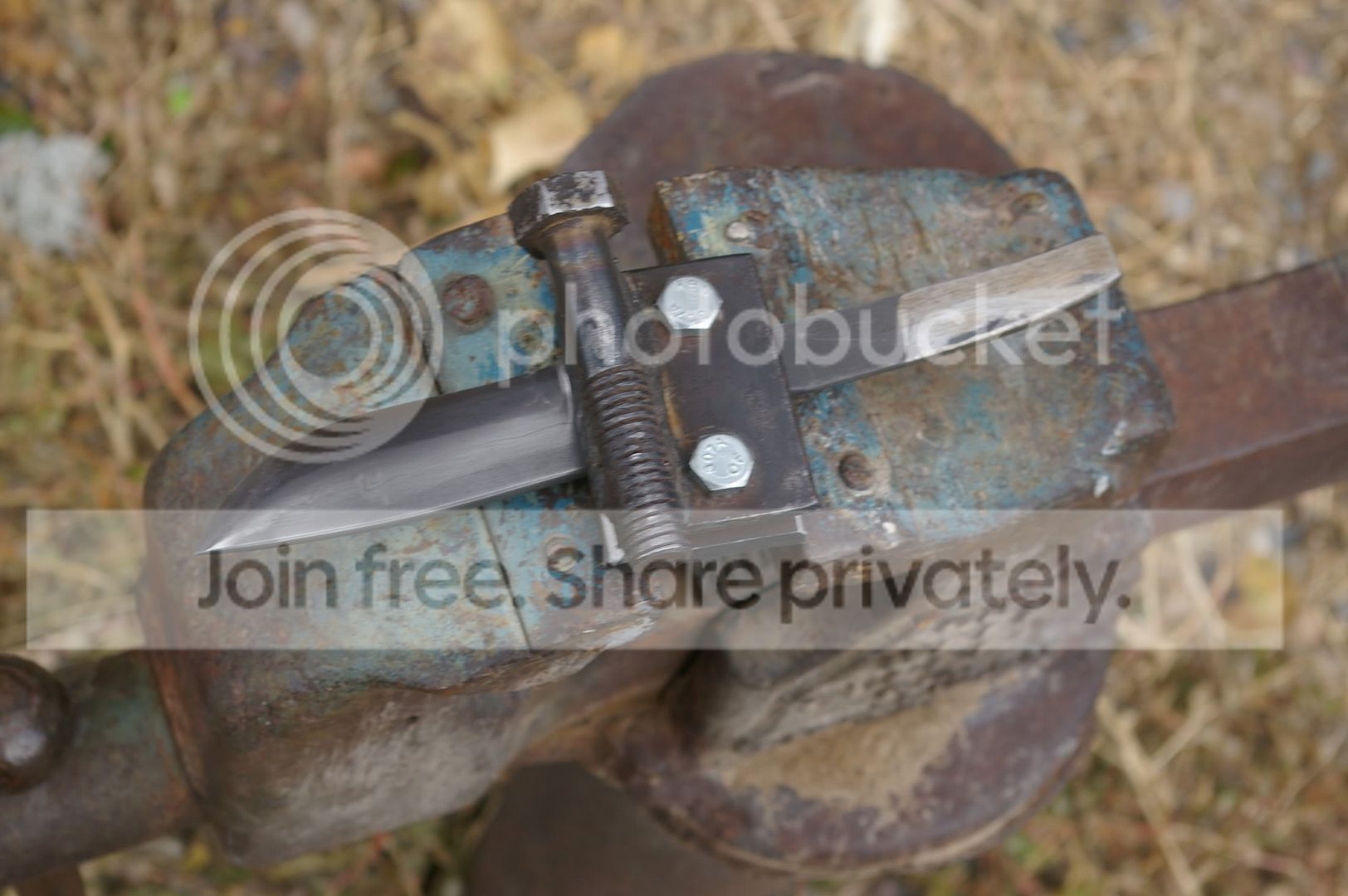
The photo second photo of the blade shows it after a 90 degree flex one way, then back to straight and 80 degrees of flex the opposite way until the edge cracked. We straightened the blade and used it for further cutting tests, it was not straight but good enough to use. You can see the 1/4 inch crack about 1/4 inch in front of the plunge grind. The fracture bifurcated when it got into the first transition zone and started running parallel to the edge. As with most of the blades tested we were experimenting with the height of the first transition zone, it performed as expected.

The bolts in the two pieces of the jig that hold the blade can be expanded with longer bolts should you want to test a blade with a handle on it. The two pieces that sandwich the blade are 1/4 inch thick and measure 1 3/4 X 2 1/2 inches.

The heavy duty vice came out of the oil field as scrap, it is welded to a heavy duty piece of pipe that is welded to a truck rim and buried 18 inches in the ground.
 
Last edited:
One more question for Ed or anyone who has done similar testing on edge quenched blades. When bending the blade like in the photo above, when does the blade reach the maximum torque value? If you say it reaches 70 ft-lbs, does it slowly get larger from 0 to peak at 70 just as it reaches 90 degrees, or does it reach peak torque at say 45 degrees, then keep constant up to 90, where the test stops?
 
Good Question!
I will have to verify my thoughts with Chris who most usually reads the torque while I watch the degrees of flex. As I remember he called 70 ft lbs very early in the flex, about 30 degrees and it holds a steady torque value until just before it cracks when some can feel a slight stiffening. I put a call in for Chris, when he calls back I will report his observations.

Another aspect I neglected to mention - you want to use two pieces of smooth and slightly rounded angle iron on the jaws of the vice or sharp jaws on the vice can create a stress raiser when you bend the other way and cause an early failure.
 
From your writings over the years I would have to assume that your goals include increased strength (torque) and a greater number of flexes and/or bends before breaking/cracking? Of course increased edgeholding is there as well, but is beyond the scope of this thread.
 
One last thing. Do you know the thickness of the blade at the transition zone (quenched to soft) in the area of the bend?
 
Another good question!

Basically our hypothesis is that you will never know the limits of your blades unless you test a representative sample to destruction and while doing the testing do it in such manner as to learn all it can reveal. Thus the torque wrench and testing one variable at a time. For example: in the blade above we were interested in the significance of the depth of the hardened zone in front of the ricasso. The blade tested before this one had a high hardened zone, this one was only hard about 3/8ths of an inch above the blade edge in front of the ricasso. These two tests pretty well confirm our belief that the center of the blade is ideal for this depth of blade and this geometry.

You are correct that lateral strength and toughness are significant variables that interest us. Edge holding and ease of sharpening are also significant, most importantly we seek to develop tests that any blade smith or knife enthusiast can duplicate our tests in his shop doing what his knives are intended to do.

Rex tells me the term he would use in a lab report (based on photographs) is tearing. The difference between tearing and breaking or cracking is very involved and beyond my ability to state in easily understandable terms, basically it has to do with the difference in separation between grain boundaries as opposed to through them.

We plan on some more tests that we have not tried before and will report the results as we learn.
 
Do you know the hardness range for the hardened portion and the spine? You printed it in one of your books, but it may have changed by now.
 
60 - 61 RC in the hardened and tempered portion, As I remember Rex called the spine RC 27,, maybe 24. You can cut the soft spine with a hack saw and as you get down to the hardened portion a hack saw won't touch it. We can get higher RC in the edge, but it chips out therefor temper at 388 f. The 388 f. temper will allow hard use (edge flex and full 90 degree bends) down to -40 f.

"The Rockwell on the spine is soft, as you drop down the blade it starts getting harder fast" somewhere I have a test blade with RC tests from spine to edge, but can't locate it at this time. When we moved into my new shop much information got misplaced, but it is here somewhere.
 
Do you know the maximum thickness that can be flexed when fully (spine to edge) hardened? I know blades hardened to 64-66 with spines slightly less than 1/16" thick will take as many 90 degree flexes as you have to offer. I quit after 5 in each direction. I will hopefully be able to try a larger bowie in this condition this weekend, with a spine of 3/32". I've also seen video of an ESEE Junglas blade flex to just shy of 90 degrees before breaking. I didn't see the pieces afterward, so I don't know if there was any permanent set. I think dropping the spine down to 5/32" might have made it. I know it took a tremendous amount of effort to get it that far, though it was not measured. Essentially I'm of the school of thought that flexibility, toughness, strength, and edge holding, and most of all, cutting ability (ease of making a cut) can be had all at once without the need of a soft back, which inherently gives up some strength. It just takes the proper geometry.
 
I gave up working with fully hardened blades years ago.
What I do in my shop with my material and methods will be different from what you do in your shop using the methods and steel you use.
Most important is that we experiment individually and share the knowledge gained.
And encourage others to join and share.


I wish you the best with your tests.
 
I just talked to Chris, He said the torque increased progressively and full maximum torque was registered at about 45 degrees and continued to the full 90 degrees.
While it sounds simple, there is a lot going on during the flex test, sorry for the error in my first call.
 
Ok, just so I'm clear, the full torque of 70 ft-lbs (or whatever it was) was reached by 45 degrees, then stayed essentially the same up to the 90 degree mark?

Here's a question that just occured to me. Why are the blades flexed to 90 degrees? Basically, why is that the stopping point? Why not stop at 45 degrees, or any other degree of choosing? What about stopping at a specified strength level/torque value? Why not just stop at 90 ft-lbs, or again, any standard value? I know the ABS chose 90 degrees, but why not some other constant criteria?
 
Yes - I believe you understand. You can make a knife stronger by making it thicker or deeper (more mass) or tougher with a higher tempering heat. This was not want I would call a heavy duty blade. It is a medium duty blade and you also need to consider the knife as a total package, cut, edge flex, geometry and overall design, what for and why all add up to a finished product.

You can decide what ever parameters you want for your blades. For me I want to know the absolute limits for my blades, there is still a lot to learn, this is why I encourage others to test, the more who contribute the greater our knowledge will be. At a 45 degree limit it would take a lot of bends to find the failure point. I want to test to destruction to know the limits and 90 degrees has been a standard since the 80's and is well known to most knife enthusiasts. Heaven forbid it may be (choke) tradition.
 
Back
Top