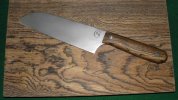
8" Chef's Knife too ambitious for first knife?

Joined
Apr 14, 2011
Messages
168
Hi, all. I've been purchasing equipment for my makeshift "shop" setup and I'm having a blast! So far, I've picked up a Sears 2x42 grinder (waiting on good belts to arrive), drill press, angle grinder with cutoff wheel, and hand files.

I've done some practice grinding on an annealed KaBar that I had ruined on a camping trip a few years back and am feeling pretty comfortable with flat grinding and also grinding a decent convex. Haven't done any handles yet, since the material seems too expensive to waste.

My question... would making a chef's knife w/ 8" blade in a fairly traditional shape be biting off more than I can chew, as first knives go?

If it help in answering the question, I was thinking: stock removal only, a flat grind, 1/8" thickness @ spine (with some filework), 0-1 or 1095 steel (sent out for HT @ Peters), and either burl or similar scales.

Thanks in advance! Also, and suggestions and/or changes are very welcome. And if I'm an idiot for even considering this as a first blade, let me know! (Thick skinned, so I can take the heat)
 
That doesn't sound like a bad project for a first knife. You will only learn by trying for yourself. Sending the knife out for heat treat is a great idea, and Peters is an excellent choice. I say have fun and go for it!!
 
If you've never completely created a knife before, my answer is yes...it's a bit ambitious for your first project. As the length of a blade increase, so does the difficulty factor. A proper kitchen blade should be very thin, and when you mix that with the length you mentioned, there are a lot more chances for problems.

I always encourage new makers to start by creating a knife with a 3-4" blade, in something that will allow for using thicker material. I feel it's important, especially when your starting out, to give yourself the best chances for success, and the way to do that is keeping it simple.
 
Ed's right, a wide 8" is a lot of acreage to goof up on ;) I have an idea for a compromise... Perhaps you could start with a couple smaller paring/utility knives that will match the chef's knife you intend to make next. You could get the big knife and two small ones out of one 24" bar if you cut carefully.

The Craftsman is pretty fast and there's not a lot of room for dipsy-doodles in 1/8" stock. You may consider profiling and doing the rough work with your grinder, then draw-filing and sanding with coarse paper to get to your final dimensions. It's easier to keep things straight and flat that way... mistakes happen more slowly and not as dramatically.

Many makers only profile and drill blades made from thin stock before HT, to minimize warping during the quench. By using Peters', you can do your grinding before hand if you want; they are very good about returning blades straight and clean. If you do decide to play it safe and grind your bevels after HT, don't worry, neither 1095 or O1 is super difficult to grind when hardened. Just keep it cool and take your time.
 
Last edited:
When grinding hardened steel it is very important to take your time and use fresh sharp belts. Worn out belts generate more heat than a fresh belt. The geometry of a good kitchen knife is very important, especially edge geometry. In a kitchen knife, the bevel structure is important. You might want a primary and secondary bevel, this will help with food sticking to the blade. also for a kitchen knife, shoot for a rockwell hardness of 60-61...Edge holding is key on a kitchen knife. Just my 2 cents

Mike
 
Perhaps you could start with a couple smaller paring/utility knives that will match the chef's knife you intend to make next. You could get the big knife and two small ones out of one 24" bar if you cut carefully.

I like that idea... maybe I'll begin with the smallest knife in the set and work my way up in size as I gain experience. I'm an avid cook, so I'm just itching to build my own perfect workhorse chef's blade. :) Hopefully I'm picking the right steel for the job. Either way, it'll be fun learning as I go along.

Worst case, I'll build better and better ones as my skills increase and give the others away to friends who've never owned anything resembling a decent knife. Never needs sharpening.... pffff....honestly...
 
Edge holding is key on a kitchen knife.

Couldn't agree with you more. I was wondering what rockwell would be appropriate. Thanks! :)
I was thinking, as it concerns the edge, that I would rough in the secondary bevel with the grinder and then move on to my EdgePro to make sure it is perfectly even and precise.
 
I too like the start at the short end of the kitchen knife set and work your way through the whole shebang.

Good luck!
 
Haven't done any handles yet, since the material seems too expensive to waste.

Not sure what material you have in mind for handles but if you want a couple pieces of walnut to practice with, PM me your address and I will send you a couple sets.
 
Do you like steak? How bout a few 1 inch tall by maybe 5 inch long blades. If carbon O1 or W2 if SS how bout cpm154. BTW 3/32 is the thickness I use on all but parring knives
 
A little ambitious, yes. Impossible, no. A bad idea, no. Likely you will catch flack from more experienced makers, yes. If your muse is telling you to make it, then make it. That particular muse is for that knife and that knife only. 8" is tough, that's a lot to keep even. 1/8" isn't bad, but it will be a HEAVY knife. Go and pick up an 8" chef knife at Wal-Mart. Notice how thin the blade is. It will likely be a lot thinner than 1/8".

This was the first knife I started with good steel, marked as #2, but I did the work at the same time as #1.
 

Attachments

  • done.jpg
    done.jpg
    66.5 KB · Views: 43
Last edited:
If you can handle the cost of wasted materials and disapointing results over and over go with a big knife, otherwise start with that smaller one that you know you would also want to make. Frank
 
I'd at least do a utility/petty knife first - say 4 1/2" to 5" blade - and start with some thinner stock.
 
Dymondwood is pretty cheap. Plain colored Micarta usually isn't too steep either.

Sometime's you just gotta go for it, learn the mistakes you made the first time, and improve upon them the second time, then the third, then the fourth.

Now, if you're like me, you'll make a mistake the second time that you didn't make the first, but you'll likely fix both on the third try while making yet another mistake. The only way to fix them all is to just keep making them until you don't. But you have to get started first!

That being said, you are likely to make fewer mistakes on a small blade than a large one. Even after "perfecting" your small blades, you may still have trouble with longer or wider grinds. That's been my experience at least.
 
Quote: "Haven't done any handles yet, since the material seems too expensive to waste."

I agree that commercial handle material is too expensive to wast. That's why whenever I'm nearby I stop into the GoodWill store. There are various household furnishings made of wood that may give you some "exotic" handle material to practice with. The best I've had came from a couple of Pakistan bookends with carved elephants, It was hard, dark and finished up real nicely. Acacia is quite common. It's probably not the best wood in the world for handles (it has quite large open pores) but it has nice grain and when finished with TruOil (My personal preference for finishing handles) it looks quite nice.

If you have a machete you could put a new handle on that. Heck, you could put new handles on it several times if you want.

- Paul Meske. Wisconsin
 
go for it pete :D. you might find out that you can grind a big knife easier than a little one. the first knife i made was 13" long and it turned out great. (it cut me bad enough to get 10 stitches :D) i'll give you a call later tonight and give you some pointers.

(zaph1, you called that right on the flack :D)
 
If you want to build on success, start with a small blade. If you want to learn from your mistakes, start with a bigger blade. The good thing about being able to grind a 8-10 inch chef knife that is about 2 inches wide, is that once you have figured it out and can grind a thin blade with distal taper and a very thin edge, grinding hunters and bowies is alot easier. However you may make alot of junk before you hit your stride. ALOT
 
Not sure what material you have in mind for handles but if you want a couple pieces of walnut to practice with, PM me your address and I will send you a couple sets.

Pm sent. Thank you! That's very generous. :D
 
Do you like steak? How bout a few 1 inch tall by maybe 5 inch long blades. If carbon O1 or W2 if SS how bout cpm154. BTW 3/32 is the thickness I use on all but parring knives

Steak?! Love it! Steak knives sound like a pretty good plan to me. I'm a big fan of carbon steel for kitchen blades, so I'll probably take your advise on the O1 or W2 -- have to read up more on the differences. I take very good care of my equipment, so potential to rust doesn't scare me a bit.

I went out and measured my current workhorse kitchen knife and found that it's around 7/64" thickness at the spine. I could see going a little thinner, but I like a little heavier knife... for some reason I feel like I have more control because of the forward weight distribution when doing very fast and precise chopping.
 
Back
Top