
#8 Done, Please Comment/ Critique!

Joined
Dec 8, 2014
Messages
814
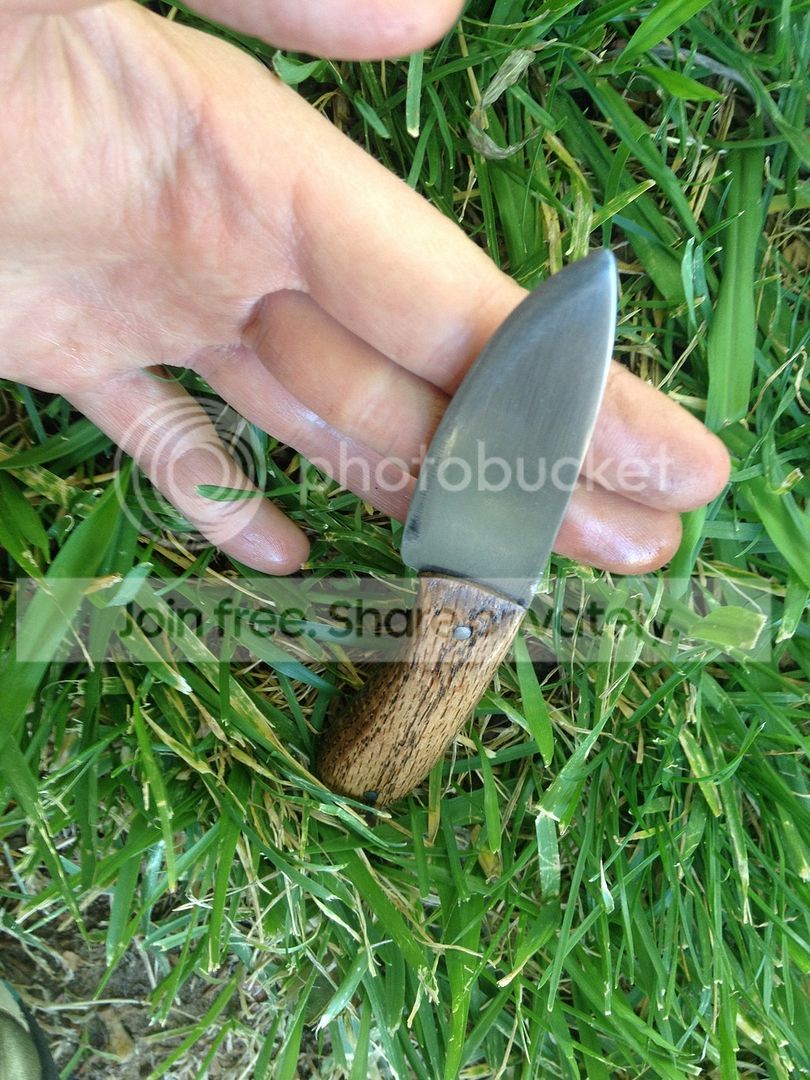
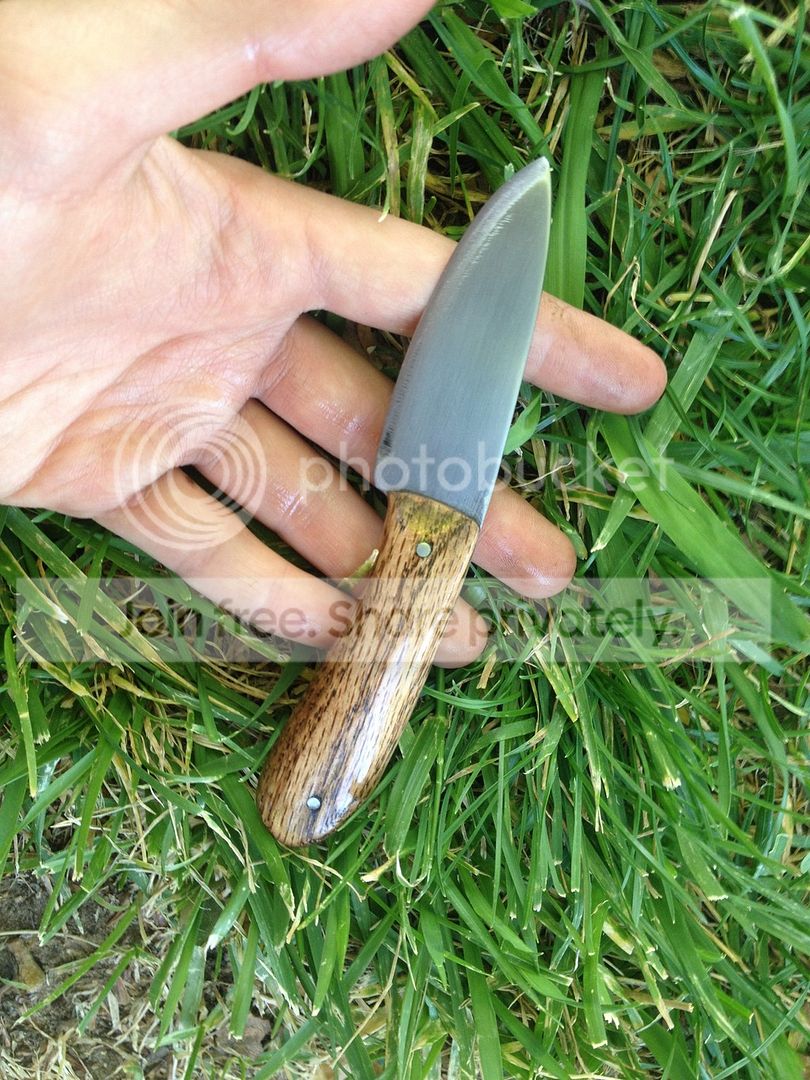
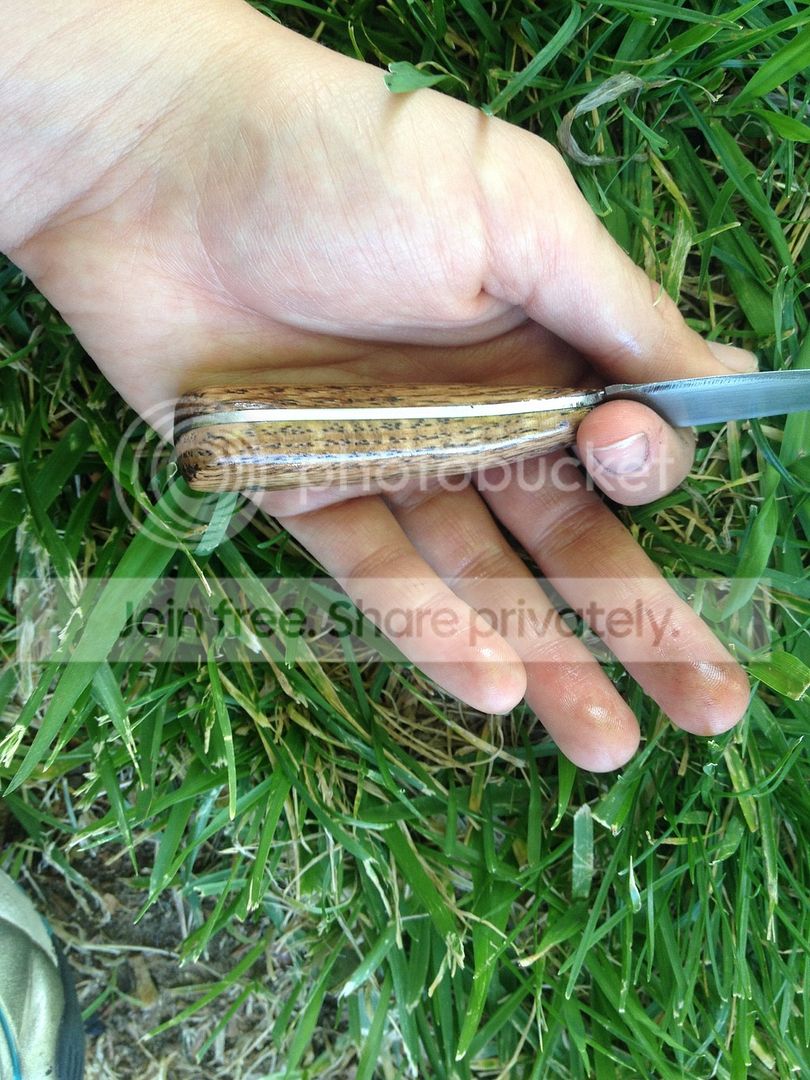
Hey all! This is number 8, and I see lots of things I can improve on, but am loving learning!! I made a couple little patch knives, and I had a couple people want them, so I made this one. Table saw steel blade, I'm grinding out 1084 blanks now, just have to hear treat and temper them, with oak scales and steel pins...and a satin(ish) finish. My main thing I with was better about this knife is pin placement. It's sharp enough to shave with and holds a good edge. Please give any comments, questions, or criticism!
 
Not all that bad, so be proud of what you did.

The main points are the pins need to be moved inward from both ends. Also, the front of the scales should be a tad farther back on the blade.

You need to work on your bevels, sanding, and finish more, too....but that comes with practice and patience.

Don't fall into the self-trap of saying, "Oh, it is just a primitive knife, so it doesn't need to have good finish." All knives need to be made right and have good finished surfaces.
 
agreed... most of the problem I had when I first started, and when I have tried to teach anybody is that they have to slow down and take their time on each one. it takes patience and time to get each stage to where they are before moving on to the next, but if you get impatient and don't finish those stages you will not make the best knife you could have, put it away till tomorrow and come back. I assume youre not making your living at knifemaking yet, so it's not a race to get #9, #29 or #100 done so take your time on the details if that's what has to be done. not bad overall, but Stacy hit it on the head with this one.
 
Not all that bad, so be proud of what you did.

The main points are the pins need to be moved inward from both ends. Also, the front of the scales should be a tad farther back on the blade.

You need to work on your bevels, sanding, and finish more, too....but that comes with practice and patience.

Don't fall into the self-trap of saying, "Oh, it is just a primitive knife, so it doesn't need to have good finish." All knives need to be made right and have good finished surfaces.
Thank you! Ok, how further back about would you move them? Yea, I just made a new grinding jig, this was my first knife with it, so I'm still perfecting it! It works better than my filing jig though.
Thanks Again!
 
agreed... most of the problem I had when I first started, and when I have tried to teach anybody is that they have to slow down and take their time on each one. it takes patience and time to get each stage to where they are before moving on to the next, but if you get impatient and don't finish those stages you will not make the best knife you could have, put it away till tomorrow and come back. I assume youre not making your living at knifemaking yet, so it's not a race to get #9, #29 or #100 done so take your time on the details if that's what has to be done. not bad overall, but Stacy hit it on the head with this one.
That's something I'm learning as well, patience:). Certainly not a professional, just a high school student doing this for fun and trying to get good at it! Thank you!
 
Agree with the comments so far, but I may add that #8 is still very early in the game. Don't ever rush the work, it will always stand out in the finished piece.
 
Not all that bad, so be proud of what you did.

The main points are the pins need to be moved inward from both ends. Also, the front of the scales should be a tad farther back on the blade.

You need to work on your bevels, sanding, and finish more, too....but that comes with practice and patience.

Don't fall into the self-trap of saying, "Oh, it is just a primitive knife, so it doesn't need to have good finish." All knives need to be made right and have good finished surfaces.

Agree here and would add:

try to make sure that you get an actual "point" on your knife, it's so easy to wash out that area and end up with a rounded bevel transition into the spine.
 
Agree with the comments so far, but I may add that #8 is still very early in the game. Don't ever rush the work, it will always stand out in the finished piece.

Thanks, I appreciate that! I'm perfecting my tools and methods and am loving learning!
 
Agree here and would add:

try to make sure that you get an actual "point" on your knife, it's so easy to wash out that area and end up with a rounded bevel transition into the spine.

Ok, thanks! I'll make sure my tip is more defined.
 
This reminds me of some of my very first knives. The fact that you are still in high school and have not only managed make this and realize improvements are needed is quite impressive. I prefer not to give too much criticism, as it can hinder someone's ability to add their own artistic flare, but I will give you a few pointers to help with basic construction. 1) pre-sand your blade up to 1000 grit before heat treating and sand at least up to 2000 grit post heat treating. 2) steel pins can cause issues when finishing the handle if using softer woods in the future. It may cause raised areas around the pins. Try moving to brass or aluminum. 3) buy some cheap mild steel and practice your bevels. You can make corrections and experiment without the heartache of ruining a project.
 
Thank you sir! Ok, I go to 600 pre heat treat, I'll bump that up on the next one. I was using brass and for some reason went back to steel, which I regretted, it's much harder to deal with. Practicing on mild steel is a great idea, I'll get some cheap bar stock at Ace and will work on perfecting my jig with that. Thank you!
 
That's something I'm learning as well, patience:). Certainly not a professional, just a high school student doing this for fun and trying to get good at it! Thank you!

hey, that's how i got my start as well. Now look at me, years later... still not a professional, lol. Love it when a knife comes together like you wanted it to though and when someone says "that knife was awesome for......." it's a feeling that's hard to beat.
 
I actually think that your finish on your flats are alright, but it seems like you've got some deeper, lower grit scratches you didn't take out around where your index finger sits and meets the edge (sorry if it's not a great explanation. Seems like you picked up a lot of scratches establishing your final bevel, I picked up a Lansky sharpener because I was having the same exact problem. You shouldn't worry too much about how high you take your grit so much as how clean it is (for reference, see Nick Wheeler's clean low grit finishes).
 
hey, that's how i got my start as well. Now look at me, years later... still not a professional, lol. Love it when a knife comes together like you wanted it to though and when someone says "that knife was awesome for......." it's a feeling that's hard to beat.

Haha, feel you there. That's something looking forward to!
 
I actually think that your finish on your flats are alright, but it seems like you've got some deeper, lower grit scratches you didn't take out around where your index finger sits and meets the edge (sorry if it's not a great explanation. Seems like you picked up a lot of scratches establishing your final bevel, I picked up a Lansky sharpener because I was having the same exact problem. You shouldn't worry too much about how high you take your grit so much as how clean it is (for reference, see Nick Wheeler's clean low grit finishes).
Ok. Yea, around the beveli was having issues sanding out gouges too deep to sand, trying to perfect my jig. I've been looking into getting a Lansky, they seem well with it! Ok, I'll check it out!
 
I got the deluxe kit + super sapphire + leather strop for about $40 off Amazon. It's got a bit of a learning curve and you have to get creative with clamping it to things, but it's given me some pretty clean final bevels without too much fuss.
 
I got the deluxe kit + super sapphire + leather strop for about $40 off Amazon. It's got a bit of a learning curve and you have to get creative with clamping it to things, but it's given me some pretty clean final bevels without too much fuss.

Ok, cool, thanks for the info!
 
I'll tell you all how to get dead flat bevels and silky smooth sanding:

For all your knives until you get the basics down pat - do a Full flat Grind - AKA an FFG.

Step one - put the jigs in a drawer or on a shelf.

Step two - take a hardwood or Micarta block about 4X1X1.5" and wrap a piece of 4X3X sandpaper on it. Use it to sand the bevel. Sand smooth and flat. Take your time. When the paper gets a but slow, change the paper. A spritz of Windex or soapy water every now and then helps a lot. Start with 120 grit paper and when every previous scratch and mark is gone, move to 220. Then 400, then 800, then 1200, then 2000. At this point it should be really smooth and flat with no marks or scratches. Go to 8000 grit if desired. A piece of hard felt glued on a piece of Micarta can be charged with polish and the surface can be mirror polished the same way if desired ( but I suggest you don't).

Sharpen the secondary (edge) bevel by hand on a good set of stones, and strop on a charged leather strop board. A medium/fine and a fine/extra fine stone are sufficient. (600 grit and 1200 are approx. equivalents.)
 
Back
Top