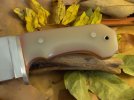
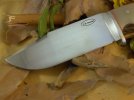
a 1095 chopper, how hard should it be?

Joined
Nov 11, 2011
Messages
747
So im building my first chopper and i was wondering, what hardness should i go for, for a fairly heavy use chopper?

Thanks in advance
 
While I would choose another steel myself, 1095 will work. Make sure you fully harden it ( right temps and oil type), and temper back to Rc58-59.
 
Last edited:
While I would choose another steel myself, 1095 will work. Make sure you fully harden it ( right temos and oil type), and temper back to Rc58-59.

Im sending it out to Peters Heat Treat, im a bit new to do much more than a stock removal knife.

I chose 1095 on Alto's recommendation as they didnt have his 1084 in the size i needed and he said it would be great for a chopper, why dont you like it?
 
Just me, but if I'm making a chopper, it's gonna be L6, 3V or 5160. The 1095 will work fine, though. Just temper it back a little more than if you were making a slicer/dicer.
 
It seems that this will depend on your ultimate goal for the knife. I have been interested in the Beckers and so forth and I've read a lot in that forum. I've also watched the videos of people using a baton to drive the knives through a tree, or chop through a 2x4. Also interesting is when they use the point to dig through a 2x4. There are a lot of videos on knifetests.com of this kind of thing, and they eventually will clamp the tip in a vise and start pulling on it to see if it will break. Even a Becker with 1095 will do pretty well with this kind of thing, so if you want your knife to be capable of this kind of performance then you could shoot for a similar hardness as the Becker. Some of the knives that they tested were more prone to breakage, probably they were hardened a little more. I'm not an expert on hardness vs. cutting and chopping ability, just relating what I've seen.
 
I like A2 for choppers but 1095 should work with the right heat treat. I usually go no higher than 59Rc just to provide some protection for the edge. In a heavy chopper I think it is more important to protect the edge from chipping than to try to keep it shaving sharp. I go with a full flat grind, takes a while to removal all that material but makes for a great chopper and good for battoning as well. I also keep the edge at about 0.02 just to have some steel the back up the edge.
\\
 

Attachments

  • chopper2018.jpg
    chopper2018.jpg
    41.8 KB · Views: 60
  • chopper2010.jpg
    chopper2010.jpg
    38.6 KB · Views: 46
  • chopper2011.jpg
    chopper2011.jpg
    30.7 KB · Views: 51
It seems that this will depend on your ultimate goal for the knife. I have been interested in the Beckers and so forth and I've read a lot in that forum. I've also watched the videos of people using a baton to drive the knives through a tree, or chop through a 2x4. Also interesting is when they use the point to dig through a 2x4. There are a lot of videos on knifetests.com of this kind of thing, and they eventually will clamp the tip in a vise and start pulling on it to see if it will break. Even a Becker with 1095 will do pretty well with this kind of thing, so if you want your knife to be capable of this kind of performance then you could shoot for a similar hardness as the Becker. Some of the knives that they tested were more prone to breakage, probably they were hardened a little more. I'm not an expert on hardness vs. cutting and chopping ability, just relating what I've seen.

It'll never be batoned, think more axe or cleaver style work. Basically im setting it up to be axe but smaller and more useful. Its going to be rather heavy but this is going to be the super heavy duty chopper i grab, i have plenty of choppers able to handle the easier stuff.
 
Sometimes I like specialized tools that aren't expected to everything perfectly, just one thing very, very well. With that in mind, I would recommend a full convex grind for a heavy-duty chopper.

I agree with the other fellows that 1095 wouldn't be my first choice, but it will certainly work. I would ask Peters' to temper it at 58Rc.
 
Ditto 58rc.
As stated above watch your edge thickness. No waves or thin spots.
I just bought some 1075 in 5/16" thickness from Aldo to make a chopper after cracking a
1095 test blade in 3/16" on some very tough pecan wood.

Good luck,
David
 
I'm with the others here in that I wouldn't normally use 1095 for a chopper. However, were I to do so, I'd temper it at or above 600 F, which would give a hardness between 54 and 57.
 
Sometimes I like specialized tools that aren't expected to everything perfectly, just one thing very, very well. With that in mind, I would recommend a full convex grind for a heavy-duty chopper.

I agree with the other fellows that 1095 wouldn't be my first choice, but it will certainly work. I would ask Peters' to temper it at 58Rc.

I agree, i have a condor golok that can do everything other than the ridiculous and about 12 other blades for lighter stuff, this is a non subtle cleaver used only in the heaviest of tasks. Otherwise the Golok does great.

I was planning on a convex grind, ive had a bit of practice with that particular edge sharpening some factory knives that werent actually sharp to begin with.

Anyone have an opinion on sharpening before or after heat treat? Ive read its best both ways but my plan was to do a rough grind with basically the profile without actually sharpening it before heat treat, anyone disagree? Its going to be a fairly heavy knife out of 1/4 stock and my plan was to use a slightly less thin edge to protect the edge while counting on the weight to help with the cleaving.

Thanks for all the help so far.
 
A knife is never sharpened before HT. Do you perhaps mean shaping the bevels?
The edge should be left at least .030" thick. On thin knives, some people cut the profile only , and do all bevels after HT. On larger and thicker knives, it is better to shape the entire knife and sand to 400 grit, leaving a thick edge.

As far as steel choices, 3V, L-6, D2, CPM-D-2, 5160, 1070/75 would all be better choices for a heavy duty chopper.

me2 -
Tempering a 1095 knife blade between 500F and 750F ( 250-400C) will place it in the temper embrittlement zone.

Temper Embrittlement Zone-
In this area there is a big dip in the impact strength. For a chopper or tough use tool, temper at 500F. If the tool will be used in such a way that high impact strength ( toughness) is the prime HT goal, them temper at 750-800F. This will make a less hard ( Rc 50-52) , but much tougher tool.This would be the way to HT an axe. If Antihero's knife is to be used as a machete/axe, then I would have Peter's do the temper at 750F. This should give a blade with Rc52 and high impact toughness.
 
A knife is never sharpened before HT. Do you perhaps mean shaping the bevels?

Yes, ive read that if i do the majority of steel removal after heat treat it can make the edge brittle from teh extra heat of sharpening or grinding. I always have a bucket of water handy to dip the knife in when i have to do a lot of sanding to get the edge sharp anyway.

Do you think that rc52 will be strong enough to prevent edge rolling? Like i said im sort of new to this so if its a stupid question, sorry. I dont mind resharpening in fairly often if i have to as long as it would hold up well enough for several hours of havy duty chopping and not break or excessively edge roll.
 
If you leave the edge relatively thick as Stacy suggested, I'm pretty sure the edge will resist rolling fairly well at 52Rc or so. The good news is, if it does roll, it will be easy to touch up with a coarse stone or even a file.

Myself I like a thinner, harder edge even on a chopper, because I've gotten pretty tired of sharpening. That's just my preference, not "right" or "wrong".

Like i said im sort of new to this so if its a stupid question, sorry.

No apology needed; you're asking very reasonable questions, that makes me think you've thought this through pretty well. :thumbup:
 
me2 -
Tempering a 1095 knife blade between 500F and 750F ( 250-400C) will place it in the temper embrittlement zone.

Temper Embrittlement Zone-
In this area there is a big dip in the impact strength. For a chopper or tough use tool, temper at 500F. If the tool will be used in such a way that high impact strength ( toughness) is the prime HT goal, them temper at 750-800F. This will make a less hard ( Rc 50-52) , but much tougher tool.This would be the way to HT an axe. If Antihero's knife is to be used as a machete/axe, then I would have Peter's do the temper at 750F. This should give a blade with Rc52 and high impact toughness.

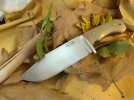
Hmm. Looks like the range is a little bigger than what I thought. I have some references that place it in the 450F - 650F range. In any case, despite having my temperatures off, the point was to get above the temperature where embrittlement occurs.
 
Yes, there are different charts on what range embrittlement occurs. I go with the wider zone to avoid any problems. For most knives, any temper between 350 and 500°F is going to be safe. If you are doing something special, then you have to design the HT and the steel type to the task.

Antihero - You may be confusing loosing the hardness in the edge by overheating during grinding with embrittlement. Not keeping the edge cool while grinding and sharpening after HT can make the edge over-temper at the hot spots. This will make an edge with softer places along it. If the edge turns blue while grinding, you have seriously damaged the temper.
 
Back
Top