A Beginner's Story or "Oh THAT'S What They Meant!"

Joined
Sep 4, 2018
Messages
163
As an eager beginner, who’s full of piss & vinegar (used to just be vinegar), I’ve done my best to try and balance my zeal with research and patience…the results have been…mixed. When I started taking an interest in knife making as a hobby, I grabbed some circular saw blades from a relative and started carving them up into knifey shaped things, more and more reading told me my results would likely be marginal at best and to get some “known steel” which is easier to steer towards predictable results. I bought some 1080, cut out a single blank to test with and prepped to heat; I had my canola oil, wrench/thongs, torch, bricks, and my blanks ready to go.

Now, I mentioned being eager, but I’m usually stuck trying to do too many things at once and distraction has a way to sneaking in to join the party, mark this for later. I made a cave of the bricks and fired up the torch, placed my blank inside and waited. I quickly realized that if I created a wedge-shaped cave that the bricks would concentrate the torch stream to the rear, and reflect some of the heat back up the blade, adjustments were made. I wasn’t able to get a nice heat vortex, but I thought the wedge worked alright, a better forge is needed but I had fireplace bricks in-house and thought I could use the heat-reflective properties by steering the reflected current back onto the blank.

Eventually, the blade turned (what I thought was) red and after a few minutes I pulled it out and dunked/stirred it in my (heated) canola oil. Remember the part about “distraction”?, in my rush to not burn myself, get the blade in the oil, not spill or start a fire, make sure my son was doing his homework, and make sure the dog didn’t get out of the backyard I managed to skip the magnet test, and I pulled it out too early (…I’ve never had that problem before….). A file test later and I realized my mistake. For those of you who are asking yourself why I’m quenching instead of aircooling for an anneal, I’ll refer you back to the "eager beginner" concept; I had mixed my steps, but I didn’t realize that until later.

Wet but undaunted (did I mention it had started to drizzle?), I lit the torch again and placed the blank back inside the forge-ish contraption. This time, for experimentation, I added one of the circular saw blade blanks to see how it would fare and prep it for a post-harden file test. I heated both to orange and kept going unsure how far I could/should go, eventually I reached an equilibrium point where things weren’t progressing any further but weren’t regressing either. I dunk/stirred the blanks, got a little smoke this time and a satisfying crackle when the steel hit the oil, however rushing to get two blanks in the oil quickly was a challenge, and I inadvertently managed to melt a small hole in the side of my plastic quenching bucket…which I discovered much later…after half the oil was on my driveway….

Regardless, after cleaning everything up, the saw blank was strapped into a vice and after a few good whacks with a hammer a bend was visible; also, I was able to easily mark it with a file. Disappointed? A little. Intrigued/entertained? Definitely. I wanted to use the saw blades as a platform to experiment, and practice tool skills, for that, things worked pretty well.

The 1080 blank was a different story; this one I wanted to succeed. I tried a file test on the flat and didn’t get much marking, but when I filed the profile material started coming off (though not as readily as the saw blade blanks). I cleaned up the edges a bit with the file and decided to call it a night…besides I needed to walk the dog. Giving my mind time to process things, I reviewed my steps and kept getting tripped-up at a few points; I needed to check a few things. You can probably guess most of what I read when I got home.

So, I have a few questions if anyone would be so kind as to hand-hold a newbie?

· Did I end up inadvertently annealing my blank, and quenching it, thinking I was hardening it?
· Is a propane torch (plumber’s style) hot enough? The interwebs says butane isn’t practically hotter than propane, what do you folks use?
· How long (ballpark) should a heat treatment take for anneal or hardening?


I plan to keep experimenting and reading, and now have a few lessons-learned:

· Don’t use a plastic bucket to hold glowing hot or recently glowing hot items
· Magnet test!
· Don’t rush

Questions/comments/suggestions/insults?

Cheers!
 
Last edited:
Hi,
I am a beginner too. I recommend a few things:

Slow down, read, digest, research. Get this dvd

Read this thread and consider building it. Soft bricks are available from Hightemperaturetools.com Buy 3 use two, save one as spare as they often break in shipping. The thread mentions a specific propane torch head. The combination of that torch and the soft brick baby forge should be enough to get you plenty hot on a small blade.

use a new 1 gallon paint can for holding your Canola oil. It is easy to put the lid on and store it. I also fits on a small hot plate to heat it to 130F prior to quenching.

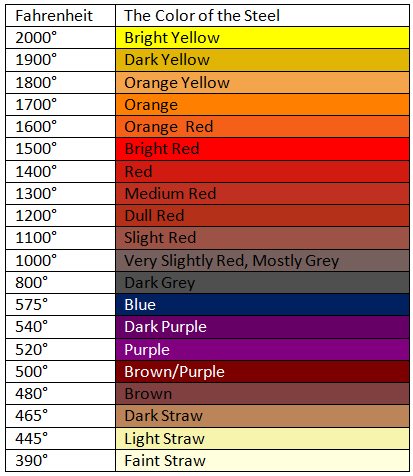
Do this at dusk or night, and get a steel color chart like these

Move the blade in/out of the opening to heat it evenly. Get a magnet as a guide but know you'll need to go a little hotter.
 
That was a very entertaining read, thanks!
Easily distracted, eh? Welcome to my world.
Suggestions? If you're really interested in this, join your local blacksmithing group. You'll learn more there in a day at a hammer-in or conference than in weeks (well, days at least) of reading. Also, in my experience, most smiths are more than willing to let a newbie stop by and learn/play, especially if you bring a 6-pack of beer.
Depending on how old the saw blade was it probably wasn't high enough carbon for a tool steel to harden. If the teeth had carbide tips welded on, then it was most likely (if not certainly) mild steel.
· How long (ballpark) should a heat treatment take for anneal or hardening?
There's really no answer to this. It depends on the steel, and how hot your forge is, and what you consider the starting time is.
For me when hardening, if I start the clock when I light my forge, it takes an hour or 2, because my forge is really way to big for knife making, I try to get the temp as exact as possible, so that takes some time fiddling around with getting the propane/air mix just right, getting the openings in the forge just right to keep it from getting too hot or too cold, etc. If I start the clock once these things are taken care of then it only takes a little longer than 10 minutes, because I use do my thermal cycling after forging (when I remember).
 
Oh yeah, another suggestion: read the Stickies at the top of the forum.
 
SLOW DOWN.
A propane plumbers torch is not hot enough.
Use the magnet.
READ a lot more.
NEVER use a plastic quench tank.
Circular saw blades for skill saws rarely will make a suitable knife blade.
 
Hi,
I am a beginner too. I recommend a few things:

Slow down, read, digest, research. Get this dvd

Read this thread and consider building it. Soft bricks are available from Hightemperaturetools.com Buy 3 use two, save one as spare as they often break in shipping. The thread mentions a specific propane torch head. The combination of that torch and the soft brick baby forge should be enough to get you plenty hot on a small blade.

use a new 1 gallon paint can for holding your Canola oil. It is easy to put the lid on and store it. I also fits on a small hot plate to heat it to 130F prior to quenching.

Do this at dusk or night, and get a steel color chart like these

Move the blade in/out of the opening to heat it evenly. Get a magnet as a guide but know you'll need to go a little hotter.

Very nice post, thanks for all the clever links!
 
Thanks for the feedback folks.

SLOW DOWN.
A propane plumbers torch is not hot enough.
Use the magnet.
READ a lot more.
NEVER use a plastic quench tank.
Circular saw blades for skill saws rarely will make a suitable knife blade.
  1. yes
  2. what would you suggest as an alternative? is the torch head the limiting factor in the heat?
  3. yes
  4. trying to; I've been reviewing the stickies, and searching the backlog of forum posts constantly, library books, youtube vids, etc.
  5. you are correct sir, as soon as I did it I knew it was a bad idea :rolleyes:
  6. the circular saw blade was an experiment for fun/curiosity, I'm focused on the 1080 blank and how to work with it.
According to the heat colour charts linked by Ashwinearl I had the 1080 up to 1600-1700F (it was past deep red well into orange), if so, using the 1080 information on Cashen's page I may have actually normalized and quenched? If the heat was lower it would have fallen into the annealing category but with a quench instead of a gradual decrease in temp., and lower still would have been in the hardening zone ("no higher than 1500F")? Since I can still easily file the 1080, is it more likely that I ended up normalizing it?

Thanks again for the help everyone :D
 
....According to the heat colour charts linked by Ashwinearl I had the 1080 up to 1600-1700F (it was past deep red well into orange), if so, using the 1080 information on Cashen's page I may have actually normalized and quenched? If the heat was lower it would have fallen into the annealing category but with a quench instead of a gradual decrease in temp., and lower still would have been in the hardening zone ("no higher than 1500F")? Since I can still easily file the 1080, is it more likely that I ended up normalizing it?
..."

You need to learn what those terms mean. You have much you don't understand in that post.

Color is very subjective. A magnet stops sticking at 1413F.
 
You need to learn what those terms mean. You have much you don't understand in that post.
Indeed, I don't know what I did other than completely bugger it up, that's why I posted those questions. I don't know where the steel is in the process based on what I did, I don't know what I should do. Have I completely damaged it beyond all hope and it's now a paper weight, or if I can simply restart with the piece and try again?

Color is very subjective. A magnet stops sticking at 1413F.
Understood, I mentioned upfront that I forgot to use the magnet, so I'm left with colour I saw (it was approximately the colour of the Orange-Orange Red bars in the pic below). Taking the subjectivity of colour into account, where might I have landed in the spectrum of options? And what effect could my completely inappropriately timed quench have produced?
blacksmithing-color-chart.jpg
 
You know, I was never able to really use the color chart to know where I was. The important thing I did learn was to look for subtle color changes. Then I tried to see where the color was when the magnet started to stick and go a shade hotter.

There is a good post, I need to look for, where a member talked about how he was able to achieve great temperature control with one of those baby forges, and a muffle pipe (straight section of stainless steel exhaust pipe), and a small propane torch. He used a thermocouple to measure temperature and the muffle pipe kept the thermocouple sensor out of a direct flame.

I actually have the Atlas 30k burner on my baby forge and it gets too hot. These are difficult to regulate temperature because you can't turn them down low enough an avoid sputtering. The way I tried to manage temp was moving the blade in and out of the flame. There is a you tube video by Caleb White where he heat treats a blade in an Atlas Forge which the baby forge I linked to earlier is a variant of. That video shows him moving the blade in/out.
 
Last edited:
You need to keep working through the stickies, lots of good info there. Hard firebrick is not good refractory like the soft firebrick, so your torch is spending a lot of energy heating up the hard firebrick. Soft refractory firebrick is what you want, like the stuff that lines pottery kilns and keeps heat inside more, what hightemptools.com sells. If you use the flat rate USPS shipping options on their site, it's a little cheaper that way that the regular freight option.

It's very possible you never got your metal hot enough to reach austenizing temperature, so that's why the 1080 fails the file test. The circular saw blades are most likely low carbon steel that won't harden much. If your file cuts both metals, it just means your knives are softer than the file. You didn't necessarily anneal the steel.

Color is not a good way to judge temperature. It depends on the ambient lighting and the adjustment of your eyes. An example of how easy to misjudge the temperature by color is here: https://www.bladeforums.com/threads/heat-treating-and-temering-1084.980622/#post-11159318

This is not to say it's impossible, but I bet it requires a lot of experience and only in your own workshop under the same lighting conditions each time. I always do my HT at night to help minimize the effect of ambient light, then I use a magnet and heat just a shade hotter than what the steel looked like when gone non-magnetic since steel goes non-magnetic around 1415F but I want to heat around 1475F to 1500F for the steel to reach austenitizing temperature.

The steel may not harden properly if you don't lower the temperature fast enough from the austenitizing temp to where martensite formation starts (I think around 800-900F). These means your reservoir of canola oil must be large enough that it can cool off the steel fast enough and it helps to agitate the blade, usually up and down edge to spine or tip to heel, not side to side which is more likely to cause warping.
 
one favor you can do yourself is start with some known steel from a reputable supplier, like Alpha Knife. I offered another forum member a 9" bar of 1084 for cost of shipping. They haven't taken me up on it yet and the offer is open to anyone. ashwinearl at gmail.com I am in 13413 NY probably $8 shipping.

7fcFups.jpg
 
I find that chart very off unless you have some experience and are in a darkened indoor smithy. It also isn't the same as some other charts.
In any case, what your eyes see is not necessarily what the chart says.
 
ashwinearl - That's very generous, although shipping to Canada seems to be a deterrent; I priced out soft fire bricks as suggested by MilkBaby, and the shipping was $55-176 sor a single $6 brick! :eek:. I have plenty of 1080 for now, and I'm finding new places to purchase periodically, but thank you again for the offer.

If you use the flat rate USPS shipping options on their site, it's a little cheaper that way that the regular freight option.
See above :D

It's very possible you never got your metal hot enough to reach austenizing temperature, so that's why the 1080 fails the file test. The circular saw blades are most likely low carbon steel that won't harden much. If your file cuts both metals, it just means your knives are softer than the file. You didn't necessarily anneal the steel.

The steel may not harden properly if you don't lower the temperature fast enough from the austenitizing temp to where martensite formation starts (I think around 800-900F). These means your reservoir of canola oil must be large enough that it can cool off the steel fast enough and it helps to agitate the blade, usually up and down edge to spine or tip to heel, not side to side which is more likely to cause warping.

Thanks for the feedback.

I agree with you guys about probably not getting hot enough, and the colour identifying; I'll make some adjustments and give it another try this time with a magnet and a more compact brick arrangement (unless I get some soft bricks first)....and a METAL BUCKET this time! :rolleyes:
 
A lot of guys use ammo cans for cheap and durable quench tanks. An added benefit is that they can be closed/sealed back up to keep critters and debris out of it. There's all kinds of sizes and shapes, and none of them should be very expensive.

You might have some luck with a weed burner and a grill sized propane tank. Looks up "weed burner forge" and you'll see plenty of options. If you want to save time (and possibly money), you may just want to get something like an Atlas forge and call it a day.
For temperature monitoring, if you don't want to spend the money on a digital read out and a thermocouple, tempil sticks might be an options.

Table salt melts at 1472 degrees F, or somewhere very close to that, IIRC.
 
I tried adding it to my profile earlier and ran out of time, but I did post in the Canadian section asking about steel suppliers here: https://www.bladeforums.com/threads...-steel-in-the-west-gta.1608971/#post-18425289

Thanks for the link

I read that thread now.

Note - Princess auto sells NO knife steel

The pages refer to fabrication (welding). They have no "1080" , only in the questions

When they refer to 1080 being listed on the site it's was a typo for AISI 1008 - that is now not listed keep in mind the people that work customer service both instore or website know NOTHING about steel.

If you want 1080 it's strictly mail order, Knifemaker.ca or Alpha, or Aldo the steel baron
knifefmaker.ca is in Canada, but he just resells the NJSB steel in Canada at a higher price

You can get O1 at
Fastenall - probably have to order
Metal supermarket
 
I read that thread now.

Note - Princess auto sells NO knife steel

The pages refer to fabrication (welding). They have no "1080" , only in the questions

When they refer to 1080 being listed on the site it's was a typo for AISI 1008 - that is now not listed keep in mind the people that work customer service both instore or website know NOTHING about steel.

If you want 1080 it's strictly mail order, Knifemaker.ca or Alpha, or Aldo the steel baron
knifefmaker.ca is in Canada, but he just resells the NJSB steel in Canada at a higher price

You can get O1 at
Fastenall - probably have to order
Metal supermarket

Well...that’s...disappointing...o_O

I’m not married to 1080, it was just “available” near me and supposed to be a friendly beginner steel.

Thanks for the heads up about Fastenal, I work nearish one. Since, i’m back at square one, do you suggest O1 as a decent starting point? Their site lists:

A2
C1018
D2
O1
W1

I’m pretty easy at this point...
 
Back
Top