- Joined
- Feb 20, 2012
- Messages
- 33
As Father's Day is approaching, I decided to make a knife shaped object for my father. Over the years he has received his share of macaroni art, ties, and socks. This year is going to be a little different. He is getting the grown up version of macaroni art, a knife made by his son.
I am new to knife making, so the knife shaped object that he gets won't be to the level that the custom makers on this forum produce. I know he'll love it though, just like the stuff I used to make, it'll be the thought and effort that count.
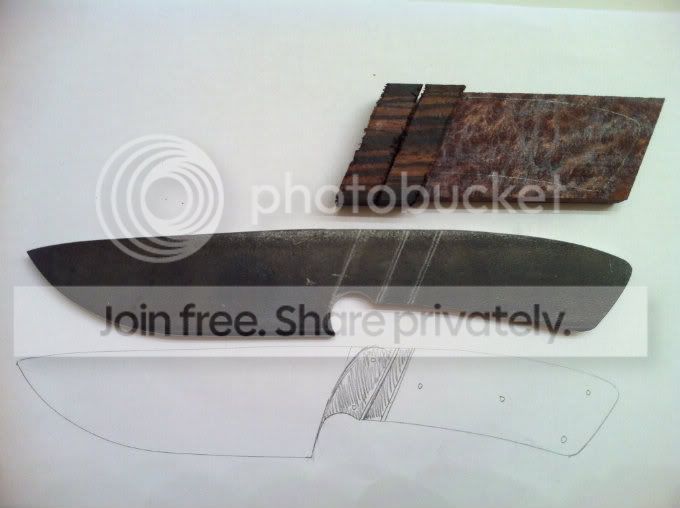
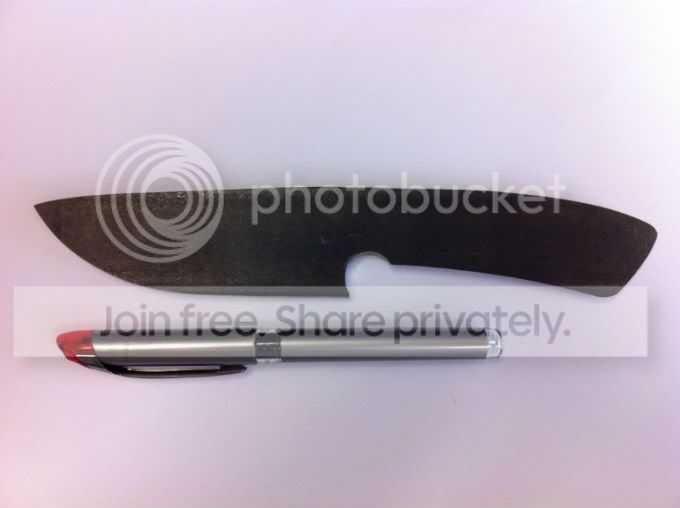
So, on to the good stuff. I picked up some 5160 from Aldo, cut into 8 inch sections. I drew and cut out the design, traced it on the steel, and away I went rough cutting the shape with the angle grinder. The profile needs cleaning up and refining, but you can see the basic idea of what I am going for. As you can see below in the picture, there is a lip on the handle side of the ricasso. I'll be widening the curve to flow better into the handle and remove the lip, so the back of the ricasso will either be straight or, more likely, have a larger radius to the curve without extending it further up toward the spine.
I have an Atlas Mini Forge with which I intend to do heat treating, using the "check for non-magnetic" method. I plan on doing two to three normalizing cycles before the final hardening and quench in canola oil. I'll then temper it two or three times at 350 for two hours a pop, letting it cool to room temp in between.
The handle will be made from redwood burl, from Burl Source, and some Macassar Ebony. The ebony will be a bolster at the blade side of the scale.
Now, I would like some advice. I am thinking of using either nickel/silver or copper as a spacer between the redwood and the ebony, and using pins of the same material, either nickel/silver or copper. If I use copper, what sort of patina can I expect to develop and will it cause a problem with the wood on either side? Is epoxy between the wood and metal spacer the best way to form the scale, or are there better ways to do that? Will the spacer cause an issue or weak spot in the connection of the scale and tang, if the scale is simply epoxied to the tang?
I'd also appreciate any feedback on the design and the process as I go through. Thanks in advance for any advice, help, and comments.
I am new to knife making, so the knife shaped object that he gets won't be to the level that the custom makers on this forum produce. I know he'll love it though, just like the stuff I used to make, it'll be the thought and effort that count.
So, on to the good stuff. I picked up some 5160 from Aldo, cut into 8 inch sections. I drew and cut out the design, traced it on the steel, and away I went rough cutting the shape with the angle grinder. The profile needs cleaning up and refining, but you can see the basic idea of what I am going for. As you can see below in the picture, there is a lip on the handle side of the ricasso. I'll be widening the curve to flow better into the handle and remove the lip, so the back of the ricasso will either be straight or, more likely, have a larger radius to the curve without extending it further up toward the spine.
I have an Atlas Mini Forge with which I intend to do heat treating, using the "check for non-magnetic" method. I plan on doing two to three normalizing cycles before the final hardening and quench in canola oil. I'll then temper it two or three times at 350 for two hours a pop, letting it cool to room temp in between.
The handle will be made from redwood burl, from Burl Source, and some Macassar Ebony. The ebony will be a bolster at the blade side of the scale.
Now, I would like some advice. I am thinking of using either nickel/silver or copper as a spacer between the redwood and the ebony, and using pins of the same material, either nickel/silver or copper. If I use copper, what sort of patina can I expect to develop and will it cause a problem with the wood on either side? Is epoxy between the wood and metal spacer the best way to form the scale, or are there better ways to do that? Will the spacer cause an issue or weak spot in the connection of the scale and tang, if the scale is simply epoxied to the tang?
I'd also appreciate any feedback on the design and the process as I go through. Thanks in advance for any advice, help, and comments.
Last edited: