

- Joined
- Apr 13, 2017
- Messages
- 2,219
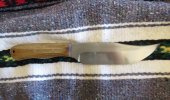
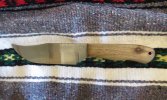
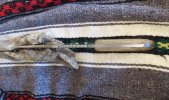
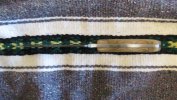
Hey all, here is a knife with a secret! Way back on Nov 13 I did a post on hidden pins and this is the result. Back then I realized I needed to grind the front choil area higher post heat treat (bad planning) and when I did the front pin was too low. So I took the good advice of setting things aside and thinking of solutions and they will come eventually. I had plenty of other things to work on of course. But this turned out pretty well. The hidden pin is 1/8 threaded rod going about 3/4 into the scale on each side. I taped the drill bit so I didn't go too far and thankfully did not break thru when final shaping. The front copper pin(s) are for looks, the rear pin goes all the way through. I think it's rock solid and happy with the way it turned out.
The scales are Vitex Agnus Castus for all you wood guys. It's pretty hard and grows in the Mediterranean and into Asia, and also in the back of my office building in mid-town Phoenix AZ where a handful of dead branches has been waiting for me for 5 years to trim them. Glad I did, I think it's beautiful wood. Down side I only have enough for maybe three more.
So, knife and scales are sanded to 600 grit, with a danish oil and carnauba wax finish. It's not sharpened yet but should take a fine edge.
Back to the pins, they are an attempt at homemade "mosaic", 1/16th copper tube inserted into 1/8th copper tube. Even though I spun them while inserting they did not center perfectly. Is there a trick to this or do we just takes our chances?
And please, any other critique of knife is also welcome.
For my next trick I'm making my first two piece/double pinned scales with threaded rod pins, from Black Limba and Ironwood, no spacer, from smaller remnants... waste not and all that. They are curing now, so far so good.
The scales are Vitex Agnus Castus for all you wood guys. It's pretty hard and grows in the Mediterranean and into Asia, and also in the back of my office building in mid-town Phoenix AZ where a handful of dead branches has been waiting for me for 5 years to trim them. Glad I did, I think it's beautiful wood. Down side I only have enough for maybe three more.
So, knife and scales are sanded to 600 grit, with a danish oil and carnauba wax finish. It's not sharpened yet but should take a fine edge.
Back to the pins, they are an attempt at homemade "mosaic", 1/16th copper tube inserted into 1/8th copper tube. Even though I spun them while inserting they did not center perfectly. Is there a trick to this or do we just takes our chances?
And please, any other critique of knife is also welcome.
For my next trick I'm making my first two piece/double pinned scales with threaded rod pins, from Black Limba and Ironwood, no spacer, from smaller remnants... waste not and all that. They are curing now, so far so good.

