- Joined
- Jan 28, 2006
- Messages
- 7,035
Yeah, I spelled it right.
I wanted to give something a try. I'm usually one to go for the more traditional pattern knives for outdoor use and all, but I bought a Busse Hellrazor and BAD a while ago and wanted to see if a "tacticool" blade is any good as a bushcrafter. There was also some talk on the Busse forum about whether or not a swedge on the spine was detrimental to batoning.
No pics as the light was failing and I don't quite have this photography thing down, so none came out with much to see (like you haven't seen knives batoned and fuzz sticks made).
For those who don't know, the basic Hellrazor,
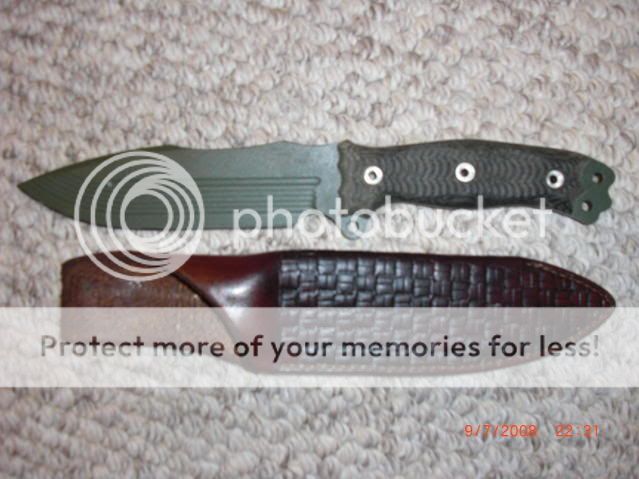
has a 6" cutting edge, 6 7/8" total blade and just under 12.5" OAL. It's 3/16" at the spine, and despite the corrugations on the blade is a pretty basic shallow convex to a secondary bevel. I figured there's no reason it shouldn't work.
I started with some light chopping of live oak, birch and pine branches from 1/2" to 1" diameter. It handled the 1/2" stuff with usually a single good chop. It made short work of the pine in all cases, and I wouldn't want to bother chopping anything over 3/4" in hardwoods unless I had to.
Next was batoning some seasoned birch rounds I still had left over. They ranged in diameter from 2" to 4.5". The HR batoned through them with ease -- easier than my BRKT Aurora, much to my chagrin (probably due to the blade width which is about twice that of the Aurora, allowing a shallower grind to the same spine thickness).
Next to cutting some tent/tarp stakes. I used some birch rounds that were about 5/8". I found three of them, chopped them in half, whittled one end to a spike and notched the other end. On two of them, I one-handed cut the notch, two I used the push-with-the-offhand-thumb method, and two I batoned the notches. The batoning method was by far the fastest and easiest, and was actually more accurate for me.
Next, I tried drilling some holes in a couple of the rounds I split via baton. I think the swedge thinning out the tip actually helped with this, as it performed with aplomb.
Finally, after all this, I tried to cut some fuzz sticks without touching up the edge at all. It cut fairly well on the seasoned birch (which is a pain to cut fuzz sticks with everything I tried). Then on to some dry pine, which was a cinch.
CHecking the baton, the swedge did no more damage than the flat spine on my 1/8" thick Leuku did. So to answer the question, a swedge is not a detriment, and is a benefit from the perspective of drilling holes.
Going inside and taking a close look, I could find no sign on the edge that it had done any work. No rolling, chipping or discernible dulling. The finish was hardly even smoothed a bit from splitting the wood.
I also tried out my BAD (Boney Active Duty):

Blade is 3.5", OAL is 7.75" with a 1/8" spine tapering all the way to the tip.
They say the tip should not be used for heavy prying and such as it's too fine. I wouldn't use this knife as a breaching tool, to open shipping crates or hammer through steel plate, but it handles outdoor chores with no problems.
I batoned it through birch rounds up to 2" in diameter with no trouble, it drilled holes (for a bow drill set) just fine, and was fairly good cutting fuzz sticks. I say fairly good because it's a bit small for my meat hooks to get a real powerful grip on it. Just like the HR, it showed no signs of use. it's a great compliment to a larger knife.
The question also comes up a lot on this forum as to why people carry medium sized blades. I think the answer is, because guys like me with big, fat hands can control a knife with a large grip better than we can a small one. Ya have to work with your own body geometry, not what someone else likes.
What's the downside to using "tactical" knives for bush work? I have the powerful urge to go buy a bunch of Maxpedition stuff.
I wanted to give something a try. I'm usually one to go for the more traditional pattern knives for outdoor use and all, but I bought a Busse Hellrazor and BAD a while ago and wanted to see if a "tacticool" blade is any good as a bushcrafter. There was also some talk on the Busse forum about whether or not a swedge on the spine was detrimental to batoning.
No pics as the light was failing and I don't quite have this photography thing down, so none came out with much to see (like you haven't seen knives batoned and fuzz sticks made).
For those who don't know, the basic Hellrazor,
has a 6" cutting edge, 6 7/8" total blade and just under 12.5" OAL. It's 3/16" at the spine, and despite the corrugations on the blade is a pretty basic shallow convex to a secondary bevel. I figured there's no reason it shouldn't work.
I started with some light chopping of live oak, birch and pine branches from 1/2" to 1" diameter. It handled the 1/2" stuff with usually a single good chop. It made short work of the pine in all cases, and I wouldn't want to bother chopping anything over 3/4" in hardwoods unless I had to.
Next was batoning some seasoned birch rounds I still had left over. They ranged in diameter from 2" to 4.5". The HR batoned through them with ease -- easier than my BRKT Aurora, much to my chagrin (probably due to the blade width which is about twice that of the Aurora, allowing a shallower grind to the same spine thickness).
Next to cutting some tent/tarp stakes. I used some birch rounds that were about 5/8". I found three of them, chopped them in half, whittled one end to a spike and notched the other end. On two of them, I one-handed cut the notch, two I used the push-with-the-offhand-thumb method, and two I batoned the notches. The batoning method was by far the fastest and easiest, and was actually more accurate for me.
Next, I tried drilling some holes in a couple of the rounds I split via baton. I think the swedge thinning out the tip actually helped with this, as it performed with aplomb.
Finally, after all this, I tried to cut some fuzz sticks without touching up the edge at all. It cut fairly well on the seasoned birch (which is a pain to cut fuzz sticks with everything I tried). Then on to some dry pine, which was a cinch.
CHecking the baton, the swedge did no more damage than the flat spine on my 1/8" thick Leuku did. So to answer the question, a swedge is not a detriment, and is a benefit from the perspective of drilling holes.
Going inside and taking a close look, I could find no sign on the edge that it had done any work. No rolling, chipping or discernible dulling. The finish was hardly even smoothed a bit from splitting the wood.
I also tried out my BAD (Boney Active Duty):
Blade is 3.5", OAL is 7.75" with a 1/8" spine tapering all the way to the tip.
They say the tip should not be used for heavy prying and such as it's too fine. I wouldn't use this knife as a breaching tool, to open shipping crates or hammer through steel plate, but it handles outdoor chores with no problems.
I batoned it through birch rounds up to 2" in diameter with no trouble, it drilled holes (for a bow drill set) just fine, and was fairly good cutting fuzz sticks. I say fairly good because it's a bit small for my meat hooks to get a real powerful grip on it. Just like the HR, it showed no signs of use. it's a great compliment to a larger knife.
The question also comes up a lot on this forum as to why people carry medium sized blades. I think the answer is, because guys like me with big, fat hands can control a knife with a large grip better than we can a small one. Ya have to work with your own body geometry, not what someone else likes.
What's the downside to using "tactical" knives for bush work? I have the powerful urge to go buy a bunch of Maxpedition stuff.