A possibility of high strength + high toughness hardened steel?

I've always thought that in practice that impact numbers should be a guide not an absolute .That's my experience with non- knife items . Many of the details in the micrcostructure can have major influence in the toughness. Fracture/microstructure photos might be of interest to you.
 
I like this discussion! As someone more concerned about camp knives and their duties, toughness is high on my list of priorities. I can sharpen a knife in the field, but I can't repair a broken one.

That being said, using a tough steel with the proper heat treat to reasonably increase the hardness, allows the edge to be thinner. It sounds do to me like the ideal approach to a camp knife. A side benefit is a thinner, lighter weight knife, which is also important to me as a backpacker.

My camp knife steel of choice is CPM 3V because it can be hardened a bit higher, while maintaining adequate toughness and, not be a 1/4" thick pry bar. It's also easy enough to sharpen.

I'll add that I don't use any knife to chop with. I use a saw for that. But I do de-limb and baton a lot. I also make feather sticks where a thinner blade is more useful.
 
80CrV2 is a finer grain & higher wear resistance version of 5160. Both are very tough, especially well fit for large knives. Just go to the KM FS, more and more 80CrV2 knives are showing up...

I got put on blast for saying 80crv2 doesn't hold up well for the heavy duty tasks a bit back. Thank you for putting some science behind my observations and experiences.
 
A good blade profile + bevel and edge geometry and mass and etc.. add up to certain efficiency/productivity. A stuck blade due to excess binding is very counter-productive. Which may point out that for certain target materials, blade geometry can be too thin - even if this blade is made out of unobtainium. Optimal thickness is a minimum that can withstand all forces from all direction (especially lateral = perpendicular to edge bevel face right up to the apex). Optimal shape (flat, convex/concave single or multi (bezier) control points to get optimal material flow dynamic and energy transfer+absorption+dispersion+deflection. Of course with proper profile including mass & motion angular vector, ideally impact zone is within sweet & percusion points. Plus a few more things... Well, well, without high strength + high toughness (and bonus: high wear resistant, high this & that) blade material then what we are just compromising along. Hopefully, I can contribute to metallurgy so we compromise a little bit less...

Not that I'm an expert in anything, but I would think that the more efficient the cutting edge, the less overall strain on the blade. I don't know how much of a difference it would make, but it stands to reason that all things being equal, reducing shock loads improves overall performance. I would also think that you would also have some different results looking at point or distributed loads, and geometry would play into that. Cool stuff. I think that for the longest time we haven't really known where some of the failure thresholds were, so as we learn more, things can be engineered to be more efficient.
 
You are right - there is no such YM-Fracture/failure (YMF). Thanks for calling it out and I am sorry for confusing others.

YMF is my internal/brain term for a wedge shape (edge cross sectional) YM cusp point between elasticity & plasticity(sometime this plasticity range is essential a fracture point). Extending this YMF point = enlarge elasticity region along with additional material strength. For me, once the edge entered plastic = set = failure. In my test, YM of a wedge shape and angular bending are way too complicated to formally figure out. So I wing it in one hand-waving-physics YMF term. That said, I will cease thinking outloud this made up term.

I'm not sure what you are saying but "youngs modulus" and "fracture" are 2 separate things that don't go together. "Youngs modulus", also called "modulus of elasticity", is the measure of the stiffness of a material, in other words the slope of the stress strain curve in the elastic region. "fracture" occurs after the material reaches yield and hopefully elongates some. A more ductile material will elongate more before fracture. I think what you meant to say is "extend the plastic region".

Thanks for feeding this crazy ht tinkerer with encouragement :thumbup:
I think it might be possible. We have a lot to learn about metallurgy.
 
Bluntcut,

Regardless the terminology, it is an impressive demonstration on what a good design + steel selection + HT can do. Efficiency is a major selling point for prospective user.
 
:thumbup: in total agreement!

A few months ago, I have to suspended my ht approach in spite of good confirmation of nano grain from SEM & BSED images, due to poor toughness at high hardness. Can't continue this track w/o uber equipments. Indeed, many other attributes are also important beside grain size. So, I took a step backward and forked my ht process to another track, aahh I got much better result with this new ht route. Real world testing help guide my way - hopefully accumulative-forward.

I've always thought that in practice that impact numbers should be a guide not an absolute .That's my experience with non- knife items . Many of the details in the micrcostructure can have major influence in the toughness. Fracture/microstructure photos might be of interest to you.
 
Agree, toughness is very high on my list too. If a thin cross section of the edge can withstand hard/harsh impact, the rest of the blade (many times more volume & mass) probably would able to take whatever you can throw at it & some. A chopper is a good test candidate for impart huge force on cutting edge. With smaller knives can have even more strength and or extra thin edge and still able to support hard-uses (or wider range of general uses).

Chopper is great for hacking small diameters (0.5 up to 5"/soft 3"/hard) woods. Also use the spine to de-teeth crocodile, can't do that with a saw - ahahahaha.

I like this discussion! As someone more concerned about camp knives and their duties, toughness is high on my list of priorities. I can sharpen a knife in the field, but I can't repair a broken one.

That being said, using a tough steel with the proper heat treat to reasonably increase the hardness, allows the edge to be thinner. It sounds do to me like the ideal approach to a camp knife. A side benefit is a thinner, lighter weight knife, which is also important to me as a backpacker.

My camp knife steel of choice is CPM 3V because it can be hardened a bit higher, while maintaining adequate toughness and, not be a 1/4" thick pry bar. It's also easy enough to sharpen.

I'll add that I don't use any knife to chop with. I use a saw for that. But I do de-limb and baton a lot. I also make feather sticks where a thinner blade is more useful.
 
Thanks Chris! Certainly, high performing steels would serve our world better :thumbup:. While keeping a balance perspective on want <=> need of high performing products.

Chris "Anagarika";14983052 said:
Bluntcut,

Regardless the terminology, it is an impressive demonstration on what a good design + steel selection + HT can do. Efficiency is a major selling point for prospective user.
 
I was curious about an edge against cinder block; rock and nail.

Spec:
52100 super quenched; 61rc; sharpened 20dps with 0.025"(0.64mm) behind edge thickness.
Cut a 16d size nail into 6 pieces. 1 cinder block cut. And cut 1 small rock.
https://youtu.be/s6YaQkXVRUA (~6 minutes length)

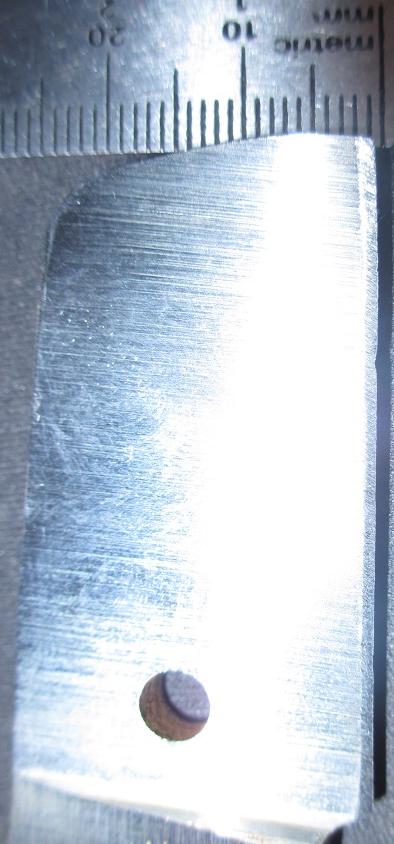
Close up pic of edge (at the end of the video)
N8XBOey.jpg
 
Last edited:
Keep the good work up man! I am waiting for you until you have your chopper ready to sell. About .5 mm "behind the edge" with W2 and 62 RC with the result showed on youtube is the most impressive demonstration of "hardening skills" I have seen so far. EXCELLENT !

Looking forward for more !
 
Thanks Andy. I haven't touch this W2 chopper since the video. There is a fairly old dirty palette made out of oak boards daring this W2 chopper to demolition it. I will make a few mis-hits (heavy lateral deflection) to see the damage mode to this ~0.5mm behind-edge-thickness. Chips = bad; ripple = actually is good (shown toughness).

Keep the good work up man! I am waiting for you until you have your chopper ready to sell. About .5 mm "behind the edge" with W2 and 62 RC with the result showed on youtube is the most impressive demonstration of "hardening skills" I have seen so far. EXCELLENT !

Looking forward for more !
 
That would depend a little bit on cardboard type [ food grade, industrial hard, industrial soft]. Industrial soft cardboard usually really abrasive, so edge with large irregularities works better. E.g. draw/saw cut using large carbides D2 or coarse grit sharpening of HCV steels. For cardboard with very fine abrasive (mostly food grade), low/high CV edge will settle down to a working edge at different apex radius depend on edge geometry. I've cut 1+mile of clean cardboard with 52100, where apex radius would stay around 1-3um indefinitely (well after 5 sessions 1/day, boredom stopped me from go on further). For those, had look/read my 'notch mirror sharpener', then there is high likelihood correlation of self-sharpening from sawing through fine abrasive materials.

Sorry about my tiny bit of rambling...

Been collecting cardboard :cool: I am thinking 1000 grit would be a good cardboard edge?
 
Bluntcut, excellent work as usual. I think in your case, you have the geometry right on. What do you think of W2 compared to 52100?
 
Thanks Cobalt!

I use Aldo (NJSteelBaron) W2 & 52100, so their carbon % around 0.94. With my SQ ht, W2 is a few percent easier to sharpen to tree topping edge than 52100. While 52100 is around 5-8% more wear resistant than W2 due to extra 1% of Cr. Also extra CrC are large in size (100-300nm) vs W2 nominal (sub 200nm and only 1/3 CrC volume compare to 52100) in size. If a person is a sharp knut, W2 would be a better choice. Don't get me wrong, Edge of 52100 can easily get into Feather DE level, but W2 can get there faster & easier. I found a little to no different in level of W2 sharpness compare to Hitachi White #2 steel.


Bluntcut, excellent work as usual. I think in your case, you have the geometry right on. What do you think of W2 compared to 52100?
 
Thanks Cobalt!

I use Aldo (NJSteelBaron) W2 & 52100, so their carbon % around 0.94. With my SQ ht, W2 is a few percent easier to sharpen to tree topping edge than 52100. While 52100 is around 5-8% more wear resistant than W2 due to extra 1% of Cr. Also extra CrC are large in size (100-300nm) vs W2 nominal (sub 200nm and only 1/3 CrC volume compare to 52100) in size. If a person is a sharp knut, W2 would be a better choice. Don't get me wrong, Edge of 52100 can easily get into Feather DE level, but W2 can get there faster & easier. I found a little to no different in level of W2 sharpness compare to Hitachi White #2 steel.

What about edge toughness difference at the higher Rc's? Are they similar in edge degradation? The way the edge starts to micro roll or chip?
 
:thumbup: Excellent and loaded questions.

When testing my edges, I look for a balance point of micro-roll and mini-chip when edge encountered damaging impact. For such impact, too soft = very big roll; too hard = large crescent chip. This 'balance point' solely depend on quality of the matrix. The finer the grain and smaller carbide, the higher this balance point will be. Higher balance-point, mean higher hardness and higher toughness go together.

I think, an ideal mode of edge degradation (for non-wearing type) would be micro-roll & mini-chip because this type of damage has less depth than big roll/ripple or large chip. Say as a kid, if ask to build a high arch 3" & 10" long 1" thick bridges out of lego. Arch = bending radius. Without much hesitation, you would choose micro lego instead of those honkin' 1" thick lego, right?

Technically, this balance mode is also applicable to 'wearing' degradation type especially when carbides serve as saw teeth. So ideally, the matrix hold onto carbide as strong & tough as possible, so ideal degradation would be a release of individual carbide rather taking out a chunk of matrix along with carbide. This way, intact matrix would protect other carbides, avoiding cascading failure. In super high alloy case, well, there aren't much matrix spacing between particle/carbide, so sometime cascade (big chip) is unavoidable if the matrix can't absorb the damaging energy. With an incoming 50cal, I would rather be behind a single wall of sandbags than a single wall of bricks :p

My current ht for low Cr steels with carbon 0.9-1.2% yield similar ultra fine grain sizes. Where 52100 has slightly more & larger CrC than in W2, so it gave up tiny toughness for gain in wear resistant.

What about edge toughness difference at the higher Rc's? Are they similar in edge degradation? The way the edge starts to micro roll or chip?

 
Back
Top