
-
The BladeForums.com 2024 Traditional Knife is available! Price is $250 ea (shipped within CONUS).
Order here: https://www.bladeforums.com/help/2024-traditional/
You are using an out of date browser. It may not display this or other websites correctly.
You should upgrade or use an alternative browser.
You should upgrade or use an alternative browser.
Abalone
- Thread starter Tom Carey
- Start date

- Joined
- Apr 14, 2006
- Messages
- 3,816
Abalone is one of those things wheo you find it get it. It is out there but finding good pieces can be difficult. I can find all sorts of it but it is illegal to sell the sport caught shell in Cal. Most all of the shell here is sport caught. Also work it with caution. You need lapidary equipment and cut it with water. The dust and vapor can kill you. It will make you really sick at the very least if you are not very careful.
Chuck
Chuck

Stacy E. Apelt - Bladesmith
ilmarinen - MODERATOR
Moderator
Knifemaker / Craftsman / Service Provider
- Joined
- Aug 20, 2004
- Messages
- 38,649
Cutting and polishing abalone requires lapidary equipment and knowledge of the material. Yes, it cuts and finishes like MOP, but it can make you very sick. Buying abalone slabs and inlay pieces is a better idea. Avoid the dust at all costs. I have a stack of shells from 25 years ago when i cut the stuff. Every now and then I think about cutting them up, then say, "Naw,not worth the trouble of setting up the water spray equipment."
Stacy
Stacy
i got some questions
first where do i get hold of this? this is the most beautiful material i have ever seen in a knifehandle.
is it really that dangerous to work with? what does it contain really? is it dangerous to have dust in your shop (on floors etc) even if you grinded it with a carbonfiltermask? i mean will it get airborne?
what is lapidary equipment?
how brittle is this material?
first where do i get hold of this? this is the most beautiful material i have ever seen in a knifehandle.
is it really that dangerous to work with? what does it contain really? is it dangerous to have dust in your shop (on floors etc) even if you grinded it with a carbonfiltermask? i mean will it get airborne?
what is lapidary equipment?
how brittle is this material?
- Joined
- Apr 14, 2006
- Messages
- 3,816
You can find it at some knife shows, Jewelery supply houses are another possibility. It is very common in the northwestern coast. One problem is that only about 25 to 30% are usable due to worms in the shell. And when you do find a good piece it is very small due to the curvature of the shell. The dust is very toxic, but also the vapor. It is dangerous to have the dust around the shop so a standard resparator will not help with that. Lapidary equipment is what you use to cut gemstones for jewelery. It uses water to keep the grinding stones and gems cool. This will also eliminate the dust and vapor. If you do use abalone and get some lapidary equipment then if you smell anything but water mist stop and make adjustments. I used this material in jewelery when i was a teenager. I felt like I was going to suffocate the next day. I did not have the right equipment and still feel residual effects 30 years later.
Chuck
Chuck

- Joined
- Jan 18, 2004
- Messages
- 1,135
I ain't touchin the stuff because it's just a bunch abalone
Oh great balls of bearhide Kerry. You crack me up


- Joined
- Mar 12, 2006
- Messages
- 2,264
- Joined
- Mar 12, 2006
- Messages
- 2,264
BTW, you can get it here:
http://www.motherofpearl.net/
I don't know if the hazards are the same as with cutting raw shell. I've never heard of any cautions beyond the obvious. I haven't noticed ill effects just using normal MOP-cutting procedures for this material.
Good luck.
http://www.motherofpearl.net/
I don't know if the hazards are the same as with cutting raw shell. I've never heard of any cautions beyond the obvious. I haven't noticed ill effects just using normal MOP-cutting procedures for this material.
Good luck.

KnifeHead
Knifemaker / Craftsman / Service Provider
- Joined
- Apr 5, 2006
- Messages
- 5,581
This is just me, but I don't get excited by a handle completely done in abalone. MOP is wonderful but abalone is sometimes too "busy" for my taste. I prefer it in smaller amounts as small geometric shapes or even a shield in the handle field. It is beautiful, but for me, you can have too much of a good thing.
- Joined
- Mar 12, 2006
- Messages
- 2,264
Well it's a lot cheaper that way, that's for sure ... I think the Paua cost about $150 for that Bowie five years ago.
If you're going to do small pieces you get this stuff thin from luthier-supply outfits. They sell it very thin for guitar necks--you cut it with an X-acto. They even have it so thin it's intended to be applied without cutting a pocket to inlay into. It just sits on top because the final finish is usually thicker than the shell and it sort of evens out when done ... Crazy. (I wouldn't try that on a knife handle, though!)
It's also a lot cheaper getting it thin than 1/8 inch or more thick. Look at the full-sheet prices on the MOP site!!!

If you're going to do small pieces you get this stuff thin from luthier-supply outfits. They sell it very thin for guitar necks--you cut it with an X-acto. They even have it so thin it's intended to be applied without cutting a pocket to inlay into. It just sits on top because the final finish is usually thicker than the shell and it sort of evens out when done ... Crazy. (I wouldn't try that on a knife handle, though!)
It's also a lot cheaper getting it thin than 1/8 inch or more thick. Look at the full-sheet prices on the MOP site!!!
You can find it at some knife shows, Jewelery supply houses are another possibility. It is very common in the northwestern coast. One problem is that only about 25 to 30% are usable due to worms in the shell. And when you do find a good piece it is very small due to the curvature of the shell. The dust is very toxic, but also the vapor. It is dangerous to have the dust around the shop so a standard resparator will not help with that. Lapidary equipment is what you use to cut gemstones for jewelery. It uses water to keep the grinding stones and gems cool. This will also eliminate the dust and vapor. If you do use abalone and get some lapidary equipment then if you smell anything but water mist stop and make adjustments. I used this material in jewelery when i was a teenager. I felt like I was going to suffocate the next day. I did not have the right equipment and still feel residual effects 30 years later.
Chuck
thanks for the info :thumbup:
yes i´m probably thinking of mosaic abalone (what queen cutlery uses i really like). is MOP cheaper than abalone? you know that white pearl like many "traditional" brands use. case, queen etc.

- Joined
- Jan 2, 2006
- Messages
- 2,280
You're probably thinking of "mosaic abalone/paua" or "laminated abalone/paua". You'll find that pieces cut straight from the shell are usually not as dramatic especially in larger flat sections often needed for knife handles.
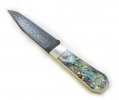
This is the stuff:
I like it. Looks nice on your knife great job. A+------------:thumbup:
- Joined
- Mar 12, 2006
- Messages
- 2,264
I like it. Looks nice on your knife great job. A+------------:thumbup:
Thanks
- Joined
- Apr 14, 2006
- Messages
- 3,816
thanks for the info :thumbup:
yes i´m probably thinking of mosaic abalone (what queen cutlery uses i really like). is MOP cheaper than abalone? you know that white pearl like many "traditional" brands use. case, queen etc.
I am not sure what the abalone costs. I have never really paid much attention since I have a bucket full of shell. MOP like most natural material is getting more expensive all the time. THe mosaic material is usually reasonable. If you are just using it in inlays then it does not set you back too much.
Chuck
KnifeHead
Knifemaker / Craftsman / Service Provider
- Joined
- Apr 5, 2006
- Messages
- 5,581
I like it. Looks nice on your knife great job. A+------------:thumbup:
I do have to agree with Terry. You did make that knife look great and I think it is due to the nice, big bolster. It is visually balanced.
- Joined
- Mar 12, 2006
- Messages
- 2,264
Thanks Kerry.
About the cost of the mosaic ...
If you look at the MOP site I linked under mosaic abalone, you'll see the prices for the thicker stuff suitable for whole-knife scales. If you want the pretty, curly stuff it's not cheap ... about $20 to $50 per inch. A 9 1/2 by 5 1/2 sheet of the really good stuff, 1/8 thick will put you back almost $2,700!!
I haven't used the stuff too much in the last few years because of the cost and like Kerry says, you have to be sensitive to how much activity is going on in you knife. It's easy for something like this to take over and work against the overall impact of your design. I usually don't design a knife around the idea of the handle being the primary focus. Having said that, however, when it works, it really works.:thumbup:
About the cost of the mosaic ...
If you look at the MOP site I linked under mosaic abalone, you'll see the prices for the thicker stuff suitable for whole-knife scales. If you want the pretty, curly stuff it's not cheap ... about $20 to $50 per inch. A 9 1/2 by 5 1/2 sheet of the really good stuff, 1/8 thick will put you back almost $2,700!!
I haven't used the stuff too much in the last few years because of the cost and like Kerry says, you have to be sensitive to how much activity is going on in you knife. It's easy for something like this to take over and work against the overall impact of your design. I usually don't design a knife around the idea of the handle being the primary focus. Having said that, however, when it works, it really works.:thumbup:
i was looking at this knife http://soonerstateknives.com/Q-14ABW.JPG
what do they use in those knives? it seems to be pretty big and thick pieces. is that some kind of glued together laminate kinda similar (when making it) to micarta or g10? or perhaps grinded down and mixed with epoxy to make a big peice? or is that a single natural peice from a shell?
what do they use in those knives? it seems to be pretty big and thick pieces. is that some kind of glued together laminate kinda similar (when making it) to micarta or g10? or perhaps grinded down and mixed with epoxy to make a big peice? or is that a single natural peice from a shell?