about infi

Joined
Apr 7, 2025
Messages
23
Has current INFI steel improved in performance and in manufacturing process compared to the INFI steel from 5 years ago?


And if we set aside wear resistance, does INFI have an advantage over 3V steel when directly comparing chip resistance (edge break resistance) and edge rolling resistance?
 
The way I understand it.....infi now is the same as the cheaper modified infi that was released through the basic series. Not the same as the the og infi. others can tell what the difference is. other than cheaper to make.
 
Has current INFI steel improved in performance and in manufacturing process compared to the INFI steel from 5 years ago?


And if we set aside wear resistance, does INFI have an advantage over 3V steel when directly comparing chip resistance (edge break resistance) and edge rolling resistance?

Do your research and enjoy the fun. Start here

Proof Of Busse (and Kin) Superiority | BladeForums.com https://share.google/3vSvufumQZEgEwRxp
 
For what it’s worth, I have been giving multiple short swords in different steel a lot of use border line abuse. While new INFI is a great performing steel, I find the older stuff is harder and tougher. Even sharpening is very different. I could put an edge really fast on the new stuff while the older was much harder on stones and felt more resistant to abrasions and wear. From my limited, non scientific observations 3v takes the cake slightly above old INFI. It’s just crazy to me how much abuse it can take with minimum damage. Hold a working edge well, and still sharpens easy enough. I have 3 pieces in 3v from 2 manufacturers Busse being one. It just is hard to beat.
 
I cant speak to the older Busse INFI but, as far as the current INFI goes, I can totally agree with kdizzog6 that the current INFI sharpens up so very nicely (easily)
Personally, ill take the current INFI over the older INFI any day of the week.
I love being able to keep my Fusion Battle Saw, Liberty Heart & Trustee Warden EXTREMELY sharp. And, its just absolutely amazing that the FBM will keep a sharp edge for such a long time after A LOT of hard use.
Im not talking anything extreme or abuse.
Imo, or personal preference ill never have to do that. Current INFI is so freakin awesome as is, that id never want anything else to be honest.
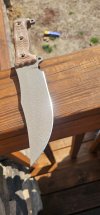
20260301_113414.jpg
Crap - I left the aluminum foil out last night- we were grillin 😆
 
Has current INFI steel improved in performance and in manufacturing process compared to the INFI steel from 5 years ago?


And if we set aside wear resistance, does INFI have an advantage over 3V steel when directly comparing chip resistance (edge break resistance) and edge rolling resistance?

I am sorry, I didn't actually answer your question. Yes, it does. INFI does outperform 3V in chip and edge damage resistance. I have directly compared the two. Not to say that 3V isn't good, because it is an excellent steel and I would not feel bad if all I had was 3V. But INFI is a step up in toughness. Long term wear resistance, I am not so sure which is better. I think at equal hardness they will be close. It really is all about the heat treat. You can get 3V that will be outperformed by 1070 steel. If the HT is just basic it will be just ok. 3V the way Busse or Carothers and I am sure some others do it, is awesome.

Just realize blade and edge geometry have a lot to do with how tough a knife can be as much or more, as steel or HT. For example, a low sabre grind knife like the Ontario marine raider is tough because of blade geometry. Or a design like a Skrama, a scandi design is basically a cheap piece of flat stock metal, beveled at one end. Easiest design to make. That's geometry making up for average steel.

Then there are new steels that are comparable to INFI and 3V. Like Ztuff. I love that there are people out there looking to up the ante with new steels. It helps the whole industry.
 
Yeah man heat treat is where its at. And Busse is a Master of it in my experience
They're AEB-L is just phenomenal!
(War Dog 5 Trailing Point)
I dunno what they do but, you can cut and slice forever with it. I love it.
 
When it comes to chip resistance and edge deformation specifically, my experiences are as follows.

D3V > INFI > All other 3V

The higher hardness of D3V does give it a higher resistance to edge deformation and better edge strength.

But D3V is an entirely different beast than standard 3V HT found in the vast(everything else) majority of blades.
 
Last edited:
When it comes to chip resistance and edge deformation specifically, my experiences are as follows.

D3V > INFI > All other 3V

The higher hardness of D3V does give it a higher resistance to edge deformation and better edge strength.

But D3V is an entirely different beast than standard 3V HT found in the vast(everything else) majority of blades.

I compared D3V to INFI and I made a video of it. The edge damage was greater in D3V by a large amount. But then again, the INFI I used was the old INFI that was 2 points higher. in Rc
 
Did a little digging around and found this thread:

and found more of the test videos:

Very impressive tests and thank you for your service Cobalt Cobalt !
 
Did a little digging around and found this thread:

and found more of the test videos:

Very impressive tests and thank you for your service Cobalt Cobalt !
Very informative thread and testing. I only fear it might be a tad dated when used to represent todays version of both steels. Since 2016 or before (whenever that survive knife was made) the D3V protocol has been perfected/improved quite a bit, also the old +2 rc INFI is not the same as todays softer INFI.

Through my usage, I find they both excel a different things.
Modern INFI for ease of sharpening, overall tensile strength (will bend before snapping)
Modern D3V for edge strength, wear resistance.

Some madman should redo some testing with todays D3V and INFI to get a definitive answer.
 
Very informative thread and testing. I only fear it might be a tad dated when used to represent todays version of both steels. Since 2016 or before (whenever that survive knife was made) the D3V protocol has been perfected/improved quite a bit, also the old +2 rc INFI is not the same as todays softer INFI.

Through my usage, I find they both excel a different things.
Modern INFI for ease of sharpening, overall tensile strength (will bend before snapping)
Modern D3V for edge strength, wear resistance.

Some madman should redo some testing with todays D3V and INFI to get a definitive answer.

Agreed on all accounts. It certainly is unfair to compare to the original run INFI. I assume you have some current D3V? If so, I would be willing to donate a dirt dart steel heart for testing comparison. That's the current setup, steel and HT. Can do a cutting durability comparison, then an edge damage comparison. The DDSH is medium in size so it's not massive and since it is flat ground geometry is excellent.
 
Agreed on all accounts. It certainly is unfair to compare to the original run INFI. I assume you have some current D3V? If so, I would be willing to donate a dirt dart steel heart for testing comparison. That's the current setup, steel and HT. Can do a cutting durability comparison, then an edge damage comparison. The DDSH is medium in size so it's not massive and since it is flat ground geometry is excellent.
Unfortunately I do not have any current D3V, Sold my last bit of it a while ago due to living costs...sad.

But now looking back into this, Im question if hammering into a nail is even a good test for real world edge impact testing. And there are far too many variables to test the steel by swinging them at wood with a nail imbedded in it, Like edge angle, speed, force, weight of the knife... ~ or are there?

There was a lock test video done by cold steel where the knife was swung by a mechanical arm with a counterweight. Albeit that test was a bit janky, I think that type of test done professionally would better reflect the steels impact toughness and chip resistance. Better than forcefully, slowly, driving the steel through metal.

In Carothers testing, even magna cut was driven through a nail without much edge damage if any, Magnacut is certainly not more chip resistance than INFI.

With this type of test you could even change the impact angle for "off cuts" and see which steel holds up better.

My hypothesis would be that INFI may hold up better from "off cuts" because the overall higher strength of the steel and malleability. D3V may hold up better from "straight on" cuts because of the overall hardness of the steel mixed with exceptional toughness.


Im pretty invested now to make such a testing contraption..

 
Unfortunately I do not have any current D3V, Sold my last bit of it a while ago due to living costs...sad.

But now looking back into this, Im question if hammering into a nail is even a good test for real world edge impact testing. And there are far too many variables to test the steel by swinging them at wood with a nail imbedded in it, Like edge angle, speed, force, weight of the knife... ~ or are there?

There was a lock test video done by cold steel where the knife was swung by a mechanical arm with a counterweight. Albeit that test was a bit janky, I think that type of test done professionally would better reflect the steels impact toughness and chip resistance. Better than forcefully, slowly, driving the steel through metal.

In Carothers testing, even magna cut was driven through a nail without much edge damage if any, Magnacut is certainly not more chip resistance than INFI.

With this type of test you could even change the impact angle for "off cuts" and see which steel holds up better.

My hypothesis would be that INFI may hold up better from "off cuts" because the overall higher strength of the steel and malleability. D3V may hold up better from "straight on" cuts because of the overall hardness of the steel mixed with exceptional toughness.


Im pretty invested now to make such a testing contraption..

I think anyway you test you can fudge things. If you swing the blade, you can swing light with one and heavy with the other. And results will be obscured by the unfair tests. Creating a jig that uses a mild steel bar that impacts the edge at the same velocity every time would be best. Regardless of what blade is tested, the bar hits at the same velocity and same force. Unfortunately charpy testing is not very relevant for knife blade geometry. Regardless, I would give overall toughness edge to INFI. I don't believe Delta HT is better than Busse and having seen what Busse's 3V can do, which I didn't think 3V could do ever, my guess is INFI with it's lower Carbon content will be considerably tougher, but will have less edge wear resistance.
 
Back
Top