
-
The BladeForums.com 2024 Traditional Knife is available! Price is $250 ea (shipped within CONUS).
Order here: https://www.bladeforums.com/help/2024-traditional/
You are using an out of date browser. It may not display this or other websites correctly.
You should upgrade or use an alternative browser.
You should upgrade or use an alternative browser.
Abrasive saw questions
- Thread starter JMJones
- Start date

- Joined
- Oct 3, 2002
- Messages
- 12,297
I burned up a couple cheap ones right off the bat, then burned up two Dewalts.
I finally bought a Milwaukee and it has been working fine for over 10 years now...
I finally bought a Milwaukee and it has been working fine for over 10 years now...

Stacy E. Apelt - Bladesmith
ilmarinen - MODERATOR
Moderator
Knifemaker / Craftsman / Service Provider
- Joined
- Aug 20, 2004
- Messages
- 38,513
There is no reason you can't make your own. A heavy mandrel that fits the blades should be easy to find or make. Make it a fixed unit with a 1.5-2 HP motor driving it directly or by V-belt. Make the cutting table under the blade hinged so it lifts up into the rotating saw. You could even automate the lift/cut by placing an air cylinder under the cutting table and operating it with a foot pedal. That way you would have both hands free to move the billet down for the next cut rapidly and safely.
I can sketch this if it doesn't make sense.
I can sketch this if it doesn't make sense.
- Joined
- Jun 5, 2012
- Messages
- 1,071
If your budget allows, try to get a carbide toothed chop saw.
They go by a few names, combo saw, multi saw, etc. They appear similar to a standard abrasive chop saw, but run at less than half the speed (proper SFM for carbide).
The blades are pricy, but they usually come with one, and you can have them sharpened for a very reasonable price.
In my personal experience, a single $60-70 blade lasts 20-30x longer than a $5-10 abrasive wheel. It also cuts almost completely cold (no overheating material), and leaves very little to no burr. When I switched to one of these saws for use as a professional fabricator, it sped up my weld/fit time significantly, in many cases I didn't even have to do anything to the cut end. At first the guys in the shop were dubious, but as soon as they tried it, the abrasive saw didn't get used for over a year until we had a huge job and had to run both.
The blades seem to be pretty tough, not having too much trouble with dirty, nasty, rusty structural steel stock and occasional stainless, so I don't think most knife steels would be a problem for them.
The upside on the abrasive saw is that it can cut hardened materials without issue, so could be used for stuff like trimming tangs, etc.
Just wanted to bring up the carbide version for your consideration.
They go by a few names, combo saw, multi saw, etc. They appear similar to a standard abrasive chop saw, but run at less than half the speed (proper SFM for carbide).
The blades are pricy, but they usually come with one, and you can have them sharpened for a very reasonable price.
In my personal experience, a single $60-70 blade lasts 20-30x longer than a $5-10 abrasive wheel. It also cuts almost completely cold (no overheating material), and leaves very little to no burr. When I switched to one of these saws for use as a professional fabricator, it sped up my weld/fit time significantly, in many cases I didn't even have to do anything to the cut end. At first the guys in the shop were dubious, but as soon as they tried it, the abrasive saw didn't get used for over a year until we had a huge job and had to run both.
The blades seem to be pretty tough, not having too much trouble with dirty, nasty, rusty structural steel stock and occasional stainless, so I don't think most knife steels would be a problem for them.
The upside on the abrasive saw is that it can cut hardened materials without issue, so could be used for stuff like trimming tangs, etc.
Just wanted to bring up the carbide version for your consideration.

- Joined
- Oct 17, 2010
- Messages
- 2,424
Are you talking about a Cold Saw Ian?
Usually they run at *MUCH* less than half the RPM of an abrasive saw. My Scotchman CPO350PK/LT ferrous cold saw ran at 22 and 44 rpm respectively, and usually, the blades are HSS for cutting ferrous metal, and run more like $150 for new blades, but you can resharpen them often.
I agree they're excellent for fab work, if you're cutting tubing or small solids they're beyond value. However, I bought mine for cutting 45 deg tiles for ferry flipped damascus billets, and found them lacking for that purpose. Kerf is large, (minimum blade thickness for this size saw is roughly 0.100, where as my bandsaw blades are 0.035, and I'd often run into problems making cuts where I'd work harden or run into hard spots if I didn't anneal the billets.
In the end I sold the cold saw, because it was taking up too much space, and I don't need it for general fabrication as much as the next guy. A larger, more rigid saw would maybe have worked better, but they're not that common in a reasonable price range, the model I had, is the lower end of industrial quality cold saws, and run about $6k new.
Now, in regards to the OP's question, there are numerous heavier duty abrasive saws, kalamazoo makes a smaller semi-reasonable priced one, that is well regarded. Personally, I don't like using an abrasive saw for cutting billets. There's still more kerf than I want, and the more kerf, the more chance of layer misalignment on restacks (an obsession of mine), they're also nasty in the shop (worse than a Surface grinder or belt grinder IMHO) and louder than hell. I use a large horizontal bandsaw, and a tiny horizontal for all my billet work. With properly broken in premium M-42 blades (I use the Haltbar M-42 701 series from sawblade.com), you can get dead square cuts with super high cut rates, but break-in is essential. Even if your saw's guides are great, but you don't break in your blades, they'll cut crooked and have poor life.
FWIW, I never anneal my billets while restacking, just let them cool, and slice em up. I haven't replaced my big saw's blade in about a year. The smaller Harbor Freight piece of poo however, goes through them like nobody's business because of all the slop and shake. I just have it modified for cutting tiles for flipped billets however, so no big deal, although ideally, I'll replace both of them at some point with a "swivel/miter head" type horizontal, like a Hyd-Mech. My current larger saw is a Startrite (14" capacity), but it's not setup to cut miters.
Usually they run at *MUCH* less than half the RPM of an abrasive saw. My Scotchman CPO350PK/LT ferrous cold saw ran at 22 and 44 rpm respectively, and usually, the blades are HSS for cutting ferrous metal, and run more like $150 for new blades, but you can resharpen them often.
I agree they're excellent for fab work, if you're cutting tubing or small solids they're beyond value. However, I bought mine for cutting 45 deg tiles for ferry flipped damascus billets, and found them lacking for that purpose. Kerf is large, (minimum blade thickness for this size saw is roughly 0.100, where as my bandsaw blades are 0.035, and I'd often run into problems making cuts where I'd work harden or run into hard spots if I didn't anneal the billets.
In the end I sold the cold saw, because it was taking up too much space, and I don't need it for general fabrication as much as the next guy. A larger, more rigid saw would maybe have worked better, but they're not that common in a reasonable price range, the model I had, is the lower end of industrial quality cold saws, and run about $6k new.
Now, in regards to the OP's question, there are numerous heavier duty abrasive saws, kalamazoo makes a smaller semi-reasonable priced one, that is well regarded. Personally, I don't like using an abrasive saw for cutting billets. There's still more kerf than I want, and the more kerf, the more chance of layer misalignment on restacks (an obsession of mine), they're also nasty in the shop (worse than a Surface grinder or belt grinder IMHO) and louder than hell. I use a large horizontal bandsaw, and a tiny horizontal for all my billet work. With properly broken in premium M-42 blades (I use the Haltbar M-42 701 series from sawblade.com), you can get dead square cuts with super high cut rates, but break-in is essential. Even if your saw's guides are great, but you don't break in your blades, they'll cut crooked and have poor life.
FWIW, I never anneal my billets while restacking, just let them cool, and slice em up. I haven't replaced my big saw's blade in about a year. The smaller Harbor Freight piece of poo however, goes through them like nobody's business because of all the slop and shake. I just have it modified for cutting tiles for flipped billets however, so no big deal, although ideally, I'll replace both of them at some point with a "swivel/miter head" type horizontal, like a Hyd-Mech. My current larger saw is a Startrite (14" capacity), but it's not setup to cut miters.
Thanks for the input. I know abrasive saws are loud and I only use it outside so I dont have to worry about sparks. I am using o1 and l6 and it tends to air harden and laugh at the bandsaw. I have been hot cutting it but that is also a pain because I then have to clean up a bunch of pieces instead of one long bar. Stacy, I would love to see a pic or sketch.

- Joined
- May 28, 2013
- Messages
- 232
We have one of these 14" Dewalts at work with the carbide blade. Our abrasive saw never gets used anymore The cool thing about it is that it's cool... literally (sorry) It doesn't generate much heat when cutting like others have said. I have to admit that it was a bit weird hacking into metal with a blade that looks like it's made for wood...
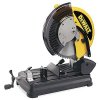
The cool thing about it is that it's cool... literally (sorry) It doesn't generate much heat when cutting like others have said. I have to admit that it was a bit weird hacking into metal with a blade that looks like it's made for wood...We have one of these 14" Dewalts at work with the carbide blade. Our abrasive saw never gets used anymore
View attachment 386907
That is the ticket. By the way, Milwaukee had one that is discontinued and has no replacement. Too bad, I really like my Milwaukee drill and Portaband. I wanted add another pup to the group, but it will have to be the dewalt.

- Joined
- Nov 20, 2008
- Messages
- 1,855
I burned up a couple cheap ones right off the bat, then burned up two Dewalts.
I finally bought a Milwaukee and it has been working fine for over 10 years now...
Can't beat a milwaukee chop saw. Like Don, ours has been in use in a busy shop for over 10 years and still ticking.
- Joined
- Jun 5, 2012
- Messages
- 1,071
Javand,
Its the saw shown in the post above me, its almost an exact cross between a cold saw and a chop saw.
Its the saw shown in the post above me, its almost an exact cross between a cold saw and a chop saw.
Javand,
Its the saw shown in the post above me, its almost an exact cross between a cold saw and a chop saw.
How fragile are these 14" carbide blades? Seems like reviews are all over the place which leads me to believe that this is user error and too aggressive feed rates.
- Joined
- Oct 17, 2010
- Messages
- 2,424
Javand,
Its the saw shown in the post above me, its almost an exact cross between a cold saw and a chop saw.
Interesting, I've never heard of those. What's the minimum kerf on the blades? Will the carbide tips handle the shock of hitting hard spots? or air hardening combos like the OP's o1/l6 combo?