
accidental hamon in 15n20

Willie71

Warren J. Krywko
Joined
Feb 23, 2013
Messages
12,214
As I was working on the kith knives, and a few others, I set the forge at about 1450f to soak the blades. I decided to try some quenches in 1095 and 15n20 under 1475f, since I now have a tester, I can verify how well HT works. I did two 15n20 blades, soaked at 1450, and slowly ramped up to 1465, then quenched in fast oil. I was going to use heated canola, but the breaker on my hot plate tripped without me knowing it, and I pulled the Maxim oil over to quench rather than starting the cycle over (I was using it for the 1095 anyway.) I did this for each of the 15n20 blades, and 1095 blades. I tempered at 350f for 90minutes, and tested the blades. Rc62 for the 15n20, and Rc64 for the 1095. Re tempered the 15n20 at 375, then 385. One is Rc6o, this one is Rc60.5. As I was sanding the kith blade, a line started appearing as I sanded. As I kept going, one of the nicest hamons I have done started showing itself. I did better in W2, but for a steel not known for a hamon, I thought this was worth posting. I was trying to get a good pic, but the batteries in the camera died, and I am apparently out of spares. This picture is at a very rough 800g, with a light vinegar then light lemon juice etch. No polishing, no lengthy etching, basically as sanded.
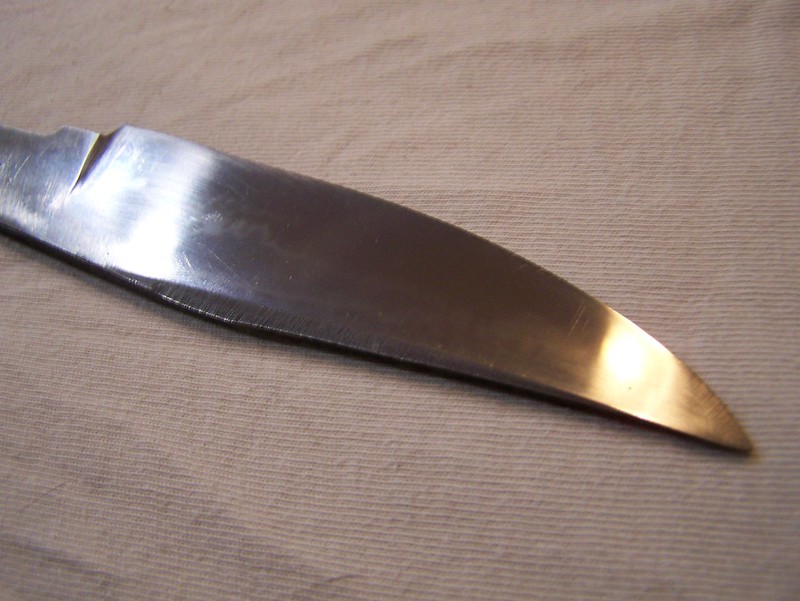
10566312783_aaf513b028_c.jpg
 
15n20 can definitely produce some nice hamons. It's shallow hardening for sure and doesn't have alloy that masks it much at least. I typically draw back martensitic spines, but I leave the ricasso unquenched often and have produced some really bold crescents unintentionally.
 
I would not call any steel with .75% manganese shallow hardening. Also, with 1.5% nickel, I would not expect much or any hamon. Can't say it won't work from experience, as I have never tried 15N20 for a hamon, but the metallurgy looks like it is a poor choice.

Generally I prefer very low alloy steels from .75 to 1.3% carbon and less than .35% manganese. I would not use a steel with more than a residual trace of chromium, nickel, vanadium, or other grain reducers and carbide formers. The perfect hamon steel would be 1% carbon and 99% iron....but good luck on finding that :)
True tamahagane and Hitachi white paper are as close as you will come.
On the subject of tamahagane, be cautious if buying online, as many unscrupulous sellers market any home smelt or even factory steels from Japan or China as tamahagane. Even in a true tamahagane smelt, there may be part of the bloom steel made that is not good for making a knife/sword. These lumps often get put on ebay. I would ask myself why someone would sell something they could turn into much more money before buying such material?
 
Yeah, odd that it would work, but it does. Haven't seen any really dramatic showy ones on 15n20, but some pretty nice pattern that looks like cumulus clouds.
 
Stacy, I thought general spec on 15N20 was .35-.40 Mn...

I agree, though - shouldn't be doing this. Not to say that it isn't a nice aesthetic!
 
I suspect the lower austentizing temp, combined with the fast oil is what caused this. The edge is fully hardened. I will see if I can duplicate this.

http://www.alphaknifesupply.com/zdata-bladesteelC-15N20.htm

I wonder if Aldo's 15n20 is 1075 with 2% Nickel. If so, this would be reasonable. There is nothing on Aldo's site as to the actual steel composition. In any event, I like it. The picture is lousy. This is better than what I get with 1095 sometimes (1475f with clay in brine for 7 seconds, then fast oil.) The W2 blades I did were better, but this is odd for this steel. I ordered 24' of this steel to play with for the winter. :)
 
You are right, many 15N20 alloys have lower Mn than the upper end. The formula range is .40-.75%. I have looked up several suppliers formulae as well as individual batch analysis, and there is considerable variability.
 
The link above doesn't show any chromium. Does that change the heat treat soak time recommendation?
 
You are right, many 15N20 alloys have lower Mn than the upper end. The formula range is .40-.75%. I have looked up several suppliers formulae as well as individual batch analysis, and there is considerable variability.

I didn't think about the manganese, you're right. The stuff I got spec'd had 0.33% and the lab categorized it as 15n20 without an asterisk for unusual alloy amount for specified grade, so I bet there's a lot of variation in this. Whatever the case, I've gotten some good transition lines using it with 1475 and 1500 deg soaks. Not as bold as W1, but very visible none the less.
 
Back
Top