Accidentally bought a Taylor Schrade...

Joined
Dec 20, 2004
Messages
3,863
... And it is pretty lousy. My own fault for not reading the fine print closely enough. At least I didn't end up paying much.

It is the Minuteman, which is a very cool peanut-like pattern. What is not very cool are the super bendy, wafer-thin blades which are actually bent and very unevenly ground. And by uneven, I mean the whole blade including the ricasso area - not just the edge. Tis one is not even worth keeping as a sacrificial, toolbox knife.

Is this a typical Taylor Schrade experience? If so, how are they staying in business?


I'll be more careful about looking at the Schrade USA designation in the future.
 
I tried a whittler, It's really really bad. Paper thin secondary blades and none of the three will take an edge that lasts at all.
It was a sad day when taylor bought the names Schrade and Camillus.

Regards

Robin
 
You would think that with all of the imported traditional knives coming out of china sporting respectable F&F (I.E Rough Rider, Colt, Marbles) that Schrade could get it together. I dunno if the Schrades are really as bad as people say they are, but if the reports of quality are true, I suppose they are manufactured by some other outfit in china possibly. I recall a while back that an individual here was impressed with their imported Schrade so maybe they put out decent knives from time to time.
 
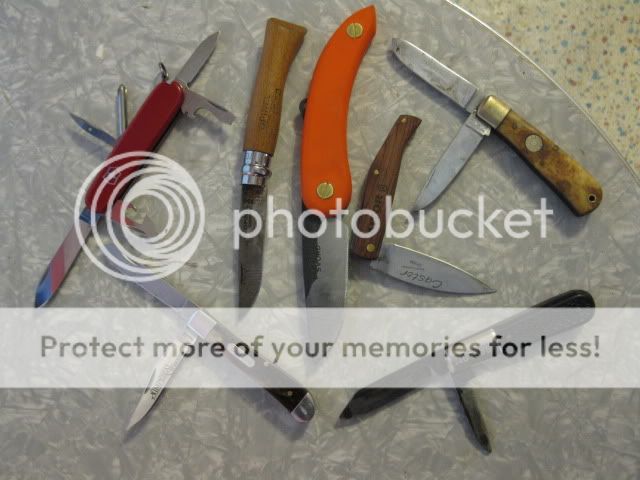
bought a taylor 'imperial by schrade' a little while back. its the trapper pattern on the bottom left;
IMG_13311.jpg

carried it for a bit but i like the aitor, svord and opinel better so ive not used it since.
 
As with most other countries or items, quality varies from factory to factory. Write a tight specification and insist on quality (i.e. meeting that specification) and country of origin doesn't mean anything. On the other hand, if your QC department accepts anything, anything is what you will get, no matter what the country of origin.
 
As with most other countries or items, quality varies from factory to factory. Write a tight specification and insist on quality (i.e. meeting that specification) and country of origin doesn't mean anything. On the other hand, if your QC department accepts anything, anything is what you will get, no matter what the country of origin.

Quoted for truth. :thumbup:
 
I agree with Elliott and Frank about Country of origin.

AG Russell would be proof that quality control is key, regardless of country of origin.

In my opinion (I will accept correction), the Taylor Schrade problem is not country of origin, but deliberate misrepresentation.

"My own fault for not reading the fine print closely enough. At least I didn't end up paying much."

If you enter "USA Schrade kinfe (knives)" or "Schrade USA knives' on the auction site and other places, you will get many hits for Taylor knives with no mention that they were NOT made in the US. This is deliberate, and deceitful.

I am ashamed to admit that I have been caught more times than I should have been. I have Old Timer shields that were loose in the box and fell out when opened. The last time I asked a deceptive seller about country of origin of a knife that my USA only search found, the answer was, if the knife does not say made in US, it was not made here.

Sounds good. He posted the knife in USA Schrade and there was not a single picture of the China Stamp on a blade.

My apologies for the rant.

I avoid the China Taylors, but I should not have to work so hard to do it.

This is no reflection on the very excellent USA made Fire & Ice Taylors made by GEC. These are excellent value and there is no deception.

Mike H.
 
I bout an UH stockman by mistake...I guess I was conned a bit...I was actually surprised. It was Rough Rider quality. It is, I guess. I never carry it, but I don't want to give it as a gift either. But it was made in China and, though the steel is not great, the overall knife ain't too bad. Surprised me.
 
Bummer :(

I got snagged once too, only with a "Camillus" Scout knife on Amazon. The dude advertised it as NOS, I bought it and it was the same import as the local Scout shop and I was out an extra 5 bucks for shipping. It's a decently made knife but no Camillus. Instead of going into my collection, it went to a Scout instead. When I gave the seller a lousy review he had the gall to protest(!) I told him that I still might lodge a complaint with Amazon unless he changed his description which he did, I didn't want anyone else to get ripped off, especially when the official online Scout store runs specials.

Now I'm very careful and try to read the 'fine print'.
 
As with most other countries or items, quality varies from factory to factory. Write a tight specification and insist on quality (i.e. meeting that specification) and country of origin doesn't mean anything. On the other hand, if your QC department accepts anything, anything is what you will get, no matter what the country of origin.

In terms of quality control, this is absolutely true.

In cycling in the 70s, Japanese made bikes were considered inferior. Now, with the aid of hind sight, it is clear that most wet far better than imports from France and England and domestic US stuff.

Still, I do think country of origin *does* matter as soon as we start discussing traditional objects. A Spanish Opinel would be different than a French Opinel. A Ukrainian Mora would be different than a Swedish Mora.

To me, it's the difference betwee a replica and the real deal. Funny thing is, sometimes the replica is BETTER in terms of QC!!
 
I did the same thing about seven years ago, I bought a Schrade OT buzz saw, I was working construction and decided I didn't need to carry my Vic Farmer and Opinel, had a tool belt full of tools, but liked having a saw for cutting strapping and laths. The knife seemed solid but if the wind blew that blade would go dull and the teeth on the saw blade rounded off very quickly, Opinel went back in the pocket. I was a knife user back then not a nut, but after that mistake I drove a hour to pick out a Boker stockman in carbon which rekindled the fire of my youth.
 
I agree with Elliott and Frank about Country of origin.

AG Russell would be proof that quality control is key, regardless of country of origin.

In my opinion (I will accept correction), the Taylor Schrade problem is not country of origin, but deliberate misrepresentation.

"My own fault for not reading the fine print closely enough. At least I didn't end up paying much."

If you enter "USA Schrade kinfe (knives)" or "Schrade USA knives' on the auction site and other places, you will get many hits for Taylor knives with no mention that they were NOT made in the US. This is deliberate, and deceitful.

I am ashamed to admit that I have been caught more times than I should have been. I have Old Timer shields that were loose in the box and fell out when opened. The last time I asked a deceptive seller about country of origin of a knife that my USA only search found, the answer was, if the knife does not say made in US, it was not made here.

Sounds good. He posted the knife in USA Schrade and there was not a single picture of the China Stamp on a blade.

My apologies for the rant.

I avoid the China Taylors, but I should not have to work so hard to do it.

This is no reflection on the very excellent USA made Fire & Ice Taylors made by GEC. These are excellent value and there is no deception.

Mike H.

I actually believe that Taylor is quilty of some misrepresentation. I have spoken to 3 non-knife-nuts in the last 6 mo. who extolled Schrade knives and then pulled out a USA made Schrade they had had for years. They had no idea that it was not a great knife to buy now and would have made Schrade their next purchase.

Taylor bought the Schrade name for a reason, and it wasn't to carry on a noble tradition.
 
I've seen pictures that show that some of these are poor knives and read credible accounts too.

However, my two non US made Schrades have been good stuff. A 3 OT lockback in Buffalo Horn (not the most stable material) has very good lockup no play and nice finish. a Teardrop Jack with nicks on both side, some kind of anniversary knife by the etching is well made too. Got this from a Forum member, good construction 6 execution, blades a bit thick as is the knife, but junk it's not. The factory must hold the key as many people seem to have had different experiences than I.
 
One way to tell if the listing is for a Taylor VS an old Schrade is whether it is listed as NEW. Since there are no new real schrades it's easy to figure that it's a Taylor.

Regards

Robin
 
Taylor is only doing what numerous other holding companies and supply chain experts have been doing for decades. They up major names and then source production from where ever in the world they can.

In the 80s, I knew a young guy from Brazil whose family was in the shoe business. Somewhere in the later 80s, GW Bass (from Maine) got purchased up and my friend was involved the transfer of the production capabilities out of Maine. Heck, I'm old enough to remember visiting the Abercrombie and Fitch store in NYC with my dad as a kid. Not the same thing I see at the mall (and no, I don't let my kids enter that place).

I can live with replicas and outsourcing. It's obvious by what I wear on a daily basis. I'm wearing a pair of Bass work boots today, as well as a pair of Wrangler jeans and an Arrow sport shirt and a Timex watch. None of them were made in the US and I suspect I'm not alone in this.

The Taylor made Schrades would become instantly more interesting if they moved their Old Timer line back to 1095. I would definitely swallow my nationalistic pride and sign up for a carbon 51OT or 7OT.
 
I tried a whittler, It's really really bad. Paper thin secondary blades and none of the three will take an edge that lasts at all.
It was a sad day when taylor bought the names Schrade and Camillus.

Regards

Robin

I believe Taylor does not own the rights to Camillus, that was bought by Acme. (Just purchased a "new" model Robo knife from the new Camillus company with the slide button for release of the blade, not really all that slick of button movement but the blade came very sharp and made with decent AUS-8A steel. The handles were twice as heavy as I would have liked.)
 
I actually believe that Taylor is quilty of some misrepresentation. I have spoken to 3 non-knife-nuts in the last 6 mo. who extolled Schrade knives and then pulled out a USA made Schrade they had had for years. They had no idea that it was not a great knife to buy now and would have made Schrade their next purchase.

Taylor bought the Schrade name for a reason, and it wasn't to carry on a noble tradition.

How true. It is a marketing strategy pure and simple. It works for Taylors . Personally I find it kind of dodgy to trade on someone elses good name no matter what you paid for it. With that in mind did anyone force Schade to sell? I'm not sure of the history surrounding that move. I have a few USA Schrades which are my first examples of collecting pocket knives. I too got dooped on ebay good and proper by words such as "original". Mine was a the largest UH type folding hunter that they make and honestly its not bad. MY tip -"have a look at the price!"
 
At the risk of another well-deserved scolding PM from knarfeng :o ... as a "professional" Quality Engineer I can say without any fear of contradicting myself that "you get what you pay for". True product quality is a delicate balance of design, materials, and manufacturing capability. Product cost (and margin) is a series of compromises in materials costs and manufacturing capability to reach a price point that meets a consumer need via a desirable combination of price, workmanship, and materials. In the real world it's possible to have a really well-made folding knife with attractive covers and mediocre metals that meets many consumer's expectations (cost versus quality). The KnifeNut (and I'm one) lives by an entirely different set of expectations than the "typical" knife buyer - we want what we want - and we all seem to want different mixes of price, quality, and pattern variety.

QC in a factory is going to fall into two very broad categories - and you will pay for the diffence between the two. The less capable the manufacuring processes (too complex a topic for this thread) the more likely "product quality" is going to be inspected into the product via visual inspection. This make the QC process entirely subjective (a fact of the manufacturing world). Set the criteria too low and junk escapes (QC lingo) ... set the criteria too high and you end up with "scrap" finished goods that kill the company's bottom line. The second strategy is to spend the resources to improve processes to the point that detailed visual inspection is not necessary (and even then you will have an occasional escape).

A frequent complaint on this forum is the inconsistent grind on (North American) high end production knives such as GEC and Queen (and most of the others also). Since these companies often tout their use of vintage equipment and the manual griding process is one of the last manufacturing steps, it's easy to understand why they don't risk the potential sale of an item by "over grinding" and turning a knife into scrap after the majority of the company's cost has been invested in it. Too much risk when the market is not willing to absorb the scrap costs which would be passed on to the customer.

I'd rather have a "new" dull high carbon knife (that I will sharpen anyway) made in America of quality materials than an out-of-the-box razor sharp stainless knife made somewhere else. Why? Because I'm a KnifeNut! Some other KnifeNut will see this completely opposite and I'm OK with that. Embrace your KnifeNuttiness and understand that to us the emphasis is on the "Knife" but to the rest of the world it's the "Nut" portion of our syndrome that seems most apparent. :D

From a metallurgical standpoint I'm not certain that a high carbon blade could tolerate the automated grinding processes used on stainless metals to achieve the near perfect grinds that many of these "foreign" knives have (like a disposable hobby knife blade). I want "patina" so stainless is always less appealing to me. Why you ask? Because I'm a KnifeNut!

Scott D (certified and certifiable KnifeNut)

 
... as a "professional" Quality Engineer I can say without any fear of contradicting myself that "you get what you pay for".

Well.... we hope so, right? There are a few threads mentioning a few domestic makers of knives that seem to point to the fact that folks don't feel like they are getting what they pay for from certain manufacturers.

Personally (and sadly) I have sent a few knives back over the years, and now won't buy a knife I can't hold in my hand regardless of the manufacturer. Spending money does not equate to a fine product or even a good value.

A frequent complaint on this forum is the inconsistent grind on (North American) high end production knives such as GEC and Queen (and most of the others also). Since these companies often tout their use of vintage equipment and the manual griding process is one of the last manufacturing steps, it's easy to understand why they don't risk the potential sale of an item by "over grinding" and turning a knife into scrap after the majority of the company's cost has been invested in it. Too much risk when the market is not willing to absorb the scrap costs which would be passed on to the customer.

I would respectfully disagree. That same equipment has been in use at some of the factories for years and years. Routine maintenance, replacement of worn parts, and proper checking of tolerances of a production machine will keep it in top shape in perpetuity. Add a qualified operator of the machine that understand how it works and is concerned with the end product and you have consistency in the end product.

Rather a moot point if you look at the videos posted by CASE touting their hand finishing on YT. The show the grinds being set by hand, by a person, free hand on a sanding belt. No worn out machinery used in setting the grind and providing a sharp edge; one person, grinding by hand on a static bench machine. According to the CASE provided video about the manufacture of CASE knives, there is no mechanical wear factor from a machine to blame it on. Failure to provide a sharp edge and even grinds are operator failure.

From a metallurgical standpoint I'm not certain that a high carbon blade could tolerate the automated grinding processes used on stainless metals to achieve the near perfect grinds that many of these "foreign" knives have (like a disposable hobby knife blade).

We will see quite soon. I understand from chatter on another thread (complete with cite) that Rough Rider will be making carbon steel folding knives soon. That will probably be the subject of many a thread when that happens.

Robert
 
I have bought a number of Taylor "Schrade" knives on purpose. The "Schrade-Walden 65th Anniversary" knives are very good. My most recent is a very neat knife: 4", two blade folder "Fish Knife". The master blade is a very nice California Clip and the secondary is a Saw blade with a hook remover tip and a Cap Lifter at the base.
The secondary on all other folding Fish knives i've seen is a Fish Scaler, something i don't see a need for. But a Saw blade is very handy. Once you start to carry a knife with a Saw blade you will find that it takes less effort to saw through some things than to cut through them.
Another very nicely made Taylor "Schrade" is their 3" two blade Gunstock with black handles (horn i think). Super nice little knife.
The few Taylor "Schrade" knives that are 'fool you exact replicas of real Schrades' that i have, are rather inferior and may be made by a different manufacturer than the very nice 65th Anniversary knives.
roland
 
Back
Top