Advantage of Combination Steel Blade, other than looks

Joined
May 28, 2012
Messages
3,189
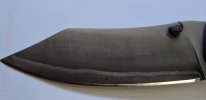
I have a plain edge Kershaw Leek 1660CB, a combination blade of D2 & 14C28N steels. I has a copper wave between the two steels. Other than looking cool what are your thoughts about a blade made of two different steels? Who else other than Kershaw makes a popular combination steel blade model?

 
Mostly to look cool , in this case . But in general the purpose is to obtain a blade with the best features of different steel types .

Cold Steel San Mai uses a sandwich of harder steel in the middle that will be the blade edge ,with softer , more flexible outer layers for toughness .
 
It's benifitial in Japanese swords to have a different softer steel at the spine, but I'm not sure what benifit you'd get in a folding knife.
 
Fallkniven is by far and away my favorite production company, and all of their blades are laminated. They offer a softer outer layer to provide toughness and corrosion resistance with a harder core for a stronger better edge. If done right, as fallkniven does, then you see the benefit.

Side note, fallkniven doesn’t use their lamination for looks. On more polished blades, like my HK9, you have to really look to see it.

84_EBC9_C3_8_F89_466_C_8231_4_CAA82_F7_DA19.jpg
 
Good question. That type of lamination never really made sense to me from a standpoint of function.
The lamination technique used by Cold Steel and Fallkniven does make sense.
 
I am far from an expert, but I do understand business and physics... but not at keeping my mouth shut. Strange...

There are several reasons for a manufacturer to use two different steels. One is because it either looks, or is percieved by the buying public to be cool. Another is the "baffle them with BS" where marketing dresses up a pig and says this is what you want to take to the dance. Classic example is when Heinz ketchup was first testing their product everyone complained that it was too hard to get out of the bottle. Marketing took that negative and sold it as a positive, "ours is slow to make it so much better than everyone else's". It's F'ing ketchup! Anyway, similar behavior in the knife world would be " we only use the finest 8Cr13MoV steel available". To a BF member that is a "Cheap chinese steel declaration" but to the general public, it is often interpreted as "oooohh, that must be really good steel".

So that is the ugly side of the business. On the smarter side, the manufacturer is reducing his costs. A knife has to have so much steel to make the blade. You can't alter how much is needed. That is a constant quantity we will call X. But you can alter the costs of the steel you use to get that quantity X. For example - and I am pulling these numbers out of thin air to demonstrate. Don't jump on me if you pay different prices. I've never bought a pound of raw steel in my life.

If Blade X is made out of 100% M390 steel, it costs $16 per unit to make.
If blade X is made out of 100% 440A steel, it costs $2 to make.

So what happens if the manufacturer combines the 2 steels? Makes the edge out of M390 and the rest of the blade out of 440A? For ease of calculations lets say the quantities used are 25% M390 for the edge, 75% 400A for the rest of the blade.
Knife X = .25 x $16 (m390 steel) + .75 x $2 (440A steel)
Knife X = $4 + 1.50
Knife X = $5.50 when made with 25% M390 steel and 75% 440A steel.

So for roughly 1/3 of the materials cost of making the knife out of M390, the manufacturer can still claim that his blade is made with M390 steel. He could also claim the edge is 100% M390 if he wishes to. Plus being able to make 4 knives out of the same quantity of M390 steel if he made it 100% M390. Keep in mind, these are just the cost of materials. It may or may not make sense for a knife maker to do this. The money you save on materials could get eaten up very quickly in labor to make the steel blank in the first place. All part of the overall costs and pricing calculations that goes into running a business.

There is also the "physics" side of 2 steel composition blades. First, 2 steels combined is the definition of damascus steel and has been done for hundreds of years at least. Japan was also making multi-layers blades. Both regions produced blades with legendary cutting capabilities. Why?

Normally the knife maker will combine a soft steel with a harder steel, and fold them repeatedly to get a multi-layered steel to fashion the blade out of. (Wootz Damascus is completely different and I won't go into it) The reason for the hard and soft steels is that they wear differently, the soft steel eroding away faster than the hard steel. What this does is create "mirco-edges" in the steel. Mini-serrations if you will. This would provide 2 conditions that a single steel blade could not provide. One is additional cutting edges in the steel, and the other is less contact area. Then the soft steel wears away faster there are miniature depressions or ridges in the blade. Those depressions lead to less surface area which leads to less drag on the blade as it slices.

For ease of manufacture of 2 steel blades, one of the best ways ways to get a premium edge steel is to make a steel sandwich. Say you want 2/3 of the knife to be 440A, and 1/3 of the knife M390, which you want for the edge. The easiest way to create that is to do a 3 layer blank. If you take the 2 different steels all the same thickness, then all you have to do is bottom layer 440A, middle layer M390, top layer 440A. Brought up to temp, and hammered or rolled to size, what you get is a (hopefully) uniform steel with a M390 center. IF everything works as it should and welds properly, it would not matter which side of the blank you put the edge on. As long as it was ground to the center, you should have a M390 edge.

 
Also with Spyderco laminating a harder carbon steel core (like Hap 40, Super Blue) with 420j.

Adds "strength" and corrosion resistance.
 
Laminated folders does provide cost savings to producer and consumer, I believe, but doesn’t it also prevent rust around the inner areas of a folder where the core steel is non stainless? As far as the OP’s question I would guess it’s done for its looks mostly.
 
Also with Spyderco laminating a harder carbon steel core (like Hap 40, Super Blue) with 420j.

Adds "strength" and corrosion resistance.

The edge, which is what matters the most for a folding knife, will still rust. As for the strength, how much do we need for a folder but more importantly how does sandwiching two steels enhance strenth, i.e., stronger than using either steel alone?

I think the above guy nailed it. It is largely marketing and cost saving. As for looking, to each their own I dont find lamination adds anything to looking especially when most lamination lines are very random.
 
You could always ask Sal why they chose to laminate those sprints. I'm sure he could answer your questions.

I kinda like my laminated Super Blue.
And love my Fallkniven F1.
 
Last edited:
I have a plain edge Kershaw Leek 1660CB, a combination blade of D2 & 14C28N steels.

I don't buy that there are "cost savings" to be had in using D2 mated to 14C28N, rather than just making the blade out of D2. There is not that much difference in the cost of the two alloys. So no savings there.

The joint has to be brazed. So you can blank the 14C28, but you still have to precision form the D2 edge. Then you have to precision mate it to the rest of the blade and braze it. That's a LOT of steps which have to be precise (precise = expensive) and I do not see the cost savings compared to just making the blade out of D2
 
That Kershaw is more so made for the folks who work there designing a building knives. It's a look what we can do knife.

The Sypderco laminate blades like the HAP40/SUS410 or 420 have the cladding there to resist corrosion around the pivot and lock area. The general public likes the idea of super sharp tool steel but they hate to see rust in the working parts. And looking at how the Kershaw is made it's also with the more stain less steel at the pivot.

It does cost more to make but saves more in the long run vs. dealing with returns.
 
In Culinary knives this can also be called a Cladding.. this is done by Shun, Yonabi etc and several other Japanese Companies where there is two outside Steels of a Non hardenable Damascus and VG-10 or a Carbon Blue Steel for instance in the Center that does the cutting ... the Stainless used in the Damascus is high on the Stainless chart! —————-These Cladding’s, Lamination’s started when the Steel was very hard to make and expensive too.. it was Iron that the cutting steel was imbedded in..————————————. As mentioned this process was used in Medieval Japan to make swords etc, because of the toughness & flex of the Iron.....-///—My .2 cents! If you like it? Buy it!
 
It's benifitial in Japanese swords to have a different softer steel at the spine, but I'm not sure what benifit you'd get in a folding knife.


Isn't this more related to how the blade is tempered than it is to a mixture of steel types? I thought the Japanese swords had some type of clay-earth smeared over the spine area to make the sword stronger when tempering it. Did anyone else use this technique in Europe or the Middle Eastern countries back in the day of swords?

Thanks for all the good info. I never realized Fallkniven knives were laminated blades so will have to take a more serious look at them. Currently I EDC a Spydie Gayle B. with M-4 steel for use around the house and shop. It takes a little cleaning after heavy use but seems to do everything I want from a folder.

Are there any performance issues with these clad type of folders that you are aware of?
 
Last edited:
The brazing two metals together like Kershaw and ZT do is just for looks. And cool factor. It's unique and shows what can be done by the engineers.
 
ok maybe someone can explain this to a dummy like me.

if you have a hard steel sandwiched between soft steel whats the advantage? the soft steel is "tougher" or doesn't crack or chip right? ok but the hard steel is where the edge is and that's where all the work is done. the softer steel wont help you at all. does the softer steel bend and return to straight better than harder steel? ok well back to the harder core. its bending as well isn't it?

so other than a long sword which may benefit from a softer outer shell when banging the crap out of it against another sword I don't see any advantage. as far as Damascus as was stated that's blended or mixed together and though there may seem to be some perceived advantage to the stuff wont you get uneven wear and have a funky edge because of that? sure maybe a toothy edge? I always thought once again Damascus was for looks more than anything . away to stand out in the crowd if you were royalty or something
 
Blade.jpg

Here's my 52100/416 San Mai

I will freely admit I bought it because it looks cool but is nice to have carbon steel with ease of stainless
 
1. Looks
2. Protecting the Core/Cutting Steel
3. Cost Savings?

It can provide some cool looking edges but to me not worth it just go with a Damascus flavor for looks though I am sure the cost is quite different. Protection is the one that makes the most sense either to provide an outer corrosion resistant layer or to add a softer outside to strengthen the blade. So I can easily see where reasons 1 and 2 come into play but reason 3 is a bit more questionable there is added cost when mating the steels together so you would have to save more than that cost to make it remotely worth it.
 
As far as Kershaw's composite blades are concerned, I believe they were having fun with a wire EDM machine and thought it was a unique thing to do with a blade and it would sell on cool factor alone.
ETA: It also threw a big middle finger to the cloners!;):D
 
Last edited:
  • Like
Reactions: Mo2
Back
Top