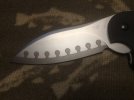
ok maybe someone can explain this to a dummy like me.
if you have a hard steel sandwiched between soft steel whats the advantage? the soft steel is "tougher" or doesn't crack or chip right? ok but the hard steel is where the edge is and that's where all the work is done. the softer steel wont help you at all. does the softer steel bend and return to straight better than harder steel? ok well back to the harder core. its bending as well isn't it?
OK, let's try it...
For discussion and illustration purposes lets say a blade is made by layering 5 thin layers of steel. When you bend the blade sideways the highest bending stress will be at the outside surface. The bending stress in the innermost of the 5 layers will only have 20% of the bending stress as the outside layers. If all 5 layers were a hard/brittle steel and you put a lot of force into bending the knife, it will break and you'll be left with a broken knife. Now lets say the innermost layer is the hard/brittle steel and the outer 4 layers are a softer more ductile steel, when you put a lot of force into bending the knife it will take a permanent bend. You'll realize that you were doing something you shouldn't be doing and you will stop, but your knife will still be in one piece and could possibly be straightened. Yes the harder core is bending just like the outer layers but being relatively thin it develops much less tension stress from bending.
Take this to an extreme- our blades aren't always nice perfect shapes, we make them with notches and corners and holes and all kinds of shapes that aggravate the tendency to break under bending stress. Combine this with a hard/brittle steel and you have a knife that will snap well before you think you have done anything wrong with it. Make the outer layers with a softer steel that is not notch-sensitive and it will tolerate irregular shapes better.