Advantages/disadvantages of a 1 sided bevel.

Status
Not open for further replies.
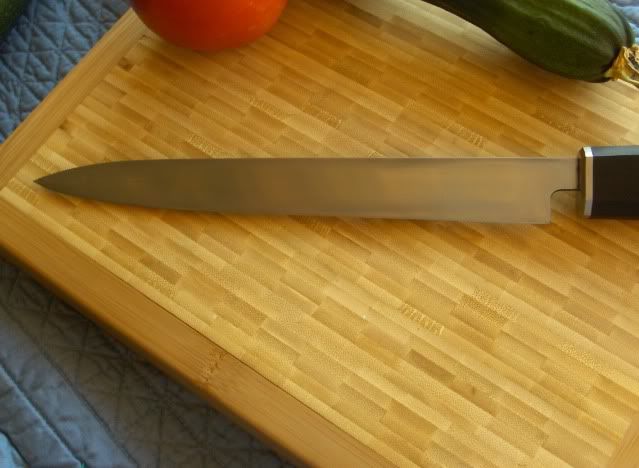
one of the first sushi knives i had done and if you look close you can see where the hone made contact with the edge.
dsc06637sm.jpg

now then here is the front side of witch i put one layer of tape on the top of the bevel to protect it from the hone. i then layed the blade face on the hones and sharpened alot like a razor (like i said was first try)
dsc06645sm.jpg

i found out a few things after making that knife
one its not to be honed to that accute an edge. and most users would put a secondary bevel on the blade any how also that the front beve is not normally hollow ground tho it sure makes the knife more laser then knife if you can deal with using it lightly on the proper meats
more often then not the blades are ever so lightly convexed (no not like the ABS edges less you are talkign about a deba )
so here is a shot of the sword that is ground to be used with much more force but still not any kind of real sword use
front you can see everr so slightly that it the edge is part way on it (i still need to hone it a bit more )
dsc05292sm.jpg

and the back (left side if holding out in front of you edge down )
dsc05295sm.jpg
 
This is an amazing forum! I learned so much more than I could have hoped for in this thread. Thanks everyone for all your information and time.
 
Thanks for those photos ,Butch. The back shot shows exactly what I was trying to describe. Really nice knife, BTW !
Did you hollow it by feel, or use a curved platen?
 
Regardless of the mass of the steel due to the grinds, chisel grind changes the way the knife is used, and where the support steel is behind the bevel, as well as the angle of impact of the edge relative to whatever is being cut. It is always going to be less supported on one side of the edge.

You've also got the issue of how it cuts. One part of cutting ability is how fine the edge radius is, and the steel, HT and sharpening job are going to determine that. But the other is the geometry that has to pass through the stuff being cut. That changes pretty drastically with a chisel ground knife.

Chisel ground knives are arguably easier to sharpen as well, they just require a different technique. Sharpen on the bevel side until you raise a burr, then microbevel on the flat side to remove the burr. Added bonus is that you don't even have to keep the angles of bevel widths symmetrical.
 
One sided grinds are extremely difficult to proprerly sharpen. Frank

I would respectfully disagree, Frank. Nothing could be simpler than honing two self-indexing faces on a blade. No secondary bevel to gauge means that unless you deliberately try to mess with the edge geometry by NOT laying the bevel/back flat on the stone, you can't screw up sharpening it. It's like a Scandi grind, but with only one bevel to worry about.

I might be biased about this grind because I'm also a woodworker and I've been sharpening chisels a lot longer than I've been making knives. I got a set of middle-of-the-road Japanese cabinet chisels almost 20 years ago and those things just won't quit! If you learn how to sharpen them the right way and you don't act like a gorilla on speed when you use them, the edge lasts through an insane amount of work and they're a joy to use. Same thing goes for a kiridashi knife, which I use as a chisel-ground marking knife. (Of course for a southpaw like me, that means you either have to find one with a left handed grind, learn to use a right hand ground knife, or make one yourself.)

Long/short, I find single-sided/chisel grinds to be the simplest blades to maintain.
 
stacy the first blade was ground with a self made wood "4foot" platten to see if i could even make it work
then i got one of the nate 4 footers and its great. with as much as i use it tho i have to ether think about one made in a steel like cpm10v or make the jump and build a big wheel grinder

since i can see myself geting even more specialized in the sushi knives the big wheel might jsut be the way to go (also the 4 footer makes a dam sexy bowie grind )
 
Butch,
Very nice blade. Japanese chisels are ground in a similar manner, hollow back.
I hope you don't mind if I use your knives as inspiration!
Bill
 
A friend wanted me to make so blades to use in his autobody shop from some planer blades he had, We mess with them and ended with a chisel grind the was almost industructable. It was strong and really a good cutter for all kinds of stuff. I have made a few more to cut strapping and tubing and they seem to really work well, I carry a folder I made that is a chisel grind and its a great strong knife, Ill try to post some pics later. I have found for some types of stuff a chisle grind is great, for wood not so good. Sharpening is pertty easy and you can get a great edge, like discussed before, sharpen bevel and then lay flat on back.

Here is a yanagibe like butcher discussed, front is chisle, back is a 4 foot diameter concave. You can just make out the secondary bevel on the front, the back you can see the upper and lower edge is flattend on the stone and the grind is untouched in the middle (kinda).

ChefKnives8-2010057.jpg


ChefKnives8-2010058.jpg
 
the first blade was ground with a self made wood "4foot" platten to see if i could even make it work
then i got one of the nate 4 footers and its great.

Butch is a "4 foot" platten a belt grinder platen with a curved approximation of a 4 foot radius?

Beautiful knives!
 
yep it works ok but gets hot fast and you hav eot have a steady hand as if you move you wash out the grind
 
I use Nathans 48" and 36" platens. They are great, but as you said, get hot if run long.

I have plans drawn in my project book for a 48" slow speed wheel to run 3" belts with water cooling and lubrication. I have most of the needed things on hand.
There are several options.
Make a turned wooden solid contact wheel from cypress...which will work fine and be fairly cheap.Imagine a giant Kalamazoo grinder.
Or, weld up an open spoke aluminum wheel from 3X3" stock, and turn it to a perfect circle. That would cost well over a grand...but what a wheel it would be. Not really an option, but a guy can wish.
Or, use a 48" steel wheel that ran a big drive belt which I saw at the scrap yard. It could have a bearing fitted in the 4" center hole, and the grooved perimeter could be filled with resin and a tire made for it. The inertia of this wheel would be amazing, especially at 25-50 RPM. I think this weighs about 300 pounds, but would only cost $100.
Or, make a 48" cypress wheel that uses 3" shop roll abrasives and a slot/twist lock system. This would be really great for a wet wheel. It could be belt/chain driven by a 1HP motor at slow speed really cheap.With no tracking or drive/idler wheels for the belt, it is the simplest and cheapest option. This is the option I like the most.
 
i have a 2hp 3500rpm motor sittign and i think till i gear it down to under 500 RPM the tq would work on a wheel build on a 1 inch thick slab wheel in Al with build ups for a 3 inch barring surface and a 3 inch wheel face
here is a link to what got me started on this big wheel kick
http://forums.dfoggknives.com/index.php?showtopic=15046

when you think abuot wha tthe cost of jsut the one wheel alone baught and shipped from japan you all of a sudden find that a 7K $ grindre is well worth the $$$$
 
Alright, I had 10 minutes to kill so I drew up some cross sections.

These are all the same imaginary piece of material, in green.
A 1" tall, .250" thick piece of steel for the sake of clarity.

I drew 4 imaginary bevels.
A zero ground chisel, a zero ground double bevel, a chisel with a .010" edge thickness before sharpening, and a double bevel with the same .010" edge.
All of them are full flat grinds.

You can see the difference in the angles.
It's miniscule, and means very little in cross sectional area, and total volume of steel, but there is a difference.
And, the difference is in favor of a double bevel.
A bigger angle means more steel.

Bevels.jpg


You might to rework your thinking here. First off thanks for the pictures but I don't they reflect reality.

You'll agree we have an y and x axis and the rectangles are the same, right? Good, I knew you would. You will also agree that a good accurate formula for the area in your first example would be (x*y)/2. Let me be more explicit, you'll agree that the area of a rectangle is x*y and you'll agree the line bisects the triangle meaning the area is ½ of the rectangle. Right. Good. Okay, let's look at the double bevel example. You'll, of course, agree that you're looking at an isosceles triangle. That is a triangle where two sides have equal length. The formula for the area of an isosceles triangle is as follows (x*y)/2. (You'll remember this from school as base (x) times height (y)) As I am sure you know it turns out, using math that (x*y)/2=(x*y)2 every single time.

WTF? What is this arcane sorcery? The drawings don't lie, right? I mean different angles! You got duped by the computer, it's no big deal happens with everyone. But man, you were certain. You said:

"It's miniscule, and means very little in cross sectional area, and total volume of steel, but there is a difference."

No man, not at all. But I appreciate the certainty of your answer.
 
necro post error in pic spotted but all and all as i posted 7 years ago 15 degrees is still 15 deggrees not mater how you clock it in the knife handle my single bevels are much thicker spine them my standard kitchen work but my doble bevel kitchen knives are ground to if i remember right 2 degrees per side but then when i sharpen i am close to 30 degrees total angle
straight razors be them Western or eastern are ground all need to be ground to total edge of between 14-22 total angle (stainless steels act better at 16-20) easteren razor blades are built for a person yo shave your face not to shave your own. it can be done but gets tricky when you get to the back sid eof your face
 
If you don't have, or don't wish to build a big wheel or curved platen, you can still hollow the flat side by forging, scraping or hand sanding...it doesn't require to be a deep hollow.
If you don't, it become actually not easy to properly sharpen a traditional japanese single bevel knife with a flat back.
 
Status
Not open for further replies.
Back
Top