Advice: activities for 4days outdoors with youths

Joined
Jun 19, 2006
Messages
103
I've been asked to take out a group of at-risk kids from the inner-city, for 4 days outdoors in a local park.
I suggested I'm not qualified, and am really just a hobbyist; they're counter is that they haven't found anyone else yet, and that anything is better than nothing.
The group is about 4-6 people, ranging in ages from 15-20, not including their 'leader' who is otherwise responsible for them.
Being a bit of an introvert and not much of a teacher, I'll admit it is not the biggest inclination of mine, but I know I'd appreciate the opportunity if I was in their shoes.

My big question is what do I do with them? Particularly as someone who is not exactly an expert..!
I figure choose a campsite, then stay there the 4 day stretch, and work on building a camp; unless they get really anxious to change up scenery.
Daily hike, between breakfast & lunch, to check out the surrounding landscape.
Some skills in the afternoon hours, such as a debris hut, and.. what else is good for an afternoon of crafting?
I'm sorry to say this phrase, particularly here of all places, but 'no knives' for the students, as per their leader's order. However, I may personally use whatever tools I need. Restricting basic tools limits capability somewhat, so what are some non-knife-related tasks?
I'll see if maybe I can bring a bow saw for them to use, and that would open up a bit of stuff. Lean-to, benches, fire-reflector wall, Nessmuk-style camp kitchen, etc. I don't mind kicking in the elbow-grease, if it makes the difference between a good activity or not.

The idea of teaching, or at least making the attempt, makes me wish all the more that I had a more thorough knowledge and experience of the basic skill sets! You guys that live with that integrity.. you rock! Guys like Kev and everyone else here that not only hones, but also shares their skills with the community, I am already learning a new layer of appreciation for. Thank you.

Please forgive my tendency to be overly long-winded.
If anyone has any suggestions of outdoors activities, I'd be very appreciative.

Also, if anyone of you skilled & caring individuals has any interest in this (the kids are from NYC area, if you are also nearby), there is a possibility for more outings like this! I am looking into finding a good outdoors mentor for them.

Thanks much, and all the best,
Krishna
 
Go to the library and get every field guide you can get your hands on for the area you'll be camping in. Have the folks "collect" things from their list (birds, trees, ferns, mushrooms etc.) by listing them in a journal. Stress the whole "leave no trace" idea.

You could also have a scavenger hunt where they could bring back evidence in the form of pictures. Nearly everyone has a camera phone or compact digital camera. Categories could include different colors, landmarks, flora, fauna, tracks, scat... If you can scout out the area beforehand it might be helpful. The field guides might come in handy here.

If you get busy, you could make up a number of bow drills and have the campers try their hand at building a fire. Flint and steel, magnifying glasses, firesteel competitions could be fun too if you have the materials.

I don't know if they'd be into it, but maybe they could make treasure maps where they hide something and create a map or series of clues to lead the rest of the group to the treasure. It'll take some time, but might be a great idea for an afternoon or morning.

Ghost stories, best jokes, sing-a-longs can be lots of fun around the campfire.

Sounds like fun any way you cut it. Let them know that you're not an expert, but you're willing to do some research to answer questions and that you're willing to try yourself. Nobody likes a know-it-all, especially college students. Be open and honest and enjoy yourself.
 
PB has given you some great ideas. One note about field guides if you go that route:get as specific as you can for your area. We did that on a recent field biology outing and found that broad guides are relatively useless. Get as close to your exact location as possible. If you tell me your area, I can probably shoot you a list of titles. Also, stick with simple stuff. Animal scavenger hunt, fire making, shelter. All great ideas. Oh, and when will this be taking place?
 
Lots of bushcrafting contest like things you could do... if you had knives. There is no possible way you could talk him into opinels, or mora's? Not to push this too much, but maybe try convincing their leader if they learn to use and respect knives they may be less likely to use them violently in the future?
 
Lots of bushcrafting contest like things you could do... if you had knives. There is no possible way you could talk him into opinels, or mora's? Not to push this too much, but maybe try convincing their leader if they learn to use and respect knives they may be less likely to use them violently in the future?

If they are 'at risk' kids, there is next to no way they will be allowed blades. Too much of a liability.
 
I run a Bushcraft /survival course for a group of Army cadets and in years gone by I some experiance as a ( Boy) Scout leader.
Even though the cadets are "outdoorsy" kids any way, Most don't have a lot of experiance with bushcraft.
As far as not being able to use knives My cadets are limited to a sub 4inch blade. We do nearly all our stuff with SAKs. You really can't do Bushcraft for four days with out knives. Tell the organisers that it can't happen without knives. My wife is a Highschool teacher and she has asked me about doing something similar with kids in similar situation and again without knives ( or matches) I said "it can't be done. It would be as boring as dogsh@t". With a knife it is a learning experiance, without a knife it is a lecture on something they have no experiance or interest in that is compteing with PS3 or Wii time. I can say that to my wife.
Battoning with a SAK Billets were cut with the SAK saw
IMGP2707.jpg

The biggest problem I face is the attention span. man it is short. So break your lessons into very short blocks and interperse them together. ( I'll get back to this)
Next suggestion is to work them towards a goal so each block gets progressivly harder but culminates with a acheivable goal. and that each stream of block all come together in the finish.
So a stream of blocks might be
lesson 1 teach them a reef knot (some of theses kids may may not have tied any more than their shoelaces.)
Lesson 2 a bowline
'" 3 a rolling hitch ( tauntline to you folks in the America's)
" 4 a square lashing
This series of knots will allow them to build a shelter frame ( Lashings) attach support guys ( bowlines) tighten them up ( tauntline)
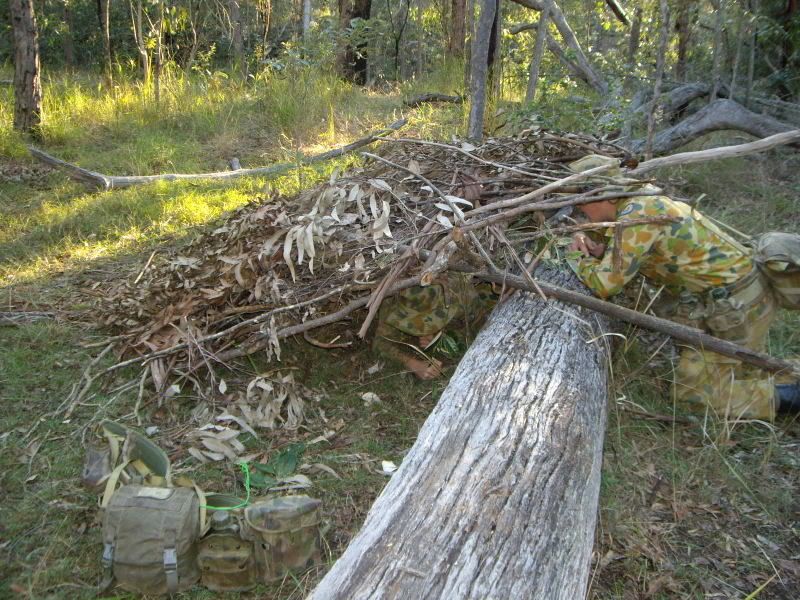
Emergency shelter built with out cordage
IMGP2727.jpg

Selecting dry tinder then kindling splitting/batoning proper construction of a fire different fire construction types ( Pryamid Log cabin ( my fav) teepee) For this explain each type but split the group up and get each sub-group to build a different type.
I base my course on two principles.
S top ( running around like a headless chook ( chicken)
T ea Makeing tea distracts you makes you slow down.
T hink While you drink you tea what do you have to do "Rule of three's"
O bserve What you have to work with
P lan what you need to do again with "threes"
A ct No good sitting there thinking about it.

Rule of threes
3 seconds to make the right decision ( put your seat belt on)
3 Minutes to maintain airway ( stop drowning or choking)
3 hours to maintain core tempreture. warm up or cool down
3 days to secure safe water
3 weeks to acheive food.

STTOPA and rule of 3's is drummed in parrot fashion every chance (eg three times an hour during lecture)
All practical lessons are based on these rules and in that order the first thing is to not make things worse, make sure your breathing, then look at shelter. ETC does that make sense?
For interspersing blocks for eg. start with a reef knot 15-20 mins then get them up looking for standing dead tinder, then a plant ID lesson. back for the lecture area for the bowline, then sourses of water, basic parts of a compass,
batroning kindling, pick a suitable site for shelter, break for smoko (morning tea) don't run two lecture ( sitting still) lessons back to back. Have a centeral place for the lecture eating .
The idea is that all these lessons come together for them to build their own LITTLE fire to cook their own dinner and heat them while the sleep in their own little shelter.
How is that for a brain burst

One last thing maintain the right to exclude or have removed any student you consider a risk to the course, imeadiatly. That include the gobby one with the attitude that just won't shut up. the others aren't learning while your dealing with behaviour problems.
Carl
P.S. on the tea thing Making tea you have to stop what your doing and find some kindling to make a fire wait for the water to boil wait for the tea to draw wait for it to cool. ( how many "waits" are in that?) while your waiting you can start thinking about what you need to do.
 
You have some good ideas going. It seems like there are a ton of topics you could cover, but I would try and hit the more "advanced" concept of the most basic topics.

Tents
I am assuming you will be staying in tents. There should be good examples of good design and bad design. Point that out. Show how to stormproof different styles of tents, and more importantly to stay dry. Most adults don't seem to know some of this stuff.

Firemaking
Like Carl said, this could be pretty boring with out actually getting to do the hands on stuff. But, you can show proper fire building techniques, how to break your tinder down into appropriate sizes and possibly use of other natural materials that you find.

You could also teach them how to find dry wood when there is seemingly nothing dry around.

Orienteering
You could do basic map and compass skills. Taking bearings, shooting bearings, and feature recognition with topo maps. If you are really ambitious, you could set a course with 3 or 4 flags for them to run.

Geocaching. If there are caches in the area, you could always do that too. Check www.geocaching.com. Also, you don't have to use a GPS. I take the coordinates and locate them on a topo map, and use map and compass skills to find them.

Knots
But in an interesting way. If you show a bunch of knots, it will be boring. Give them a problem and knots to solve them, and it will be fun. When camping or backpacking or whatever, a properly rigged tarp can be a godsend, for cooking, taking shelter from rain, etc. Show them how to properly rig one, and learn the knots in the process. IMO, this skill will be MUCH more used, and used more often than constructing emergency shelters, etc. Don't get me wrong, both are good to know. Just thinking of reinforcing the basics before moving on.

Good luck, and take care,
B
 
If i may suggest one thing... I have no idea about your knowledge. But figure out what would want to practice and do if you had 4 days on your own. Now do it with those kids. If you are realy into it then it would be catching, they would follow you. Its a small group bring a knife with you and every one can share... Besides it would be intresting to practice what can you do with no knife... Take pics so they can share with there friends and you can share with us.... I took my sister kids and i just practiced what i wanted they still had a blast watching me and doing there own traps, Making rope,find edible plants and just hiking with me.

Sasha
 
Hmmm you got 4 days why not go over the 4 fundamentals of survival, 1 per day?

Shelter, water, fire, food. Working in some of the other great suggestions where they apply best. It doesnt have to be all encompassing just a few general retainable methods on how to accomplish each aspect of the days theme.
 
BTW Kudos for caring enough to step out of your comfort zone to do some good. I applaude your effort!:thumbup::thumbup::cool::)
 
Awesome replies guys, thank you all!
Lots of really great stuff here that I'm digesting, as well as seeing areas of potential personal growth; particularly identification and orienteering skills.:foot:

We'll be in Harriman state park, 30miles north of NYC. Dougo, or anyone else for that matter, if you perchance happen to have any recommendations/info relevant to the area, that'd be great both for the kids and I'd for sure enjoy it also.
They want to head out beginning of next week. Not a whole lot of time to mail-order toys.. err, gear, as I was just contacted today.

The concept of 4 days and 4 fundamental skill-sets of survival is a really neat coincidence I did not notice until you pointed it out, Runsalone! I may just have to run with it..:thumbup::D

Sorry I don't have a full reply here, each response was really a big help, and just what I am looking for. :thumbup::thumbup:

Time I start getting together an outline of activities!

Thanks again,
 
Personally 4 days at the same site might get old... (Im assuming the hike in and out is relatively short).

Maybe spend 2 days at one site... teaching core skills

then move to another, and let them practice what they've learned...

As for 'teaching'- dont worry too much.. all you have to do is know more than they do;)
 
you should just move to 4 different sites for each of the days completing some kind of loop in order to feel accomplished.
 
perhaps a little first aid instruction on blisters, cuts, dehydration, heat stroke, etc.
 
Kudos to you for taking on this assignment. Taking the at-risk youths into the woods is going to be very good for them no matter what they do. There is a lot you can do without sharp objects. Wood gathering by hand, learning to build a fire for cooking, water purification methods, first aid, cooking, scouting for wildlife, scouting for rocks, bones, etc.

Camp fire activities are great no matter what age group. Story telling, reading from wilderness classics.

Team building activities are good as well. Prepare for a day hike and tell the young men that you are lost, pool your resources, what does everyone have in their packs? what do we need to survive? what are the first priorities? how can we cooperate and share resources to survive as a group?

Good luck
 
This is simply a game, but a fun one we played as a kid at summer camp.

Hide playing cards with clues on a scavenger hunt sheet. The harder, the higher value.

When they get 5 cards, they come back to the meeting point.

Whoever has the best poker hand wins a prize.
 
This is simply a game, but a fun one we played as a kid at summer camp.

Hide playing cards with clues on a scavenger hunt sheet. The harder, the higher value.

When they get 5 cards, they come back to the meeting point.

Whoever has the best poker hand wins a prize.

I am gonna use this sometime...great idea...
 
Aye, kudos for doing this!

I work for a small company that does several trips like this, but on a much larger scale, every year. My boss (who happens to be my neighbour and a longtime friend of the family as well) used to work mostly with at-risk kids, but recently it's more regular school groups. In fact, last week we had a school group of 50-some-odd seventh graders up from Tampa for a week-long hiking/camping trip on the local trails, using the local Girl Scout Camp as a base. I'm still sorting through the pictures for the website. :D

I'd second Bigdumplings' suggestion; keep moving. It'll be easy with only a half-dozen or so. Teach them the right way to build a fire when you make camp, and the right way to put out a fire when you break camp. Teach them the knots needed to set up a tarp shelter, then give them tarps and paracord and have them put the knots to use. Then in the morning teach them the proper way to fold the tarps for packing. Or focus on one of the Four each day.

Games are a good idea. Teach them, but make it fun. Maybe teach some trap-making, snare-making, or makeshift fishing skills if you'll be near water. Incorporate everything you teach them into a game or a practical usage that they can readily understand; it makes it more fun and less boring for them. It might also help to play some games that will teach them some teamwork, and make them use their heads. If you have an even number, let them do a scavenger hunt or orienteering course in teams of two maybe.

This is simply a game, but a fun one we played as a kid at summer camp.

Hide playing cards with clues on a scavenger hunt sheet. The harder, the higher value.

When they get 5 cards, they come back to the meeting point.

Whoever has the best poker hand wins a prize.

Excellent idea! I really like that, will have to remember this one. :thumbup:

Ultimately, NW, just have fun. Be sure to take along a camera and post pics when you get back, too!
 
Anything that would help build confidence would be a good thing I would think. Fire building, shelter building, etc.

Weather permitting, maybe try tarp camping one night.
 
Back
Top